FIT Taxable Wages: A 2026 Payroll Guide for Business Owners
By Jaden Miller , October 24 2026

Your employee points at the tax line on a pay stub and asks: why doesn't this match my gross pay? You need a clear answer, and you need payroll that backs it up. FIT taxable wages are the earnings your business uses to figure federal income tax withholding. Get the number wrong and every stub, deposit, and W-2 that follows is off.
This guide covers what counts and what doesn't, a worked stub example, how withholding is figured, and how to tie it all back to the W-2 before year end.
Key Takeaways
- FIT taxable wages equal gross pay minus qualifying pre-tax deductions.
- Federal income tax has no wage cap, unlike Social Security.
- An exempt Form W-4 claim expires each year, so the employee must file a new one.
- W-2 Box 1 should match year-end FIT taxable wages.
- What Are FIT Taxable Wages?
- What's Included in and Excluded From FIT Taxable Wages
- FIT Taxable Wages vs Gross Pay: A Worked Stub Example
- What Is FIT on My Paycheck?
- FIT vs FICA: Why Federal Income Tax Has No Wage Cap
- Form W-4, Exempt Status, and 2026 Changes
- How Employers Figure Withholding Each Pay Period
- Reconciling FIT Taxable Wages to the W-2
- Why Is My FITW So High? Common Mistakes
What Are FIT Taxable Wages?
FIT taxable wages are the part of an employee's gross pay that is subject to federal income tax withholding. Employers start with gross wages, subtract qualifying pre-tax deductions such as health premiums and traditional 401(k) deferrals, and withhold from what remains. The result appears on pay stubs and flows to W-2 Box 1.
Payroll teams also call this FIT tax, short for federal income tax. The IRS sets the rules in Publication 15. Your payroll software or provider applies them each pay period.
What's Included in and Excluded From FIT Taxable Wages

Most cash pay is included. Salary, hourly wages, overtime, bonuses, commissions, and tips all count. So do taxable fringe benefits, such as personal use of a company car or group-term life insurance over $50,000.
Some pre-tax payroll deductions are excluded from federal taxable wages. The table shows the common ones with 2026 limits.
| Item | Reduces taxable pay for FIT? | 2026 note |
|---|---|---|
| Section 125 health, dental, vision premiums | Yes | Plan rules apply |
| Traditional 401(k) or 403(b) deferral | Yes | $24,500 limit |
| HSA contributions through payroll | Yes | $4,400 self-only, $8,750 family |
| Dependent care FSA | Yes | Plan limit applies |
| Qualified commuter benefits | Yes | Annual limit applies |
| Roth 401(k) deferral | No | After-tax contribution |
Review IRS Publication 15-B before you code any fringe benefit. Misclassified benefits are a common audit finding.
FIT Taxable Wages vs Gross Pay: A Worked Stub Example
Take a biweekly employee with $2,500 in gross pay. She contributes $150 to a traditional 401(k) and pays $95 for health insurance through a Section 125 plan.
- Gross pay: $2,500
- Minus 401(k): $150
- Minus health premium: $95
- Wages subject to FIT: $2,255
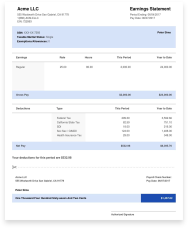
Her stub should read: your federal taxable wages this period are $2,255. Withholding is then figured on that amount, not on $2,500.
Notice that her Social Security and Medicare wages are $2,405. The Section 125 premium lowers them too, but the 401(k) deferral doesn't. That's why one stub can show two different taxable wage figures.
What Is FIT on My Paycheck?

FIT on your paycheck stands for federal income tax. It is the amount your employer withholds from each payment and sends to the IRS on your behalf. It may appear as FIT, FITW, Fed Tax, or Federal Withholding. It is separate from Social Security and Medicare, which appear on their own lines.
Employees often search for the FITW tax line when a stub looks wrong. Show them three things: the current amount, the year-to-date total, and the taxable wages it was based on. Our pay stub templates show each of these lines clearly.
FIT vs FICA: Why Federal Income Tax Has No Wage Cap
Federal income tax is progressive, and withholding keeps going all year. Social Security stops at a wage base. The table shows the contrast.
| Tax | Rate | 2026 wage limit |
|---|---|---|
| Federal income tax | Varies by bracket | None |
| Social Security | 6.2% | $184,500 |
| Medicare | 1.45% | None (plus 0.9% over $200,000) |
| FUTA (employer only) | Varies | First $7,000 |
What Is FIT and FICA on My Paycheck?
FIT is federal income tax. FICA is Social Security plus Medicare. Both come out of each check, but FICA is a flat percentage and FIT depends on the W-4. The Social Security Administration publishes each year's wage base.
Wondering whether the two are the same? Read our guide on FICA tax on a pay stub.
Form W-4, Exempt Status, and 2026 Changes
Employees control withholding through Form W-4. The current form uses filing status, a multiple-jobs step, dependents, and other adjustments. It no longer uses allowances.
Who is exempt from federal income tax withholding? Only an employee who had no federal income tax liability last year and expects none this year. Exempt workers still owe Social Security and Medicare. They must file a new W-4 each year. If the form isn't renewed, withhold as single with no adjustments.
New for 2026: tips and overtime are still taxable for withholding. The new tax deductions are claimed on the employee's Form 1040. The 2026 W-4 lets employees estimate those amounts to lower withholding, so confirm the current form on IRS.gov before you update your onboarding packet.
How Employers Figure Withholding Each Pay Period
Employers use the W-4 plus the percentage method or wage-bracket method in IRS Publication 15-T. The federal income tax withholding tables change by filing status and pay frequency. Most payroll software applies them for you.
The process is simple. Take the taxable pay figure, apply the table for the employee's filing status, and withhold the result. Want the full steps? See our guide on how to calculate federal withholding.
Reconciling FIT Taxable Wages to the W-2
At year end, W-2 Box 1 should equal the year's federal taxable wages. Boxes 3 and 5 can be higher.
Example: an employee earns $60,000, defers $6,000 into a traditional 401(k), and pays $3,000 in Section 125 premiums. Box 1 is $51,000. Boxes 3 and 5 are $57,000, because the 401(k) deferral is still subject to FICA.
Compare these totals to your quarterly Form 941 filings before you issue W-2s. A mismatch now saves a corrected return later.
Why Is My FITW So High? Common Mistakes
Employees ask this after a bonus, a second job, or a life change. Bonuses are supplemental wages. Employers may withhold a flat 22% on supplemental wages up to $1 million in a year. Above $1 million, 37% is mandatory.
Use this payroll checklist to prevent errors:
- Code each deduction as pre-tax or after-tax for FIT, FICA, and state separately.
- Stop the exclusion once an annual limit is reached.
- Update records when benefit elections change.
- Keep every signed W-4 on file.
- Load the current year's Publication 15-T tables.
You Might Also Like
- Gross vs Net Pay Differences
- What Is Social Security Wages on W2
- Taxes and Pay Stub Deductions
- How State Tax Affects Federal Tax
- Lower Taxable Income
Conclusion
FIT taxable wages drive every federal withholding figure on a pay stub. Code deductions correctly, renew exempt W-4s, and tie Box 1 back to your payroll totals each year. Need clean stubs that show every line? Use a reliable paystub generator to create accurate pay documentation in minutes.



Frequently Asked Questions
Similar Articles



We’ve helped numerous individuals and businesses create professional documents! Create yours today!