



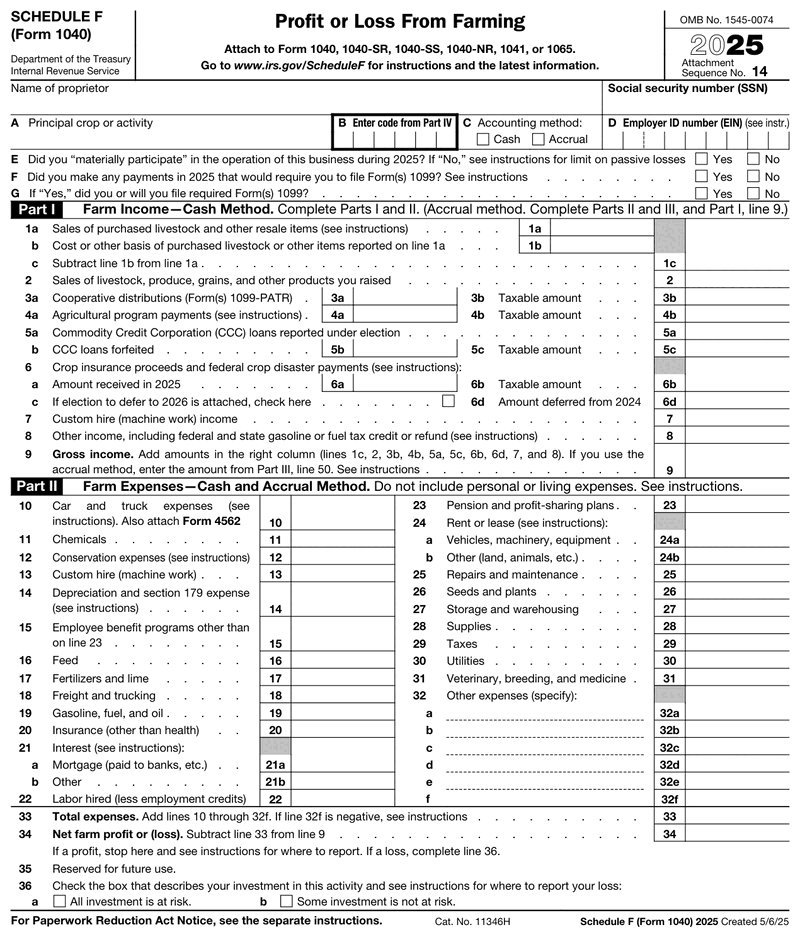





How to Fill Out Schedule F Line by Line
The Schedule F instructions run long, so here is the practical sequence. Our generator walks the same path and does the arithmetic for you.
Before You Start: The Header
At the top of the form, enter your name and Social Security number, then the principal crop or activity on line A. Line B takes a six-digit agricultural activity code chosen from the list in Part IV, such as 111100 for oilseed and grain farming or 112111 for beef cattle ranching. Line C is where you check cash or accrual accounting. Line D holds your employer identification number if you have employees, and line E is the material participation question covered above.
Part I: Farm Income, Cash Method
Part I captures gross farm income across lines 1 through 9.
Livestock and items you bought for resale are handled in two steps: report the sales price on line 1a, then subtract what you originally paid for those animals on line 1b, leaving the actual margin on line 1c. Crops, grain, and livestock you raised yourself go on line 2 at full sales value, because you have no purchase basis to subtract.
The remaining income lines cover cooperative distributions, agricultural program payments, Commodity Credit Corporation loans if you elected to report them as income, crop insurance proceeds, custom hire income from doing machine work for neighbors, and any other farm income. Line 9 totals gross income.
Part II: Farm Expenses
Part II is where most of the money is, and where most of the mistakes happen. These lines apply under both cash and accrual methods, and the same substantiation standards that govern 1099 tax deductions apply here.
| Line | Expense category | What it covers | Common mistake |
|---|---|---|---|
| 10 | Car and truck expenses | Farm vehicle mileage or actual costs | Including personal or commuting miles |
| 11 | Chemicals | Herbicides, pesticides, treatments | Mixing in fertilizer, which belongs on line 17 |
| 12 | Conservation expenses | Soil and water conservation | Exceeding the 25% of gross farm income cap |
| 13 | Custom hire | Machine work hired from others | Confusing with wages for hired labor |
| 14 | Depreciation and Section 179 | Equipment, buildings, capitalized assets | Expensing an asset that should be depreciated |
| 15 | Employee benefit programs | Benefits other than pension plans | Including your own health insurance |
| 16 | Feed | Purchased feed for livestock | Deducting prepaid feed above the 50% cap |
| 17 | Fertilizers and lime | Fertilizer, lime, soil amendments | Splitting incorrectly with chemicals |
| 18 | Freight and trucking | Hauling costs for farm goods | Duplicating with car and truck expenses |
| 19 | Gasoline, fuel, and oil | Fuel for farm equipment | Including fuel already in vehicle mileage |
| 20 | Insurance | Farm property and liability, not health | Including personal or health policies |
| 21 | Interest | Mortgage (21a) and other interest (21b) | Deducting principal payments as interest |
| 22 | Labor hired | Wages paid to farm workers | Omitting the related payroll tax filings |
| 23 | Pension and profit-sharing | Plans for employees | Including your own retirement contribution |
| 24 | Rent or lease | Equipment (24a) and other property (24b) | Treating a capital lease as a rental |
| 25 | Repairs and maintenance | Keeping property in working order | Classifying an improvement as a repair |
| 26 | Seeds and plants | Purchased seed and seedlings | Deducting seed for a crop not yet planted |
| 27 | Storage and warehousing | Off-site storage of farm products | Double-counting with freight |
| 28 | Supplies | Consumable farm supplies | Including capitalized tools |
| 29 | Taxes | Real estate and payroll taxes | Deducting federal income tax |
| 30 | Utilities | Farm portion of power, water, phone | Including the full household bill |
| 31 | Veterinary, breeding, medicine | Animal health costs | Missing breeding fees |
| 32 | Other expenses | Anything not captured above | Using it as a catch-all without records |
Subtract total expenses from gross income and you have net farm profit or loss. That figure moves to your Form 1040 and, if it is $400 or more, to Schedule SE.
Ready to skip the arithmetic? Our generator totals Part I and Part II for you and returns a completed, print-ready form.
Parts III and IV
Part III applies only if you elected the accrual method, restating farm income on an accrual basis. Most operations skip it entirely. Part IV is the reference list of agricultural activity codes for line B, not a section you complete.
Cash vs. Accrual Accounting for Farm Income
Most farms use the cash method, and for good reason. Under cash accounting you report income when you actually receive payment and deduct expenses when you pay them, which gives you real control over which tax year a sale or a large input purchase lands in.
Accrual accounting recognizes income when it is earned and expenses when incurred, regardless of when cash moves. It requires inventory tracking and fills out Part III. Farms with large inventories or corporate structures may be required to use it. Once you choose a method, changing it requires IRS consent.
Self-Employment Tax on Farm Profit
This is where farm taxes get expensive, and where planning actually pays. Net farm profit is subject to self-employment tax at 15.3%, which breaks into 12.4% for Social Security and 2.9% for Medicare. The tax applies once net farm earnings reach $400.
The calculation is not applied to your full profit. Self-employment tax is computed on 92.35% of net farm profit, which approximates the employer-side deduction a wage earner would receive.
Consider a working example. A cattle operation reports $110,000 in gross farm income against $72,000 in deductible expenses, leaving $38,000 in net farm profit. Self-employment tax applies to 92.35% of that, or $35,093. At 15.3%, the self-employment tax comes to roughly $5,369. Half of that amount is deductible against income tax on your Form 1040. If you also take non-farm self-employed work, a self-employed pay stub helps you track that income separately.
The Social Security portion applies only up to the annual wage base, which was $176,100 for 2025 and is adjusted each year. The Medicare portion has no ceiling and applies to every dollar of net farm earnings.
Schedule F taxes also interact with the qualified business income deduction. Farm profit generally qualifies as income from a pass-through trade or business, which can shelter up to 20% of that income from federal income tax, though the self-employment tax calculation is unaffected.
Schedule F Deadlines and the Farmer's Special Rule
The schedule follows your Form 1040. For the 2026 tax year, the standard due date is April 15, 2027, and Form 4868 extends the filing deadline to October 15, 2027. An extension moves the paperwork date, not the payment date.
Farmers get a genuinely different set of options, and most operations leave this on the table. If at least two-thirds of your gross income comes from farming, in either the current or prior year, you can skip quarterly estimated payments altogether and choose one of two paths:
- Make a single estimated payment by January 15, then file your return on the normal April schedule.
- Skip estimated payments entirely and file your return with full payment by March 1. For the 2026 tax year that date is Monday, March 1, 2027, so no weekend shift applies.
To check whether you qualify, total your gross farm income and compare it to total gross income from all sources. If farming accounts for two-thirds or more, the special rule is available to you. The March filing path suits operations that have their books closed early; the January payment path suits those who would rather file on the normal timeline.
Recent Tax Law Changes for Farm Filers
Several recent changes affect farm filers:
- 100% bonus depreciation is restored and made permanent for qualified property acquired after January 19, 2025. Equipment purchases can be fully expensed in the year placed in service rather than depreciated over time.
- The Section 179 expensing cap rose to $2.5 million, with a phase-down beginning once total purchases exceed $4 million.
- The 20% qualified business income deduction is now permanent, removing the expiration that had complicated multi-year planning.
- The excess business loss limitation still applies. Very large farm losses remain capped, with the disallowed portion carried forward as a net operating loss and reported on Form 461.
- IRS Direct File was not available for the 2026 filing season. If you have used it in the past, confirm its status before you count on it for your next return.
Common Filing Mistakes to Avoid
Two line items account for a disproportionate share of corrections.
Repairs versus improvements. A repair keeps property in ordinary working condition and is fully deductible this year on line 25. An improvement adds value, extends useful life, or adapts the property to a new use, and must be capitalized and depreciated. Patching a barn roof is a repair. Replacing the entire roof is an improvement. Deducting an improvement in full is a common and easily spotted error.
The prepaid supply cap. Cash-method farmers often prepay feed, seed, and fertilizer in December to pull the deduction into the current year. That deduction generally cannot exceed 50% of your other deductible farm expenses for the year, with an exception for full-time farmers meeting specific tests. Prepaying heavily without checking the cap gets part of the deduction disallowed.
Beyond those two, watch for personal use bleeding into vehicle and utility lines, and for hobby-level operations claiming business treatment.
Penalties for Late or Inaccurate Filing
Filing late without an extension triggers a failure-to-file penalty of 5% of unpaid tax per month, capped at 25%. Paying late runs 0.5% per month against the unpaid balance, also capped at 25%. Interest accrues on top of both.
Accuracy matters separately. Substantially understating your tax carries a 20% accuracy-related penalty on the underpayment. For farm returns, that usually traces back to overstated expenses or omitted income such as agricultural program payments or crop insurance proceeds that arrived by 1099.
If you cannot pay in full, still file on time. The failure-to-file penalty is ten times the failure-to-pay penalty, so filing without payment is far cheaper than doing neither.
How to File Schedule F
The schedule is an attachment, never a standalone filing. It travels with your Form 1040, along with Schedule SE if you owe self-employment tax and Form 4562 if you are claiming depreciation or Section 179.
You can e-file through commercial tax software, have a paid preparer transmit it, or mail a paper return. E-filing gives you confirmation of receipt and faster processing. A tax preparer can file on your behalf, and many farm operations hand off a completed form along with supporting schedules rather than raw receipts.
Keep a copy of the filed return and every supporting document, including any pay stubs used for tax filing if you also draw wages. That is the record you will work from if a question arises.
Record Retention for Farm Businesses
Farm records carry longer retention requirements than most small businesses, because of how depreciation and livestock basis work.
- Three years is the general rule for supporting documents, matching the standard assessment period.
- Six years applies if you underreport income by more than 25%.
- Seven years is the practical standard for records supporting a loss claim.
- For as long as you own the asset, plus three years, keep purchase records for land, buildings, breeding livestock, and equipment. Depreciation schedules depend on original basis, and that basis matters again when you sell.
Records worth keeping include sales receipts and settlement sheets, purchase invoices, feed and input records, breeding and herd records, loan documents, and any 1099 forms reporting program payments or crop insurance. Organized records turn an audit into a document request rather than a reconstruction project. It is worth knowing the common IRS audit red flags that draw attention to a farm return in the first place.
Key Terms Worth Knowing
A few terms carry outsized weight on this form:
- Material participation: regular, continuous, and substantial involvement in running the operation. It determines your form and your self-employment tax exposure.
- Basis: what you originally paid for an asset or animal, adjusted over time. It drives depreciation and the gain or loss when you sell.
- Raised versus purchased livestock: animals you bred report full sales value on line 2, while animals bought for resale report sales price less original cost.
- Placed in service: the date an asset is ready for its intended use, which starts depreciation, not the purchase date.
- Net operating loss: a loss exceeding current-year income, carried forward to offset future farm profit.
Why Use Our Schedule F Generator
Filling out the form by hand means moving figures between four parts, tracking roughly 23 expense lines, and getting the arithmetic right on every subtotal. Our generator handles the structure and the math so you can focus on whether the numbers are correct.
You enter your farm income and expenses, and it returns a properly formatted, print-ready Schedule F tax form. The document is yours to file, forward to your accountant, or keep with your records. It works the same way whether you run a single operation or prepare documents for several.
You can browse our other document templates if your operation needs more than the one form.
Which Tax Year of Schedule F You Need
Schedule F is reissued every year, so "Schedule F 2025" and "Schedule F 2026" really are two different documents. Pull the one matching the tax year you are reporting, not the year you happen to be filing in. The farm rules barely moved between the two, but several numbers did, and two of them change what your operation can deduct.
| Tax year 2025 | Tax year 2026 | |
|---|---|---|
| Due with Form 1040 | April 15, 2026 | April 15, 2027 |
| Farmer safe harbor (file and pay in full) | March 2, 2026 | March 1, 2027 (derived; 2026 instructions not published) |
| Extended date via Form 4868 | October 15, 2026 | October 15, 2027 |
| Business mileage, line 10 | 70 cents flat | 72.5 cents January 1 to June 30, then 76 cents from July 1, 2026 |
| Section 179 cap / phase-out | $2,500,000 / $4,000,000 | $2,560,000 / $4,090,000 |
Two things catch farm bookkeepers out. The extension is not free: taking the October date forfeits the March safe harbor, so an operation leaning on the two-thirds rule must file by March. And a 2026 mileage log has to be split at June 30, since one flat rate across the year understates the second half.