








How Depreciation and Amortization Work
When your business buys something that lasts more than a year, the IRS doesn't let you deduct the full cost immediately as a routine expense. Instead, you recover that cost over the asset's useful life. That recovery is the depreciation deduction.
Each asset gets three key attributes. The cost basis is what you paid, including sales tax and delivery. The placed-in-service date is when the asset was ready and available for business use, not when you ordered it. The recovery period is how many years the IRS assigns to that asset class: five years for computers and vehicles, seven for office furniture, thirty-nine for nonresidential buildings.
Most businesses use MACRS, the Modified Accelerated Cost Recovery System, which front-loads deductions into the early years. MACRS has two flavors. The General Depreciation System (GDS) is the default and gives you the faster write-off. The Alternative Depreciation System (ADS) stretches recovery over a longer period and is required for certain property, including assets used 50% or less for business.
Amortization works the same way, just for intangible assets, and it typically runs on a straight-line schedule rather than an accelerated one.
Depreciation is only one line in a wider set of business write-offs. Our guide to 1099 tax deductions covers the operating expenses that get deducted in full the year you incur them, which is the other half of the picture.
Who Must File Form 4562?
File Form 4562 if you placed new business property in service this tax year, are electing a Section 179 deduction, claiming bonus depreciation, reporting listed property such as vehicles, or beginning amortization. Businesses carrying forward existing MACRS assets with no new additions generally do not need it.
That covers a wide range of filers. Sole proprietors and contractors attach it to Schedule C. Partnerships, S corporations, and C corporations file it with their entity returns. A farmer depreciating equipment files it alongside Schedule F, and an individual landlord reporting rental property depreciation files it with Schedule E. If you're still sorting out which workers sit where, our comparison of W-2 and 1099 classifications covers the distinction.
One common exemption sits in the Form 4562 IRS rules. If your only depreciation this year is the continuing write-off of assets you placed in service in earlier years, and you have no listed property and no new elections, you can usually report those amounts directly on your return without attaching the form. Add a single new asset, though, and the form comes back.
Form 4562 Instructions: A Part-by-Part Breakdown
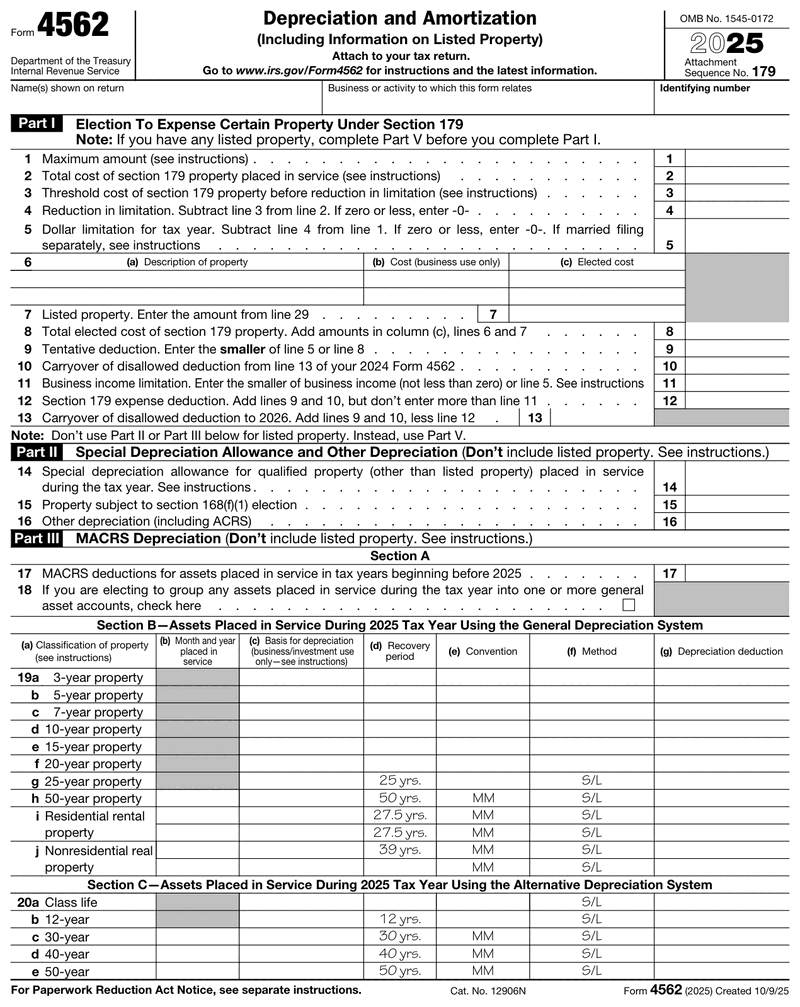
The form runs six Parts, and you almost certainly won't need all of them. The IRS Form 4562 instructions run dozens of pages, so here's what each Part actually does.
Part I: Section 179 Election
This is where you elect to expense qualifying property immediately instead of depreciating it. You list each asset, its cost, and the amount you're electing. Part I also enforces the annual dollar cap and the phase-out, and it applies the business income limitation that can defer part of your deduction to next year.
Part II: Special Depreciation Allowance
Bonus depreciation gets claimed here, in aggregate rather than asset by asset. That's the key difference from Part I: you won't itemize individual purchases, you'll report one combined figure for qualifying property placed in service during the year.
Part III: MACRS Depreciation
The core of the form for most filers. Section A handles assets from prior years in one summary line. Section B covers assets placed in service this year under GDS, sorted into the recovery-period rows: 5-year property, 7-year property, residential rental, nonresidential real property. Section C handles anything running under ADS.
Part IV: Summary
A short arithmetic Part. It pulls the totals from Parts I through III, adds listed property from Part V, and produces the single depreciation figure that carries to your tax return.
Part V: Listed Property
Complete this Part before Part I, despite the numbering. Part V handles vehicles and other property with personal-use potential, and it asks for business-use percentages plus whether you have written records to back them up. The totals from here feed into the earlier Parts.
Part VI: Amortization
Startup expenditures, business organization costs, patents, and goodwill acquired in a purchase get written off here. Report the date the write-off began and the statutory period you're using, which replaces the MACRS recovery tables entirely for these assets.
Section 179 and Bonus Depreciation in 2026
These two provisions are why the depreciation allowance matters so much to a growing business, and both changed recently.
For 2026, the Section 179 maximum deduction is $2,560,000, and it begins phasing out once your total qualifying purchases exceed $4,090,000. Above that threshold, the deduction drops dollar for dollar. Many guides still quote the old $1.16 million or $1.22 million caps, which are several years stale.
Bonus depreciation changed more dramatically. The One Big Beautiful Bill Act permanently restored 100% bonus depreciation for qualifying assets acquired after January 19, 2025. That acquisition date matters more than people expect: property you committed to buying before January 20, 2025 stays on the old phase-down schedule even if you didn't place it in service until later, so a late-2024 order and an early-2025 order can be treated very differently. For anything acquired after the cutoff, the step-down toward zero is gone, and a qualifying asset can be fully written off in year one without touching your Section 179 cap.
Which Deduction Should You Take First?
The order isn't optional. You apply Section 179 first, then bonus depreciation on the remaining basis, then standard MACRS on whatever is left.
The distinction that catches business owners out: Section 179 is capped at your business taxable income, so it can't create or deepen a loss. If that figure isn't one you track closely, our explainer on the provision for income taxes walks through how it's calculated. Bonus depreciation carries no such limit. If you had a thin year, a large Section 179 election may be partly deferred, while bonus depreciation still delivers the full write-off.
A freelance photographer buying a $3,000 camera and lighting kit can elect Section 179 and clear the whole cost in the purchase year. A retail shop owner installing $50,000 of store fixtures may prefer standard MACRS to spread deductions into years when the tax burden is heavier. Same form, two different outcomes, driven entirely by the election.
Depreciation vs. Amortization: What Is the Difference?
Depreciation recovers the cost of tangible business property such as vehicles, machinery, and equipment, while amortization recovers intangible assets such as patents, trademarks, and goodwill. Both are reported on Form 4562, but depreciation is claimed in Part III and amortization in Part VI.
The amortization depreciation distinction comes down to whether you can physically touch the asset.
| Depreciation | Amortization | |
|---|---|---|
| Asset type | Tangible (vehicles, equipment, buildings) | Intangible (patents, trademarks, goodwill, startup costs) |
| Form Part | Part III (and Parts I, II) | Part VI |
| Typical method | Accelerated (MACRS) | Straight-line |
| Section 179 eligible | Often yes | Generally no |
Buy a delivery van and a competitor's customer list in the same year and both land on the same form, in different Parts, on different schedules.
What Is Listed Property?
Listed property is business property that can easily be used personally, including passenger automobiles, other transportation vehicles, and certain entertainment or recreation property. You report it in Part V of Form 4562 and must track the business-use percentage. Business use above 50 percent qualifies for accelerated depreciation.
The 50% threshold is the one to watch. Cross below it and you lose Section 179 eligibility on that asset, you're pushed onto the slower ADS schedule, and if business use drops below 50% after you've already claimed accelerated depreciation, you may have to recapture part of it as income.
Property use records matter here more than anywhere else on the form. Part V asks directly whether you have written evidence supporting your business-use percentage. A mileage log or usage record kept during the year is what satisfies that question.
How to Build a Depreciation Schedule for Your Business
A depreciation schedule is the running register behind the form: every business asset you own, listed with its cost basis, placed-in-service date, recovery period, method, prior-year depreciation, and current-year deduction.
The form asks for prior-year amounts on continuing assets, which is exactly why the schedule matters. Without one, every filing season turns into an archaeology project through old returns and invoices.
Build it as you buy. The moment an asset goes into service, add a row: what it is, what it cost, the date it was ready for use, and its business-use percentage if it's listed property. A tax depreciation schedule maintained this way takes minutes a year. Reconstructing one from scratch takes days.
The payoff scales. One van is easy to remember. Fifteen assets across three purchase years, some fully depreciated and some mid-schedule, is not, and that's the point at which a maintained register stops being optional.
Keeping the rest of your business paperwork just as tidy? Our pay stub templates cover the payroll side of the same record-keeping habit.
When Is Form 4562 Due?
Form 4562 is due with your business tax return, so the deadline follows your entity type. Partnerships and S corporations file by March 15, while sole proprietors and C corporations file by April 15. A filing extension moves the 4562 form deadline with the return.
Those dates apply to calendar-year filers; a fiscal-year business follows its own schedule. Note that an extension pushes the filing deadline, not the payment deadline. Tax you owe is still due on the original date, which is why it helps to estimate quarterly taxes with your expected depreciation deduction already factored in.
How to Use Our Form 4562 Generator
The math on this form is mechanical, which makes it a good candidate for automation. Before starting with the 4562 generator on this page, gather the following for each asset:
- A description of the asset and its cost basis, including sales tax and delivery
- The placed-in-service date
- The business-use percentage, if it's a vehicle or other listed property
- Prior-year depreciation already claimed on continuing assets
- Which election you want: Section 179, bonus depreciation, or standard MACRS
From there, the tool sorts each asset into the right Part, applies the current-year Section 179 cap and phase-out, runs the MACRS recovery-period tables, and totals Part IV for you. The 4562 form it produces is ready to attach to your return or hand to your accountant.
One clarification worth making: Form 6252 is a different form entirely. The 6252 reports Installment Sale Income when you sell property and collect payments over time, so it's a disposal form, not a depreciation form. They're occasionally confused because both deal with business property over multiple years.
If contractors are part of your cost base, the same asset details feed your year-end contractor paperwork. Our 1099 generator handles that side of the filing.
When a specific line on the form is ambiguous, the IRS Form 4562 instruction for that line is the authoritative answer, and you'll find the current set in the official IRS instructions. Publication 946 covers depreciation methods in depth.
Record-Keeping and Audit Readiness for Business Assets
Depreciation is a multi-year claim, so your records need to outlive the deduction. Keep purchase invoices, proof of the in-service date, and business-use logs for listed property.
The retention rule that trips people up: hold asset records for at least three years after you file the return covering the asset's final year of depreciation, not three years from purchase. For a 39-year building, that's a very long file.
Those records also determine your gain or loss when you eventually sell the asset, since accumulated depreciation reduces your basis. Handing an accountant a clean IRS 4562 history and a current asset register is the difference between a fast return and an expensive reconstruction.
Which Version of Form 4562 Do You Need?
Form 4562 is reissued every year, so the version genuinely matters here. Pull the one that matches the tax year your assets were placed in service, not the year you happen to be filing in.
| Tax year 2025 | Tax year 2026 | |
|---|---|---|
| Section 179 maximum | $2,500,000 | $2,560,000 |
| Phase-out threshold | $4,000,000 | $4,090,000 |
| SUV limit | $31,300 | $32,000 |
| Part VI (Amortization) | On the form | Removed on the draft |
The 2026 figures come from Rev. Proc. 2025-32 sec. 4.24. The structural change is the one to raise with your accountant before year-end: the 2026 draft is retitled "Depreciation (Including Information on Listed Property)," runs Parts I through V only, and ends at line 41, with no amortization section at all. Treat that as provisional. It is still a draft, the IRS has not published where amortization reporting goes instead, and the final form could restore Part VI. Keep amortizing on the 2025 form as normal.
Notice the table carries no due date. Form 4562 has none of its own, it inherits the parent return's, which is why the year alone never answers the question. A 2025 form attached to a Form 1065 or 1120-S was due March 16, 2026, but attached to a Form 1040, 1120 or 1041 it was due April 15, 2026. For tax year 2026 those become March 15, 2027 and April 15, 2027.