








1065 Form Deadlines and Due Dates
The rule is the 15th day of the third month after your tax year closes. For calendar-year partnerships, that lands in March.
Two dates matter right now for the 1065 form:
| Tax year | Original due date | Extended due date |
|---|---|---|
| 2025 | March 16, 2026 | September 15, 2026 |
| 2026 | March 15, 2027 | September 15, 2027 |
The rule behind the table is that when the 15th lands on a weekend or a legal holiday, the due date rolls to the next business day. That is why the tax year 2025 deadline sat on the 16th. No shift applies for tax year 2026: March 15, 2027 is a Monday already, so the date stands as written.
Need more time? File Form 7004 by the original due date and you get an automatic six-month extension. No explanation required, no approval to wait for. One caveat worth repeating: an extension of time to file isn't an extension of time to pay. Partners still owe their estimated taxes on the original schedule.
Fiscal-year partnerships apply the same three-month rule against their own year-end rather than December 31.
What You Need Before You Start
Gather everything first. Starting the 1065 form without full records turns a two-hour job into a two-week one.
Get your EIN confirmed first. You can't file the return without a federal Employer Identification Number, or EIN. If your partnership is new, look up your EIN before anything else.
Then pull together the financial information you'll need:
- Profit and loss statement and balance sheet for the tax year, exported from the bookkeeping software you already use, such as QuickBooks or Xero
- Partner roster with each partner's legal name, address, taxpayer identification number, and ownership percentage
- Prior-year return, which you'll need for beginning balances and capital accounts
- Asset and depreciation schedules
- Cost of goods sold figures, if your partnership carries inventory
One filing-method note. Two separate tests force e-filing, and either one on its own is enough: filing 10 or more returns of any type during the tax year, or having more than 100 partners. That count includes all returns, W-2s and 1099s among them, not just this one. It catches more small businesses than owners expect.
How to Fill Out the 1065 Form: Step by Step
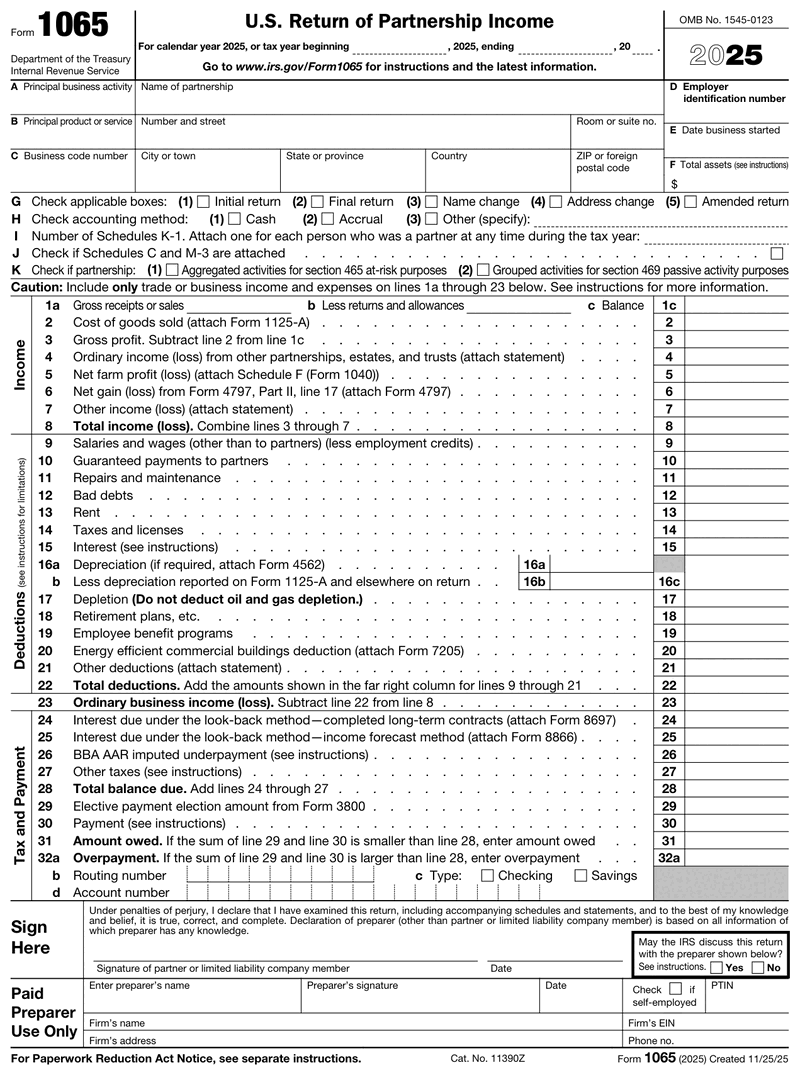
The 1065 form runs five pages plus schedules. Work through it in order. Later schedules pull from earlier ones, so the numbers stay consistent. Keep the official Form 1065 instructions open alongside, especially for the codes.
Page 1: Business Details and Income
Start with identification. You'll enter the partnership's legal name, address, EIN, principal business activity, and principal product or service. Add the business activity code that matches your industry. Also record the date the business started and total assets at year-end.
The income section captures gross receipts or sales, then subtracts returns and allowances. Sell physical products? Cost of goods sold gets worked out on Form 1125-A, then carried over here.
From there, add the remaining income lines:
- Gross profit after cost of goods sold
- Ordinary income or loss from other partnerships, estates, and trusts
- Net farm profit or loss, if applicable
- Net gain or loss from Form 4797 on business property sales
- Other income not captured above
Total these for gross income. Accuracy matters most here, because every downstream schedule and every partner's K-1 depends on it.
Page 1: Deductions and Ordinary Business Income
Deductions follow, and this is where partnerships differ from other entities in one important way.
Report salaries and wages paid to employees, but leave out guaranteed payments to partners. Those get their own line. They count as pay to the partner, not as an ordinary payroll expense. Mixing the two is a common error that skews both the return and the partner's K-1.
Other business deduction lines cover rent, interest, taxes, and licenses. You'll also report repairs and maintenance, bad debts, depreciation, employee benefits, and retirement plan contributions.
Subtract total deductions from total income and you have ordinary business income or loss. That single figure flows to Schedule K, then splits across every partner's K-1 according to their share.
Schedule B: Other Information
Schedule B is a questionnaire, not a calculation. It asks what type of entity the partnership is and who owns what percentage. It also asks whether any partner is a foreign entity, and whether the partnership holds stakes in other partnerships.
Watch the question about total receipts and total assets. Answer "yes" to that threshold test and you won't need to complete Schedule L, M-1, or M-2 at all. Many small partnerships qualify and fill out far less of the return than they expect.
Schedule B is also where you designate your Partnership Representative.
Schedule K: Partners' Distributive Share Items
Schedule K totals every item allocated out to partners:
- Ordinary business income, rental income, and interest
- Dividends, royalties, and capital gains
- Section 179 deductions and credits
- Foreign transactions
Think of it as the partnership-level summary that Schedule K-1 later divides up. The totals on Schedule K must equal the sum of all the K-1s you issue.
One forward-looking note. The Qualified Business Income deduction has been around since 2018, but it was scheduled to expire. The One Big Beautiful Bill Act made it permanent and reworked the phase-in thresholds. Those changes apply to tax years beginning after December 31, 2025, which makes tax year 2026 the first return under the permanent rules. Section 199A information reaches partners through Schedule K-1 under code Z.
Schedule L: Balance Sheets Per Books
Schedule L reproduces your balance sheet at the beginning and end of the tax year. Use your books, not tax-adjusted figures.
Assets, liabilities, and partner capital accounts all appear here. The ending balances have to tie to your accounting records. If they don't reconcile, fix the bookkeeping before finishing the return, not after.
Schedules M-1 and M-2: Reconciling Books to Tax
These two schedules explain the gaps between what your books say and what the return says.
Schedule M-1 squares book income with tax income. Gaps usually come from depreciation methods, costs you can't deduct, and tax-exempt interest.
Schedule M-2 tracks partner capital accounts across the year. That means beginning balance, contributions, allocated income or loss, distributions, and ending balance. Keeping these accurate year over year matters more than most partnerships realize. Capital accounts drive each partner's basis, and eventually their gain or loss on exit.
Signing and Submitting
A partner or the named Partnership Representative signs the return. If a paid preparer did the work, they sign too. E-file if the 10-return rule applies to you. Otherwise, mail it to the IRS service center listed in the instructions for your state.
Schedule K-1 (Form 1065): Reporting Each Partner's Share
Schedule K-1 Form 1065 breaks the partnership's totals into single shares. Each partner gets one. It shows their portion of income, deductions, credits, and capital account activity for the year.
Allocations follow the partnership agreement, which doesn't always match capital put in. A partner holding 25% of capital might get 40% of profits if the agreement says so. The 1065 K-1 instructions cover special allocation rules in detail. Read them if your agreement is anything but a straight percentage split.
The K schedules confuse people, so here's the whole family in one place:
| Schedule | What it covers | Level |
|---|---|---|
| Schedule K | Total distributive share items for the entire partnership | Partnership |
| Schedule K-1 | One partner's individual share of those items | Per partner |
| Schedule K-2 / K-3 | International tax items | Partnership / per partner |
Furnishing Schedule K-1s to Your Partners
Filing the return is only half the job. You also have to send a K-1 to every partner by the return due date, including extensions.
This is where the friction shows up. Every business partner depends on you here. Your partners can't complete their personal returns until their Form 1065 K-1 is in hand. A late one cascades straight into late partner filings and unhappy phone calls in April.
A few practices that keep this clean as the partner count grows:
- Send K-1s through a consistent channel every year rather than ad hoc email
- Keep a written record of when each K-1 went out and to which address
- Request acknowledgement of receipt, especially from partners who've moved
- Flag any partner whose TIN or address changed during the year before you generate the forms
If figures change after you've distributed K-1s, partners who already filed will need amended returns. Catching errors before you send is far cheaper than fixing them after. The penalties below apply per K-1.
Need clean, professional records for the people you pay? Our pay stub templates keep your business paperwork in order year-round.
Schedule K-2 and K-3: When International Reporting Applies
Schedule K-2, and its partner-level twin Schedule K-3, report items of international tax relevance. Think foreign income, foreign taxes paid, and what a partner needs for a foreign tax credit.
The K-2 schedule attaches to the 1065 form itself. K-3 goes to each partner alongside their K-1.
Most small domestic partnerships can skip both. These schedules generally don't apply if all your partners are US persons and all your income is US-sourced. No foreign activity means no K-2 or K-3. They matter if the partnership has foreign partners, foreign operations, foreign bank accounts, or foreign tax credits.
When in doubt, ask a tax professional. These reporting requirements have shifted several times since the schedules were introduced.
Penalties for Filing the 1065 Form Late
Late-filing penalties on the 1065 form multiply by partner. That's what makes them dangerous for a growing business.
For returns due in 2026, the IRS charges $255 per partner for each month the return is late. Partial months count as full months. The penalty caps at 12 months, and the rate rises to $260 for returns due in 2027.
Run the numbers on a four-partner partnership that files three months late:
$255 x 4 partners x 3 months = $3,060
Failing to furnish K-1s carries its own penalty, assessed per K-1:
| When you correct it | Penalty per K-1 |
|---|---|
| Within 30 days | $60 |
| By August 1 | $130 |
| After August 1, or never | $340 |
| Intentional disregard | $680 minimum, no cap |
Those amounts apply to returns due in 2026. Seen $310 quoted elsewhere? That was the figure for returns due in 2024. The IRS 1065 penalty amounts adjust for inflation every year. Always check the year attached to any number you rely on.
Reasonable-cause relief is available if you can show the failure wasn't willful neglect.
Record-Keeping and Audit Readiness for Partnerships
Filing on time is the baseline. Being able to defend the return three years later is what actually protects the business.
Retention: Keep the filed 1065 form, all K-1s, and supporting schedules for at least three years from the filing date. Records tied to property and partner basis last longer. Hold those until you dispose of the asset, plus three more years.
Basis and capital account tracking: This is the record gap that causes the most trouble later. Partner basis changes with contributions, allocated income, losses, and distributions every year. Rebuilding it years later, after a partner exits or sells, is painful and costly. Track it each year while the numbers are fresh.
What backs up the return: Bookkeeping records that tie cleanly to Schedule L, plus a current partnership agreement. If your allocations don't match the agreement on file, expect questions.
Partnership Representative: Under the centralized audit regime, you name one person to speak for the partnership before the IRS. Choose with care and keep that name current. Their decisions bind every partner.
Common 1065 Form Mistakes to Avoid
Most filing problems fall into a short list of repeat offenders:
- Single-member LLCs filing this return instead of reporting on Schedule C
- Missing or incorrect partner TINs, which trigger per-K-1 penalties even when the return itself is fine
- Allocation percentages that don't total 100% across all partners
- Skipping a zero-activity year, on the assumption that no income means no filing requirement
- Schedule L that doesn't tie to the books, usually from unreconciled year-end entries
- Guaranteed payments recorded as distributions, which misstates both the tax form 1065 deductions and the partner's K-1
- Filing the return on time but forgetting the K-1s, a separate duty with its own penalty
- Using last year's business activity code after the partnership changed what it actually does
How Our 1065 Generator Helps
Our 1065 generator is built to organize your inputs, not to replace your tax preparer.
Here's what it handles:
- Structured entry of partnership and partner details
- Organized capture of your income and deduction figures
- Consistent formatting across every partner record
- A downloadable output you can review or hand to your accountant
Here's what it doesn't do, stated plainly:
- It doesn't e-file to the IRS on your behalf. Submission is still your responsibility.
- It doesn't replace a pro's judgment on complex allocations, depreciation methods, or international reporting.
- It doesn't reconcile your books. Garbage in, garbage out applies here as everywhere.
Partnerships that pay contractors usually need 1099s as well, and our 1099 generator covers those.
Bring in a CPA for multi-tier ownership, foreign partners, large depreciable assets, or special allocations. For a simple two-to-five partner shop with clean books, a structured tool plus a pro review usually does it.
Which Form 1065 Version You Actually Need
The 1065 form is genuinely reissued each year, so "form 1065 2025" and "form 1065 2026" are two different documents. Pull the edition that matches the tax year you are closing, not the year you are sitting in.
| Tax year | Edition | Current status |
|---|---|---|
| 2025 | 2025 Form 1065 | Final. It is the information return for calendar year 2025, and it stays the right edition even when you file on extension |
| 2026 | 2026 Form 1065 | Draft only, posted 07/17/2026. Draft Schedule K-1 posted 05/21/2026, draft Schedules K-2 and K-3 posted 06/17/2026, draft Schedule D posted 05/20/2026 |
No 2026 instructions exist yet, in draft or final, so treat the draft form as a planning document for your bookkeeping and partner data, never as something to file. The underlying timing rules did not change between the two years either: the 15th-day-of-3rd-month rule and the six-month Form 7004 extension are unchanged, and only the calendar moved.
One item to act on before your 2026 books close. Line 20 code AR on the 2025 form warns that an EIN will be required after 2025 for IRA partners receiving a UBTI allocation. The notice is printed this year, but the requirement lands on the K-1s you issue for 2026. If any partner is an IRA, add that EIN to the roster you already gather.