








Form 1099 OID Instructions: A Box-by-Box Breakdown
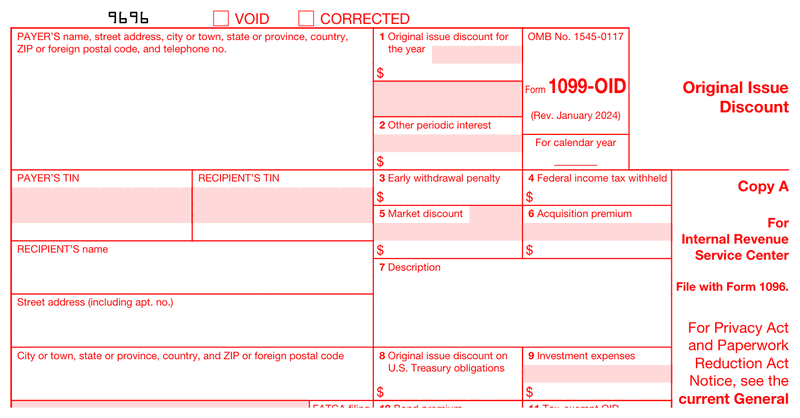
Most published box charts cover only the four or five entries filers use most often. These 1099 OID instructions cover the full form 1099-OID as issued in the current January 2024 revision, so you are not guessing on the less common boxes.
| Box | What it reports |
|---|---|
| 1 | Original issue discount for the year on a taxable obligation, for the portion of the year the holder owned it |
| 2 | Other periodic interest, meaning qualified stated interest paid separately from the OID itself |
| 3 | Early withdrawal penalty, such as the forfeited interest when a CD is cashed before maturity |
| 4 | Federal income tax withheld, which is where backup withholding is reported |
| 5 | Market discount that accrued during the year, when the holder has elected to include it in income as it accrues |
| 6 | Acquisition premium, which reduces the amount of OID the holder includes as interest |
| 7 | Description of the obligation, typically the CUSIP number or a plain description with coupon rate and maturity year |
| 8 | Original issue discount on U.S. Treasury obligations, reported separately because it is exempt from state and local income tax |
| 9 | Investment expenses, the holder's share of expenses from a single-class REMIC |
| 10 | Bond premium, the amortization allocable to the interest payment for a taxable covered security |
| 11 | Tax-exempt OID, for a covered tax-exempt obligation issued with OID |
| 12-14 | State information: the state code, your state identification number, and any state tax withheld |
Two entries cause most of the correction notices. Box 5 is market discount and Box 11 is tax-exempt OID. Older third-party charts sometimes list these in the wrong order, and an amount posted to the wrong box will not match what the holder reports. Box 7 deserves care as well: a vague description makes it harder for the holder to reconcile the form against their own records, which generates avoidable phone calls in February.
Form 1099 OID Filing Deadlines
Three separate deadlines govern this form: furnishing the copy to the holder, filing on paper, and filing electronically. Missing any of them carries its own penalty, and the furnishing date has two exceptions built into it. When a deadline falls on a Saturday, a Sunday, or a legal holiday, it moves to the next business day.
| Requirement | General rule | Next cycle (2026 tax year, filed 2027) |
|---|---|---|
| Furnish copy to the holder | January 31 | Monday, February 1, 2027 |
| Furnish inside a consolidated broker statement | February 15 | Tuesday, February 16, 2027 |
| Furnish as a WHFIT trustee or middleman | March 15 | Monday, March 15, 2027 |
| File on paper with the IRS | February 28 | Monday, March 1, 2027 |
| File electronically with the IRS | March 31 | Wednesday, March 31, 2027 |
The January 31 recipient date is the general rule rather than a universal one, and the exceptions matter more here than on most 1099s. If you furnish the form as part of a consolidated reporting statement, the kind a broker sends covering several form types at once, the recipient deadline moves to February 15. Trustees and middlemen of widely held fixed investment trusts get until March 15. Standalone filers stay on January 31, but if your OID reporting rides along on a brokerage platform's consolidated statement, confirm which date applies before you build your January schedule.
Electronic filing is not always optional. If you file 10 or more information returns of any type in a calendar year, the IRS requires you to e-file. That count is aggregated across form types, so a business filing a handful of 1099-NECs alongside a few OID forms can cross the threshold without issuing many of either. If your business also makes estimated payments, note that these information-return dates are separate from the schedule for quarterly taxes on 1099 income.
Backup Withholding on Form 1099 OID
This is the part filers underestimate, because it turns a reporting task into a withholding task. If backup withholding applies to a holder, you must withhold 24% and remit it, not simply note the problem on the form.
Four situations trigger it:
- The holder fails to furnish a TIN in the manner required.
- For instruments acquired after 1983, the holder fails to certify under penalties of perjury that the TIN provided is correct.
- The IRS notifies you that the holder furnished an incorrect TIN.
- The IRS notifies you that the holder is subject to backup withholding for underreporting.
There is an important limit specific to this form. Backup withholding applies to the amounts reported in Boxes 1, 2, and 8, but it is capped at the cash actually paid on the obligation. Before you apply the 24% rate, you may also reduce the Boxes 1 and 2 figures by any early withdrawal penalty reported in Box 3. OID accrues without any cash changing hands, so on a pure discount instrument that pays nothing until maturity, there may be no cash to withhold from in a given year. Report the withheld amount in Box 4, and report the withholding itself on Form 945, your annual return for withheld federal income tax. If you fail to collect and pay over backup withholding when required, you can become personally liable for the uncollected amount.
OID Bonds Issued Before 1985
The original issue date determines which set of basis rules applies, and there are three eras. Instruments issued before May 28, 1969, those issued between May 28, 1969 and 1985, and those issued after 1984 each follow different rules for how the discount accrues and how basis is adjusted. Older OID bonds are still in circulation, and long-dated instruments from the 1980s continue to generate reportable discount today.
The practical takeaway is a recordkeeping one: log the original issue date of every debt instrument alongside its OID schedule. That single date decides which of the three rule sets governs the instrument, and it is far easier to capture when the instrument is acquired than to reconstruct years later. Incomplete basis records are among the IRS audit red flags worth avoiding.
State Filing Requirements for Form 1099 OID
Federal filing does not automatically satisfy your state. Boxes 12 through 14 carry the state code, your state identification number, and any state income tax withheld. Many states participate in the IRS Combined Federal/State Filing Program, which forwards the federal return to the state for you, but participation is not universal and some participating states still require a separate reconciliation return.
Note that OID on U.S. Treasury obligations, reported in Box 8, is exempt from state and local income tax. That is precisely why it sits in its own box rather than being folded into Box 1. Confirm the requirements with the revenue department in each state where your holders reside before you file, and keep in mind how state tax affects federal tax when you reconcile the two.
Common 1099-OID Mistakes to Avoid
The most frequent error is form confusion, and knowing the 1099 oid meaning relative to its neighbors prevents it:
- 1099-OID reports discount that accrues on a debt instrument bought below face value. It is taxed as it accrues, before any cash is received.
- 1099-INT reports interest that was actually paid out during the year.
- 1099-DIV reports dividends and capital gain distributions.
If you issue several information returns each year, our breakdown of W-2 and 1099 forms is a useful reference for which document belongs to which relationship.
The second common error is a TIN mismatch. A name and TIN combination that does not match IRS records generates a B notice and can put you into backup withholding on the account. Collect a signed Form W-9 before the first payment rather than chasing certifications in January. Finally, do not print and file the red Copy A downloaded from the IRS website. That online version is not scannable, and filing it can draw a penalty.
Generate Form 1099 OID with PayStubs.net
Building these forms by hand is slow and easy to get wrong, particularly across multiple holders with different acquisition dates and premium adjustments. Our 1099 OID generator uses the current Rev. January 2024 layout, so every amount lands in the correct box the first time, and it works the same way as our 1099 generator for the rest of the 1099 series. If you also issue payroll documents, the same account covers our pay stub templates.
It is also the fastest way to fix an error. If a form goes out with a wrong TIN or a misposted amount, regenerating a corrected version takes minutes, where hand-editing a paper form invites a second mistake. You keep a clean record of what was issued to whom, which is exactly what you want in front of you if the IRS asks.
For the authoritative technical rules, including the accrual tables, see IRS Publication 1212, Guide to Original Issue Discount (OID) Instruments.
Is There a Separate 1099-OID for Each Tax Year?
No, and for once that answer is genuinely simple. Form 1099-OID is a continuous-use form: the IRS issues one document and leaves it in place until a superseding revision comes out. The current revision is January 2024, and it is the correct form for the 2025 tax year and the 2026 tax year alike. So when a holder, a bookkeeper or a broker platform asks you for the "1099-OID 2025 form" or the "1099-OID 2026 form," they are naming the tax year of the discount you are reporting, not a different piece of paper. There is no newer edition to go hunting for.
Nothing on the form itself moved between those two cycles either. The instructions carry no What's New section at all, the $10 per-holder threshold is unchanged, and the address fields were not split into individual entry boxes. That last point matters if your team files across the series: Forms 1099-NEC, 1099-G and 1099-R were all caught by the 2026 revision wave, and the 1099-OID was not. Do not assume it followed them.
What does move is the calendar. For the 2025 tax year, holder copies were due February 2, 2026 and paper filings March 2, 2026, both weekend rolls. E-filing is fixed at March 31, 2026, the same date in every year. None of this is a form change.