



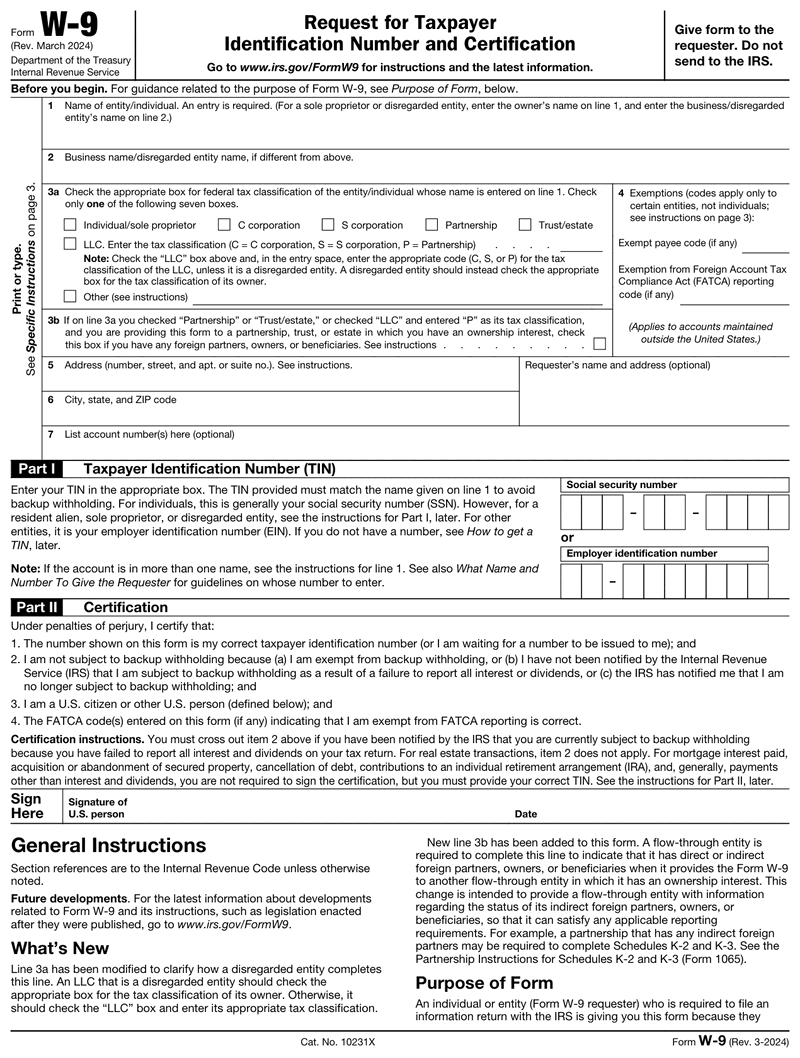





How to Fill Out a W9 Form (Line by Line)
Filling out a W9 form takes a few minutes once you know which boxes apply. If you'd rather not print anything, our fillable W9 walkthrough shows the same fields on screen. Walk the lines in order.
Name and Business Name
Enter your legal name on line 1. If you operate under a DBA, or your LLC uses a separate name, add it on line 2.
Tax Classification
Check one box. This is where most mistakes happen. Three common cases show how it works:
- A sole proprietor uses their own name and SSN.
- A single-member LLC that hasn't elected corporate status is a disregarded entity, so it usually uses the owner's SSN or EIN.
- An S corp checks the S corporation box and uses its EIN.
Finishing the Form
People rush this part, so slow down. Enter the mailing address for tax documents, add your SSN or EIN, then sign and date to certify the details. Before sending it, double-check three things: the right classification box, a current TIN, and a real signature. If you incorporated recently, use your new EIN, not the personal SSN it replaced. And check that the copy in play is the current March 2024 revision.
Create and E-Sign a W9 Online
You don't need to print anything. Our W9 generator lets you enter the details, validate them, e-sign, and download a clean PDF in minutes. The IRS accepts an electronic signature on the form, so a digital signature holds up the same as ink.
Here's a practical tip if you onboard contractors regularly. Save each completed W9 PDF to a shared drive the moment it comes back, filed under the contractor's name. When 1099 season arrives you're pulling stored files instead of chasing signatures.
Need the paperwork two ways? You can download a blank W9, grab the W-9 form PDF for your records, or generate a completed one to send right now. Either way, you preview the result first and pay only at download, with no subscription. If you'd rather start from a layout for other documents, browse our pay stub templates. Ready to handle it now? Fill in the form above and skip the printer entirely.
Collecting and Managing W9s for Your Business
Smart businesses make the W-9 part of vendor setup, not a year-end scramble. Add it to your onboarding checklist and request one before you release any payment.
You've probably sent your own W-9 more than once. Common requesters include a marketplace like Upwork or Fiverr, a bank opening a business account, or a property manager reporting rental income. On the other side of that exchange, your business is the requester, and the same discipline applies.
Keep each signed IRS W9 on file in one secure place. If you run contractor payments through QuickBooks or FreshBooks, a W-9 already on file lets the software generate 1099-NECs at year-end without a last-minute chase. When you need to produce those forms yourself, our 1099 generator builds them from the same details. And if you also pay W-2 staff, keeping their wage documentation in the same system spares you a second year-end scramble. Refresh a form only when a contractor's name, address, or TIN changes.
Backup Withholding and a Missing W9
Here's what happens when a W9 is missing or wrong. If a contractor won't provide a valid TIN, the IRS requires you to withhold 24% of their payments as backup withholding and send it in. That's money out of their check and extra work for you.
File 1099s with missing or incorrect TINs and you can draw penalties too, plus a CP2100 or CP2100A notice from the IRS flagging the mismatch. Neither is fun to unwind.
So why does backup withholding exist? It guarantees the IRS can still collect tax on income even when a payee's TIN is missing or incorrect. Collecting a complete W-9 up front, then verifying the TIN, is the simplest way to keep that 24% out of the picture.
What's New for the 2026 W9 Form
Here's the part that trips people up. The official form is still Form W-9 (Rev. March 2024), so there is no finalized 2026 W9 sitting on the IRS site waiting to be downloaded. Search for a W9 form 2026 download and you'll land on the March 2024 revision, which is the correct one to use. What changed for 2026 is the reporting math around the form, not the form itself.
The big one is the threshold. For payments made after December 31, 2025, the 1099 reporting threshold rises from $600 to $2,000, and it gets indexed for inflation after 2026. Note this is the 1099 reporting threshold, not a change to the 24% backup withholding rate. Fewer contractor payments will trigger a 1099, but you still collect a W9 from everyone up front, because in January you don't know who will cross $2,000 by December.
The IRS has also circulated a draft W-9 form 2026 revision, dated June 2026, that adds a Part II certification checkbox for US digital asset brokers. It is still a draft and could change before release. Until the IRS finalizes it, don't treat that version as required, and don't reject a properly signed March 2024 form for looking out of date.
So the takeaway for your records is short. Collect the current March 2024 revision, watch for the final W9 2026 release, and re-paper your contractors only once the IRS actually publishes it.
W9 vs. W-4, W-8, and 1099
It's easy to mix up the forms in this family. Here's how they line up:
| Form | Who uses it | Purpose |
|---|---|---|
| W-9 | US contractors and vendors | Give the payer a legal name and TIN |
| W-4 | Employees | Set income tax withholding from wages |
| W-8 | Non-US persons | Certify foreign status for withholding |
| 1099 | The paying business | Report what you paid a contractor |
The short version is simple. You collect a W-9 from US contractors and a W-8 from non-US ones. Employees give you a W-4. The W-9 data is what you eventually turn into a 1099. Still not sure whats a W9 versus a W-4? A W9 covers contractors, while a W-4 covers staff on your payroll. For an employee-versus-contractor breakdown, see W-9 vs W-2, and if you're choosing which form to file, compare 1099-MISC vs 1099-NEC.
Is There a Separate W9 for 2025 or 2026?
Worth clearing up before you chase a year-specific version: the W9 is not an annual form. The IRS does not reissue it each tax year the way it does a W2 or a 1099. The current revision is dated March 2024, and it is the right form to collect in 2025, 2026 and beyond.
That means a search for w9 form 2025, w9 form 2026 or w9 form 2024 lands on the same document. If you are collecting these from contractors, the version is rarely the problem. What matters is whether the information is current.
| Situation | Do you need a new W9? |
|---|---|
| Contractor's details unchanged | No, the one on file still stands |
| Name, business name or address changed | Yes, collect a fresh one |
| Taxpayer ID or tax classification changed | Yes, collect a fresh one |
| New tax year, nothing else changed | No |
Keep each completed W9 with the tax year you paid that contractor, since that is the year the 1099 will report.