








How Our Form 4868 Generator Works
Our tool walks the form in the IRS's own order, so what you produce reconciles line by line with the official form. Enter your details, add your tax estimate and payments, then download a clean PDF.
Two details make the 4868 generator worth it, and the same engine powers our pay stub generator. You preview free and pay only at download, no subscription. And the output is always the current-year version, since an outdated form is an avoidable rejection.
Need pay documentation to support the figures you're estimating from? Our pay stub templates keep those records consistent.
Tax Filing Deadline 2027 and Extended Due Dates
When is the last day to file taxes? It depends on your situation. The four cases below cover nearly every filer.
Tax Extension 2027 Deadlines at a Glance
| Your situation | Original due date | Extended due date |
|---|---|---|
| Most individual filers | April 15, 2027 | October 15, 2027 |
| U.S. citizen or resident out of the country | June 15, 2027 (automatic, no form) | October 15, 2027 |
| Form 1040-NR filer with no U.S.-withheld wages | June 15, 2027 | December 15, 2027 |
| Federally declared disaster area | Varies by IRS notice | Varies by notice |
The deadline to file taxes 2027 falls on a Thursday, with no weekend shift. October 15 is the end of the line: the IRS generally won't extend a return more than six months, so treat that tax extension deadline as final.
How to File a Tax Extension
There are three routes, and only two involve sending the form.
How to File Tax Extension Requests Electronically
Pay your estimated tax online and flag it as an extension, and the IRS processes it automatically. You never file the form. Otherwise, file tax extension paperwork through tax software or a tax professional. You'll need your 2025 return for verification, and you'll get an electronic acknowledgment worth keeping.
Several companies offer free e-filing through IRS Free File, with no income limit on the extension itself.
How to File for Tax Extension by Mail
The correct address depends on your state and whether you're enclosing a payment, so check the table on the form. Fiscal year taxpayers must use paper. Anyone wondering how to file an extension for taxes at the last minute should skip this route, since a mailed form must be postmarked by the deadline.
What You'll Need to Complete Form 4868
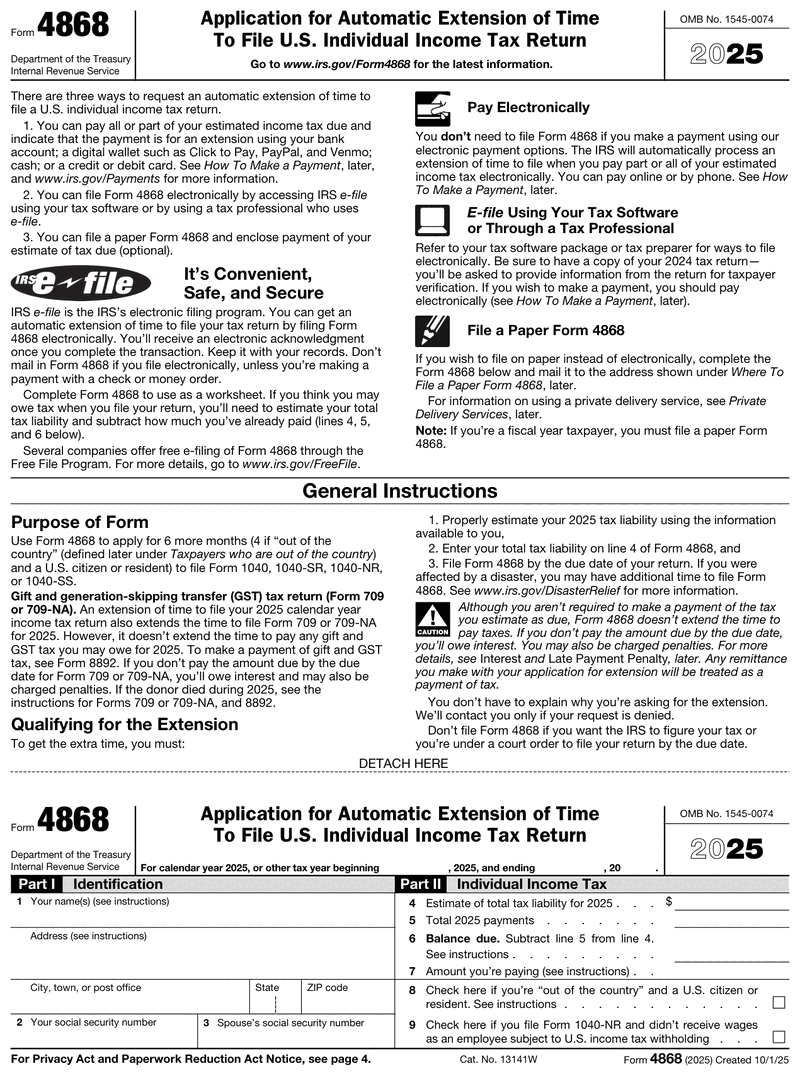
Gathering a few things ahead turns this into a five-minute job. The tax extension form is short, and Part I is identification.
Identifying Information
Your name and address, your Social Security number, and your spouse's SSN if you're filing jointly. Report a recent name change to the Social Security Administration first, or processing can stall.
Line 4, Your Estimated Total Tax Liability
This is the line that carries weight. Enter the total tax you expect to report for 2026, and make it as accurate as your information allows. The IRS is blunt here: if it later finds your estimate wasn't reasonable, the extension is null and void.
Here's the shortcut. Your most recent pay stub for tax filing already shows year-to-date gross pay and federal withholding, two of the three inputs you need. Add self-employment income and estimated payments, and you have a defensible number.
Lines 5 Through 7
Line 5 is your total 2026 payments, line 6 the balance due, line 7 what you're paying now. If line 6 exceeds what you can cover, you still get the extension.
A Tax Extension Doesn't Extend Time to Pay
This is the expensive misunderstanding. An IRS tax extension moves your filing date only. Payment was still due April 15, 2027, and interest starts the day after, even with the out-of-country grace period.
So pay something. Anything sent by the original due date shrinks the interest and the penalty base. Use IRS Direct Pay, your IRS online account, EFTPS, or a card, and save the confirmation number.
Who Can File for a Tax Extension
Any individual expecting to file a 1040 series return can file for a tax extension, including employees, freelancers, and sole proprietors. No reason or approval is required. The IRS does not send a confirmation letter, so silence means accepted. Rejections are rare and usually trace to a mismatched name, SSN, or prior-year AGI.
Two situations disqualify you: wanting the IRS to figure your tax, or a court order to file by the due date.
Form 4868 vs. Form 7004: Which Extension Your Business Needs
Sole proprietors and single-member LLCs use Form 4868, because business income flows to the personal return. Partnerships, multi-member LLCs, S corps, and C corps use Form 7004 instead. S corp owners often need both: Form 7004 for the entity by March 15, 2027, and Form 4868 for their personal return.
| Your entity | Extension form | Original due date |
|---|---|---|
| Sole proprietor, single-member LLC | Form 4868 | April 15, 2027 |
| Partnership, multi-member LLC | Form 7004 | March 15, 2027 |
| S corporation | Form 7004, plus 4868 personally | March 15, 2027 |
| C corporation | Form 7004 | April 15, 2027 |
The trap is that March date. Pass-through returns fall due a month earlier than owners expect, triggering a per-partner penalty unrelated to your personal return.
Extension Planning for Business Owners and the Self-Employed
Owners file extensions more often than employees, usually because the books aren't closed or a K-1 hasn't arrived. Neither is a problem once you separate filing from paying. A rideshare driver, a freelancer invoicing six clients, and an owner waiting on a K-1 land in the same place: file early, pay your best estimate by April 15, then reconcile in the fall. One caution, an extension doesn't pause quarterly estimated taxes.
State Extensions and Filing From Abroad
This form covers your federal return and nothing else. Some states grant an automatic extension alongside the federal one, others want their own form. Check your state Department of Revenue before assuming you're covered, and read up on how state tax affects federal tax. This is the mistake that quietly generates penalty notices in November.
Out of the country on the due date? U.S. citizens and residents get an automatic two months to June 15, 2027, without filing anything. Check the box on line 8 if you need the additional four months. Interest still runs from April 15.
Penalties for Filing or Paying Late
The two penalties differ wildly in size, which is the argument for filing on time.
- Late filing: 5% of the amount due per month or part month, capped at 25%. More than 60 days late, the minimum is $525 or your balance due, whichever is smaller.
- Late payment: 0.5% per month or part month, also capped at 25%.
Say you owe $10,000 and file four months late without paying. The filing penalty is reduced by the payment penalty in any month both apply, so the combined rate is 5% per month, not 5.5%. That's roughly $2,000. File the extension instead and you'd owe about $200.
There's a documented way out of the late payment penalty. The IRS treats you as having reasonable cause if you paid at least 90% of your 2026 tax by the original due date and pay the rest with your return. The estimated tax underpayment penalty has its own safe harbor: 100% of prior-year tax, or 110% if your prior-year adjusted gross income topped $150,000.
Which Tax Year's Form 4868 Do You Need?
Form 4868 is one of the few extension forms that carries a printed tax year, so the 2025 and 2026 editions really are separate documents. Pick by the tax year you are extending, not the year you happen to be sitting in. An owner searching "form 4868 2025" because the books for that year never closed needs the 2025 edition, and its April 15, 2026 filing deadline has already passed.
| Tax year you're extending | Return due | Extended to | Abroad on the due date |
|---|---|---|---|
| 2025 | April 15, 2026 | October 15, 2026 | June 15, 2026 |
| 2026 | April 15, 2027 | October 15, 2027 | June 15, 2027 |
The 2025 row is the IRS's own published wording. The 2026 row is the standing calendar rule carried forward: as of July 21, 2026 the IRS had not published the TY2026 form, so treat those dates as the rule rather than as freshly printed IRS text.
For a bookkeeper or payroll team filing on an owner's behalf, the year on the form is the only meaningful difference between the two. Nothing material changed in substance: Part I identification and Part II lines 4 through 9 sit exactly where they did before, out-of-country box on line 8, 1040-NR box on line 9. Grab the right year, and the rest is the same job twice.