



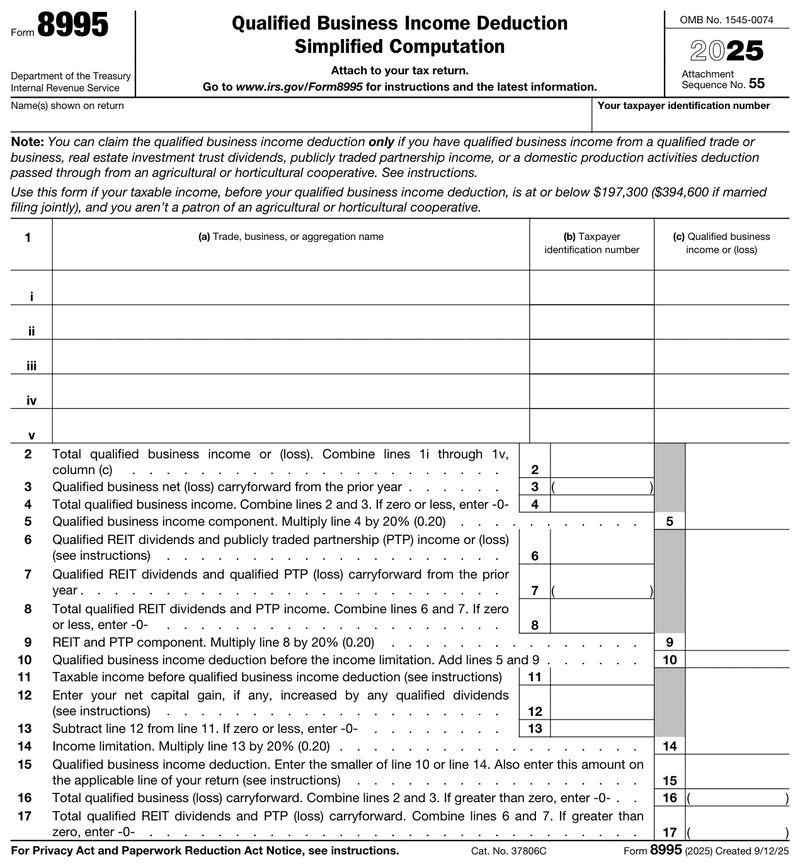





Form 8995 Instructions: How to Fill Out Each Line
The generator on this page is built around the same three blocks the form itself uses: your operating businesses, your investment income from REITs and publicly traded partnerships, and the final limitation that caps the deduction against your overall taxable income. Working through the form 8995 instructions in that order keeps the math straightforward.
How to Calculate Qualified Business Income
Most filing errors happen before anyone touches the form, in the number that gets fed into it. Start from net profit, confirm it excludes wages and investment income, subtract any prior-year qualified business loss, and you have the figure the rest of the tax form 8995 operates on. Owners who learn how to calculate QBI once find the annual filing becomes mechanical, because the only variable that changes is the profit number.
Lines 1 to 5: Your Qualified Business Income
Line 1 has room for up to five businesses. For each one you enter the business name, its taxpayer identification number, and its qualified business income or loss.
The single most common question about this form is where the Line 1 number actually comes from, and the answer depends on your structure. If you are a sole proprietor or single-member LLC, it is the net profit from Schedule C, Line 31, which is where you report freelance income whether or not a client issued you a 1099. If you are a partner or S corporation shareholder, it comes from your Schedule K-1, which reports your share of QBI directly. It is not your gross revenue, and it is not your owner draw.
Line 2 totals your QBI across all businesses. Line 3 is where you subtract any qualified business loss carried forward from a prior year. This line is easy to overlook and it matters: a loss from a previous year reduces the income eligible for this year's deduction. Line 4 gives your total QBI after that adjustment, and Line 5 applies the 20% rate to produce your QBI component.
Lines 6 to 9: REIT Dividends and PTP Income
This block handles income that qualifies for the deduction but does not come from a business you operate. Line 6 captures qualified REIT dividends and qualified publicly traded partnership income. Contractor payments reported on a 1099-NEC rather than a 1099-MISC are business income and belong on Line 1 instead. If you hold real estate investment trusts in a taxable brokerage account, those dividends often qualify, and the figures appear on the Form 1099-DIV you receive.
Line 7 subtracts any REIT or PTP loss carryforward from a prior year, Line 8 gives the combined total, and Line 9 applies the same 20% rate to produce your REIT and PTP component.
Lines 10 to 15: Your Final Deduction
Line 10 adds your QBI component from Line 5 to your REIT and PTP component from Line 9. That sum is your deduction before the income limitation is applied.
Lines 11 through 14 calculate that limitation. You start with taxable income before the QBI deduction, subtract net capital gain, and multiply the result by 20%. This is the ceiling. The purpose of the limitation is to prevent the deduction from sheltering income that was never business income in the first place.
Line 15 is your actual deduction: the lesser of Line 10 and Line 14. Lines 16 and 17 record any losses that carry forward to next year, which is the figure you will need on Line 3 of next year's form.
A Worked Example
Take a consultant operating a single-member LLC with $90,000 of net profit on Schedule C, Line 31, no prior-year losses, no REIT income, and $110,000 of taxable income before the deduction with no capital gains.
That $90,000 goes on Line 1 and carries to Line 2 and Line 4. Line 5 applies 20%, producing a QBI component of $18,000, which flows to Line 10 unchanged because there is no REIT or PTP income. The limitation runs in parallel: $110,000 of taxable income minus $0 of net capital gain, multiplied by 20%, gives $22,000 on Line 14. Line 15 takes the lesser of $18,000 and $22,000, so the deduction is $18,000.
Change one variable and the outcome flips. If the same consultant had only $80,000 of taxable income, the Line 14 ceiling would fall to $16,000, and the deduction would be capped at $16,000 rather than the full $18,000. Knowing how to calculate QBI deduction limits from both directions is what tells you which constraint is actually binding on your return.
8995 Generator: Fill Out the Form Online
Running the math by hand is manageable for one business and tedious across several. Our 8995 generator handles the calculation and returns a completed form ready to attach to your return. You can preview your result free and pay only when you download, with no subscription.
The tool computes your QBI component across each business, adds any REIT and PTP component, applies the taxable income limitation, and carries loss figures to the right lines so nothing is dropped between steps.
Gather these five inputs before you start, and you can finish in one sitting rather than stopping to hunt for a number:
- Business name and taxpayer identification number for each business, up to five
- Qualified business income or loss for each business, from Schedule C Line 31 or Schedule K-1
- Prior-year qualified business loss carryforward, for Line 3
- Qualified REIT dividends and PTP income, plus any prior-year carryforward, for Lines 6 and 7
- Taxable income before the QBI deduction, and net capital gain, from your Form 1040
The output is a completed IRS form 8995 PDF you can download, review with your accountant, and file with your return. If you manage several entities, or prepare returns for more than one client, the same inputs produce consistent output each year without rebuilding the calculation from scratch.
Start with the generator on this page, enter those five inputs, and let the calculations handle themselves. If you also need clean income records to support the Line 1 figure you enter, our pay stub templates cover that side of the documentation.
SSTB Rules: Does Your Business Qualify?
A specified service trade or business (SSTB) is one whose principal asset is the reputation or skill of its people, including health, law, accounting, consulting, financial services, brokerage, athletics, and performing arts. SSTB status only matters if your taxable income exceeds the threshold. Below it, an SSTB claims the deduction on the same terms as any other business.
That last point is the one most often missed. A solo consultant earning $120,000 is running an SSTB by definition, and it changes nothing about their deduction, because they are well under the 2026 threshold. The classification only becomes consequential once income climbs into the phase-in range.
The full statutory list covers health, law, accounting, actuarial science, performing arts, consulting, athletics, financial services, brokerage services, and any trade or business involving investing, trading, or dealing in securities. There is also a catch-all for businesses whose principal asset is the reputation or skill of one or more employees or owners.
Once taxable income passes $403,500 for joint filers or $201,750 for other filers, an SSTB deduction begins to phase down. When income reaches the top of the range, $553,500 joint or $276,750 for other filers, the deduction for an SSTB is eliminated. Non-service businesses are not cut off at that point, but they become subject to limits based on W-2 wages paid and qualified property held.
Form 8995 vs. Form 8995-A: Which Do You File?
File Form 8995 if your taxable income before the deduction is at or below the 2026 threshold of $403,500 joint or $201,750 for other filers. File Form 8995-A if you are above that threshold, run an SSTB in the phase-in range, aggregate multiple businesses, or are a patron of an agricultural or horticultural cooperative.
| Situation | Form to File |
|---|---|
| Taxable income at or below the threshold | 8995 |
| Taxable income above the threshold | 8995-A |
| SSTB inside the phase-in range | 8995-A |
| Aggregating multiple businesses | 8995-A |
| Patron of an agricultural or horticultural cooperative | 8995-A |
The 8995-A is longer because it has to accommodate the wage and property tests that the simplified form assumes away. If you are close to the threshold, run the number before choosing a form, since the correct choice depends on taxable income rather than on revenue.
Common Mistakes to Avoid
- Treating the wrong income as QBI. W-2 wages, capital gains, dividends, and interest are not qualified business income. Only net income from a qualified trade or business counts.
- Skipping the Line 3 carryforward. A prior-year qualified business loss reduces this year's eligible income. Omitting it overstates the deduction.
- Forgetting the taxable income limitation. The deduction is capped at 20% of taxable income minus net capital gain. Claiming 20% of QBI without checking Line 14 is the most frequent error on the form.
- Filing the simplified form when 8995-A is required. Above-threshold filers and SSTBs in the phase-in range cannot use Form 8995.
- Using a prior year's thresholds. The figures change annually. Confirm you are working from the current tax year's numbers.
Where Your QBI Number Comes From
The figure you enter on Line 1 is only as reliable as the books behind it. Schedule C Line 31 is not an independent number: it is revenue minus deductible expenses, which means the accuracy of your deduction rests on records you maintain throughout the year rather than anything you do at filing time.
For most small businesses that means four categories of documentation: income records showing what the business actually received, expense receipts substantiating every deduction claimed, mileage and home office logs where those deductions apply, and pay records for any wages paid to yourself or to employees. If you operate as an S corporation, the reasonable compensation you pay yourself is a W-2 wage, which is excluded from QBI but directly affects the profit figure that becomes QBI.
This matters at the business level for a practical reason. An audit does not test the form, it tests the records underneath it, and thin documentation is one of the better known IRS audit red flags. A clean Line 1 figure that traces cleanly back to categorized income and expense records is straightforward to defend. A figure assembled from bank statements at the last minute is not.
Keeping a consistent self-employed pay stub record through the year is what turns tax filing into a transcription task rather than a reconstruction project, and the same records support every pay stub for tax filing request you field later.
Which Tax Year's Form 8995 Do You Need?
Form 8995 is reissued annually, so searching the 2025 form versus the 2026 form really does point at two different documents. The due date, though, is inherited rather than printed: the 8995 attaches to Form 1040, making it due April 15, 2026 for a 2025 return and April 15, 2027 for a 2026 return, extended to October 15, 2026 or October 15, 2027 with Form 4868.
What separates the editions is the math your books feed into.
| Threshold to use Form 8995 instead of 8995-A | 2025 | 2026 |
|---|---|---|
| Married filing jointly | $394,600 | $403,500 |
| All other filers | $197,300 | $201,750 |
The 2026 figures come from Rev. Proc. 2025-32, sec. 4.26. Married filing separately runs slightly higher for 2026, at $201,775, with the phase-in topping out at $276,775.
Two further changes land on the 2026 edition only. The phase-in band above the threshold widened under OBBBA from $50,000 ($100,000 joint) to $75,000 ($150,000 joint), pushing the 2026 ceilings to $276,750 and $553,500 joint. And the new $400 minimum deduction for a filer with at least $1,000 of active QBI applies to tax years beginning after December 31, 2025, so it does nothing on a 2025 return. Those amounts index after 2026.