








1099-R Distribution Codes
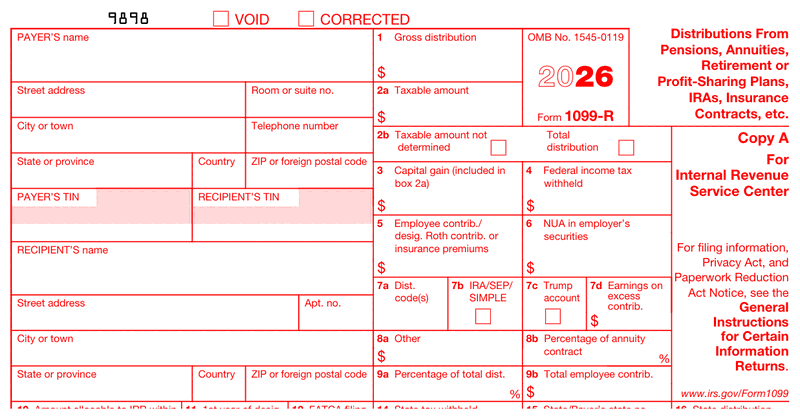
The distribution code is the most important character on the form, in Box 7a on the 2026 revision and Box 7 before it. The 1099-r distribution codes tell the IRS what kind of retirement distribution occurred, and they drive whether tax and penalties apply. As of the 2025 form there are 30 codes, and two can appear together.
| Code | Meaning | Typically Taxable? |
|---|---|---|
| 1 | Early distribution, no known exception | Yes, plus 10% penalty |
| 2 | Early distribution, exception applies | Yes, no penalty |
| 3 | Disability | Yes, no penalty |
| 4 | Death | Yes to the beneficiary, no penalty |
| 5 | Prohibited transaction | Yes |
| 6 | Section 1035 exchange | No, reported with $0 taxable |
| 7 | Normal distribution | Yes if pre-tax |
| 8 | Excess contributions or deferrals, current year | Yes |
| 9 | Cost of current life insurance protection | Yes |
| A | May be eligible for 10-year tax option | Special calculation |
| B | Designated Roth account distribution | Depends on holding period |
| C | Reportable death benefits under 6050Y | Varies |
| D | Nonqualified annuity, subject to 1411 tax | Yes |
| E | Distribution under EPCRS | Yes |
| F | Charitable gift annuity | Partly |
| G | Direct rollover and direct payment | Generally no |
| H | Direct rollover of Roth to Roth IRA | Generally no |
| J | Early distribution from a Roth IRA | Earnings may be |
| K | IRA assets without readily available FMV | Varies |
| L | Loan treated as deemed distribution | Yes |
| M | Qualified plan loan offset | Yes unless rolled over |
| N | Recharacterized IRA contribution, current year | No |
| P | Excess contributions taxable in a prior year | Yes, prior year |
| Q | Qualified distribution from a Roth IRA | No, tax-free |
| R | Recharacterized IRA contribution, prior year | No |
| S | Early distribution from SIMPLE IRA, first 2 years | Yes, plus 25% penalty |
| T | Roth IRA distribution, exception applies | Possibly on earnings |
| U | ESOP dividend distribution under 404(k) | Yes |
| W | Charges for qualified long-term care contracts | No |
| Y | Qualified charitable distribution | No |
Do I Have to Pay Taxes on a 1099-R?
Not always. Receiving a 1099-R does not automatically mean you owe tax. Check Box 7a. Code 7 normal distributions from pre-tax accounts are generally taxable, and code G direct rollovers usually are not. Code Q qualified Roth distributions are tax-free, while code 1 adds a 10% early-withdrawal penalty.
Account type sets the baseline. Distributions from a traditional 401(k) or traditional IRA are generally subject to ordinary income tax, because the contributions went in untaxed. A qualified plan distribution before age 59½ typically adds a 10% early distribution penalty. Exceptions apply for disability, death, birth or adoption, and certain education and medical costs.
Roth accounts work differently. You can pull contributions from a roth ira at any time without tax or penalty, since they were funded with after-tax dollars. Earnings are the catch: withdraw them before 59½ or before the five-year holding period closes, and that portion becomes taxable and possibly penalized. When the numbers get complicated, hand the form to a tax professional rather than guessing.
If a distribution is taxable and large enough to create a bill, check whether quarterly estimated taxes apply so you avoid an underpayment penalty.
Rollovers, Transfers, and Plan Loans
Moving retirement funds between accounts still generates a form. A direct rollover from one qualified plan to another is coded G, and a Roth account rolled directly into a Roth IRA is coded H. Neither is usually taxable, but both are reportable.
Take possession of the money yourself and it becomes an indirect rollover. You have 60 days to redeposit it, and the payer withholds 20% federal tax up front. The IRS also allows only one indirect IRA rollover per 12-month period across all your IRAs.
Plan loans have their own trap. Miss the payments and the unpaid balance becomes a deemed distribution coded L, taxable and potentially penalized. A qualified plan loan offset, common after a layoff, is coded M instead. A Section 1035 tax-free exchange shows up as code 6 with a $0 taxable amount.
1099 R Deadlines and Penalties for Payers
Three dates matter. The recipient copy of the 1099 r form is due January 31. Copy A goes to the IRS by February 28 on paper, or March 31 if you file electronically.
Electronic filing isn't optional at scale. Say you file 10 or more information returns of any type in a year. Counting W-2s and 1099s and everything else together, you must file them electronically. That aggregate threshold catches small businesses that would never hit it on 1099-R volume alone.
Sponsors who don't file still have work. Confirm participant addresses, distribution amounts, and termination data with your administrator before year end. A correction after January 31 costs more than getting it right the first time. Box numbering and reporting requirements also shift between tax years, so check the current year's form and IRS instructions rather than reusing last year's layout.
How to Get a Copy of Your 1099 R Form
Three reliable paths, in the order worth trying:
- Check mail and email around January 31. Most payers post electronic copies between January 31 and early February, with paper following.
- Log in to the plan portal. Your recordkeeper's tax documents section holds the PDF. Fastest route, and it works at 11pm.
- Contact the plan administrator or HR. If the form never arrived, request a duplicate directly from the payer.
Save the PDF to a dedicated tax folder the day it arrives, set a late-January reminder, and bookmark the portal login. It's usually a separate site from your main banking dashboard.
If There's an Error on Your Form
Contact the payer or plan administrator, not the IRS. They issue the correction, and the replacement arrives with the CORRECTED box checked at the top. Catch it before the deadline and wait for the corrected copy rather than filing on numbers you know are wrong. A wrong Box 1 or Box 7a code means the IRS taxes the distribution incorrectly, and unwinding that takes longer than waiting a week.
Which Tax Year Form 1099-R Do You Need?
Form 1099-R is one of the few information returns with a genuine annual version: the year is printed on Copy A. A search for "1099-R form 2025" and one for "1099-R form 2026" point at two different documents. Match the form to the year the distribution was paid, not the year you file it.
The 2026 form is not a reprint. Address fields split into separate entry boxes. Box 7 and the IRA/SEP/SIMPLE checkbox are renumbered 7a and 7b, with new box 7c (Trump account) and new box 7d (Earnings on excess contributions). Box 8 and its percentage box become 8a and 8b, and entering the year-end value of an annuitized commercial annuity in box 8a is not required for tax year 2026. If your recordkeeper maps fields from an older layout, that is where errors surface.
| Deadline | Tax year 2025 | Tax year 2026 |
|---|---|---|
| Statement to the recipient | February 2, 2026 | February 1, 2027 |
| Copy A to the IRS, paper | March 2, 2026 | March 1, 2027 |
| Copy A to the IRS, e-file | March 31, 2026 | March 31, 2027 |
Form 8809 filed by the original due date buys an automatic 30 days from that date, with a possible second 30 days on hardship; the IRS publishes no fixed extended date. Form 5498 runs on its own May 31 / June 1 calendar, so keep the two apart.