
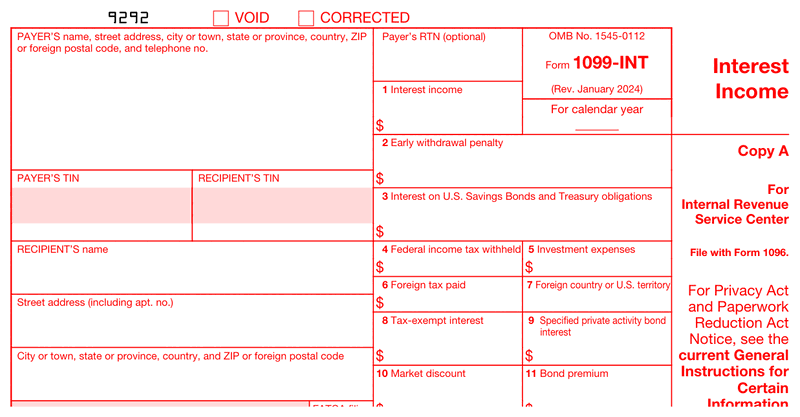



1099-INT at a Glance

  • Issue a 1099-INT to anyone you paid $10 or more in interest. For trade-or-business interest the printed figure is $600, but confirm it against the current Guide to Information Returns first.
  • Box 1 reports ordinary taxable interest. Box 3 reports Treasury and savings bond interest, which is usually exempt from state tax.
  • For tax year 2026, recipient copies are due February 1, 2027, paper filing March 1, 2027, and electronic filing March 31, 2027.
  • Filing 10 or more information returns of any type means electronic filing is mandatory.
blue dollar money icon 100% Money-Back Guarantee

We understand that satisfied customers are loyal customers and we strive to provide you with high quality documents.

blue unlock secure payment icon 100% Secure Payment

Our secure payment method provides you with the utmost security, the ease and the peace of mind you deserve.

blue conversation bubble icon 100% Customer Satisfaction

Having our customers at the core of our business, we make sure that our experienced customer care team is on call 24/7.

Most business owners meet Form 1099-INT from the receiving end, then get caught off guard when they turn out to be the one who has to issue it. The threshold is lower than almost anyone expects. Ten dollars of interest on a deposit account triggers it. For interest paid in the course of a trade or business the January 2024 instructions print $600, but that figure predates recent law changes, so confirm the current one before you rely on it. Carried a note on a property sale? Financed equipment for a customer? Paid interest on a shareholder loan? You may owe someone a 1099 INT, and PayStubs.net can generate it.

Handle interest income reporting correctly and it's a short administrative task. Handle it wrong and you're funding backup withholding out of pocket and answering IRS notices in the spring.

What Is a 1099 INT Form?

A 1099 INT form is an IRS information return that reports interest income paid during the tax year. The payer, usually a bank or a business, files Copy A with the IRS and sends Copy B to the recipient. You must issue one for $10 or more in interest. The trade-or-business figure is printed as $600 in the January 2024 instructions, which predate recent law changes, so check the current Guide before relying on it.

The form does one job. It tells the Internal Revenue Service how much interest changed hands and between whom. It carries the payer name, address, and taxpayer identification number, the same details for the recipient, and the amounts split into numbered boxes. Accuracy matters on every copy, because the IRS matches what you report against what the recipient reports.

You'll see this tax form written several ways. Form 1099 INT, 1099-INT, and even 1099int with no space at all refer to the same document.

1099 INT Meaning in Plain Terms

Think of the form as a receipt that the government also received a copy of. That's the short answer to "what is 1099-INT" for anyone already holding one. The follow-up, "what is 1099 INT used for," is just as simple: it tells the IRS how much taxable interest to expect on someone's return. It isn't a bill, and it isn't a tax return of its own.

What Is Interest Income?

Interest income is money earned for letting someone else use your funds. It includes interest from savings and checking accounts, certificates of deposit, money market accounts, Treasury securities, and loans your business makes to others. Nearly all of it is taxable at the federal level, even when no form arrives.

That last point catches people out. The reporting threshold and the taxability rule are two different things. A bank isn't required to send anything under $10, but the income is still reportable.

Interest Income Meaning and Scope

For a business, the concept runs broader than a savings account statement. Hold several accounts across different institutions, each earning a few dollars, and no single one generates a form, yet the total still belongs on your return. The IRS interest income definition also reaches seller-financed mortgages, private notes, and interest a customer pays you on an overdue balance. When you report 1099 interest income, the figure should reflect everything you earned, not just the amounts that produced paperwork. Those totals feed your quarterly estimated tax math too.

Who Must File a 1099-INT (and Who Just Receives One)

These are two different obligations, and most pages blur them together.

You must file if you're a bank, credit union, broker, or other financial institution paying $10 or more in interest to a person or entity. Businesses outside the financial sector file at the trade-or-business threshold, printed as $600 in the January 2024 instructions. Confirm the current figure before you decide not to file. Withheld backup withholding or foreign tax? File regardless of the amount.

You simply receive one if you're an account holder, CD owner, bondholder, or investor, or an individual who financed a sale and collected interest on the note.

A 1099-INT From Bank Accounts and Credit Unions

Individuals typically see theirs arrive in late January. Many institutions post the form to online banking before the mailed copy shows up, so check the portal first. Small business owners running several accounts should watch the under-$10 gap: no form gets issued, but the interest is still taxable and has to be totaled manually.

Why Make Your Form 1099-INT Here?

Guided fields

Plain-English questions in the order the form expects them, with format checks as you type.

Automatic math

Totals, taxes and carryovers calculate themselves. No arithmetic, no transposition errors.

Print-ready PDF

Preview the finished document free, then download it the moment your payment goes through.

Form 1099-INT preview

How Do I Create My Form 1099-INT?

  • Enter your details

    Answer guided, plain-English fields. The math is calculated for you.

  • Preview your form

    Check a live preview of the finished document before you pay.

  • Download your PDF

    Get a print-ready PDF the moment your payment goes through.

What
people
say

5.0 Rating

559 Reviews

white tick in green background icon Verified User
smiley-face James Oliver

Great

Published Apr 22, 2023
white tick in green background icon Verified User
smiley-face Sherry Logan

Paystubs.net is the best! They take care of all my pay-stub needs.

Published May 26, 2023
white tick in green background icon Verified User
smiley-face Jay Price

I love this website! Its the most reliable & Ive been using it for a few years now. Its the best one out there. Thanks :)

Published Apr 26, 2023
white tick in green background icon Verified User
smiley-face Mark Patterson

Fast - Easy

Published May 05, 2023
white tick in green background icon Verified User
smiley-face Sharolene Bantaculo

they are very helpful.

Published Jul 22, 2023

Everything To Know About Form 1099-INT


1099-INT Box-by-Box Breakdown

Most people who land here have the form in hand and just need to know what one specific box means.

Box What it reports
Box 1 Taxable interest not included in Box 3. Ordinary bank, CD, and business interest.
Box 2 Early withdrawal penalty. Interest or principal forfeited for cashing a time deposit like a CD early.
Box 3 Interest on U.S. Savings Bonds, Treasury bills, notes, and bonds.
Box 4 Federal income tax withheld, which in practice means backup withholding.
Box 6 Foreign tax paid on interest, reported in U.S. dollars.
Box 8 Tax-exempt interest of $10 or more, typically from state or local government obligations.

Two boxes deserve extra attention. Box 3 income is federally taxable but generally exempt from state income tax, so keeping it out of Box 1 matters to the recipient's state return. Box 2 represents a penalty the recipient can deduct as an adjustment to income, so folding it into Box 1 quietly costs them money.

The FATCA Checkbox

Check this box if you're a U.S. payer reporting on Form 1099 to satisfy your reporting requirement for a U.S. account under chapter 4. Most small business payers never check it. When you're unsure whether it applies, confirm against the IRS instructions for Form 1099-INT rather than guessing.

1099 INT Filing Deadlines and the E-File Threshold

Interest reporting runs on three dates, and they shift when they land on a weekend. For tax year 2026, filed in early 2027:

Obligation Due date
Copy B to the recipient Monday, February 1, 2027
Copy A to the IRS on paper Monday, March 1, 2027
Electronic filing to the IRS Wednesday, March 31, 2027

The first two moved because January 31 and February 28 both fall on a Sunday in 2027. That rollover is a standing rule rather than a one-off: when a due date lands on a weekend or legal holiday, the next business day applies.

One threshold now catches smaller filers. File 10 or more information returns of any type combined, counting W-2s and 1099s together, and electronic filing becomes mandatory. That aggregate limit dropped from 250 for returns required to be filed on or after January 1, 2024, and it pulls in businesses that used to mail a small stack of paper without a second thought.

How to Create a 1099 INT Form Online

Producing the document yourself takes three steps.

  • Enter the details. Payer name, address, and TIN, then the recipient's, followed by the amounts for each box.
  • Preview the result. Check the figures and the box placement before you commit. Errors are far cheaper to fix here than after a recipient has filed.
  • Download the PDF. Save it to your records and deliver the recipient copy.

Our 1099 INT generator handles the layout so the document comes out clean and readable instead of hand-typed onto a blank template. One caveat worth knowing: a downloaded PDF works for the recipient copy and your own records, but paper filing Copy A with the IRS requires the official scannable form. Filing electronically sidesteps that problem entirely. Need employee pay documentation in the same sitting? Our pay stub templates cover the payroll side of your records.

Common 1099-INT Filing Mistakes to Avoid

Five errors account for most interest reporting problems.

  • A missing or mismatched TIN. Names and taxpayer ID numbers that don't line up with IRS records trigger backup withholding obligations and CP2100 notices. Collect a W-9 before you pay, not after.
  • Printing Copy A from the website. The downloadable Copy A isn't scannable. Paper filers need the official version from the IRS, or they file electronically instead.
  • Skipping the FATCA checkbox. It applies narrowly, but leaving it blank when it does apply is a reporting failure.
  • Paper filing over the threshold. Ten aggregate returns and up means electronic filing, not envelopes.
  • Swapping payer and recipient fields. On a 1099-INT form the payer is the party that paid the interest out. Reversing the two assigns income to the wrong taxpayer, and it's a common data entry slip.

Nominee Interest: When You Must Issue a 1099-INT

Here's the situation almost nobody plans for. You hold a joint or partnership account, the 1099-INT arrives with your Social Security number on it, but part of that interest belongs to someone else.

Report the full amount on Schedule B, line 1, then enter a subtotal. Below it, write "Nominee Distribution" with the share that isn't yours and subtract it. The remainder carries to line 2.

Then comes the part that creates real work. You also have to furnish a 1099-INT to the actual owner, unless that person is your spouse, and file it with the IRS along with Form 1096. A shared business account can quietly turn you into a payer. The Schedule B instructions walk through the mechanics.

Which Form 1099-INT Revision Do You Need

Searches for "1099-INT form 2025" and "1099-INT form 2026" both land on the same document. There is no annual Form 1099-INT. The IRS put it on continuous use, and the current revision is January 2024 for both tax years. The year in the search refers to the tax year of the interest you paid, not to a separate version of the form. It shares one instruction document with Form 1099-OID, and those instructions carry no What's New section at all, so nothing about the form itself has changed.

What does move between years is the calendar, and only because of weekend rolls. Interest paid in 2025 required recipient copies by February 2, 2026, paper filing by March 2, 2026, and electronic filing by March 31, 2026. The 2026 dates appear in the deadline table above.

Two things worth checking before you issue. New vehicle loan interest reporting under section 6050AA does not go on this form: the IRS created Form 1098-VLI (Vehicle Loan Interest Statement) for $600 or more of specified passenger vehicle loan interest. And while the $10 threshold is settled, the $600 trade-or-business figure is what the January 2024 instructions print, and those predate recent law changes. Confirm it against the current Pub. 1099, Guide to Information Returns, before you rely on it.

Form 1099-INT Questions, Answered

Do I have to report interest income under $10?

Yes. The $10 figure is a payer's reporting threshold, not an exemption for the recipient. Banks aren't required to issue a form below it, but the interest remains taxable income and belongs on your return. Total up small amounts across accounts yourself.

What happens if I file a 1099-INT late?

Penalties are charged per return and scale with how late you are, climbing further if the IRS finds intentional disregard. Filing late still beats not filing at all. When you catch a missing return after the deadline, submit it right away rather than waiting for the next season.

Is interest from a Treasury bond taxed by my state?

Generally no. Interest reported in Box 3 from Treasury bills, notes, and bonds is subject to federal income tax but exempt from state and local income tax. That difference is exactly why Box 3 is kept separate from Box 1.

What is a 1099-INT versus a 1099-DIV?

A 1099-INT reports interest paid on deposits, bonds, and loans. A 1099-DIV reports dividends and distributions from stocks and funds. Different income types, different forms, and a single institution may well send you both in the same envelope.

Can I issue a 1099-INT without the recipient's Social Security number?

You shouldn't file with a blank TIN. Request a completed W-9 first. If the recipient refuses to provide one, you're required to begin backup withholding at 24% on the interest paid and still file the return with the information you have.

Preview free, pay at download.

When you need the document itself, the 1099 INT form generator on this page produces a clean, accurate copy you can preview before downloading. Handling payroll documentation as well? Our paystub generator covers employee pay records in the same place.

No subscription — you pay per document, only when you download.

  • Guided fields with automatic math
  • Free live preview before any payment
  • 100% money-back guarantee
Experiencing a problem?

Fill out our contact form and we will get back to you soon.

Contact Us
Lost your order?

No need to panic! You can resend your order for free.

Resend Your Order

Jaden Hi! How can I help you?

Hello from our chat team!

To best assist you, please fill out the form, and we'll get back to you swiftly.
Start the chat