








1099-DIV Instructions: How to Fill Out the Form
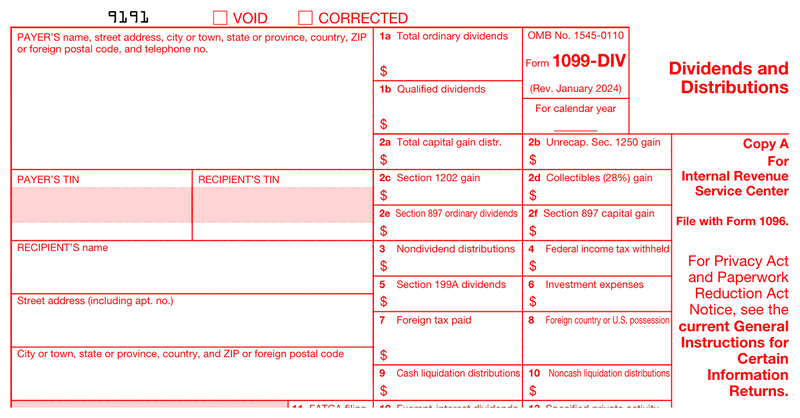
Start with the two identity blocks at the top of the form. The payer block takes your business name, address, and TIN. The recipient block takes their name, address, TIN, and account number if you use one. An incorrect TIN is the single most common reason a 1099-DIV form gets rejected. Collect it up front with a fillable W-9 so you're not chasing numbers in January.
From there, the 1099 DIV instructions come down to putting each dollar in the right box:
| Box | What goes in it |
|---|---|
| 1a | Total ordinary dividends paid for the year |
| 1b | The portion of Box 1a that qualifies for lower rates |
| 2a | Total capital gain distributions |
| 2b to 2f | Unrecaptured Section 1250 gain, Section 1202 gain, collectibles gain, and Section 897 amounts |
| 3 | Nondividend distributions, meaning a return of the shareholder's capital |
| 4 | Federal income tax withheld under backup withholding |
| 5 | Section 199A dividends, where any of Box 1a qualifies |
| 7 and 8 | Foreign tax paid, and the country or U.S. possession it went to |
| 9 and 10 | Cash and noncash liquidation distributions |
| 12 | Exempt-interest dividends from a mutual fund or other RIC |
| 13 | Specified private activity bond interest dividends, which also count toward the Box 12 total |
| 14 to 16 | The state, your state identification number, and the state tax withheld |
Leave a box blank rather than entering a zero. Once your form is complete, check Box 1a against your distribution ledger. That total drives everything downstream.
Types of Dividends on Form 1099 DIV
Every payout you report falls into one of three categories. The category decides the rate the recipient pays.
Ordinary dividends go in Box 1a and are taxed at regular income tax rates. Qualified dividends go in Box 1b and are taxed at the lower long-term capital gains rates. That's why the split matters. Capital gain distributions, common from mutual funds, go in Box 2a and also get long-term treatment. Get the category wrong and you don't just create a correction later. You move real money between rate brackets. If your business issues more than one kind of 1099, the 1099-MISC and 1099-NEC comparison covers the other forms you may owe.
Where 1099-DIV Numbers Go on a Tax Return
Recipients carry Box 1a and Box 1b onto Form 1040. If their total dividend and interest income is large, they may also need Schedule B. Point them to the current-year Form 1040 instructions for that threshold rather than guessing at it.
One clarification worth making, because it's a common mix-up: are dividends tax deductible? No. They're taxable income to the person receiving them. For the corporation paying them out, they generally aren't a deductible business expense either, unlike interest on business debt.
Do You Pay Taxes on Dividends That Are Reinvested?
Yes. Dividends reinvested through a DRIP are taxable in the year they are credited to your account, even though no cash reached your bank. They appear in Box 1a of Form 1099-DIV, and Box 1b if qualified. The reinvested amount becomes the cost basis of your new shares.
This is where most confusion starts. Shareholders and business owners ask the same thing every spring: if you reinvest dividends are they taxable? The money never hit a bank account, so it doesn't feel like income. The IRS treats it as income anyway, because the account holder controlled where it went. Choosing to buy more shares is a use of the money, not a deferral of it.
Dividend reinvestment tax treatment has one detail worth flagging to recipients. The reinvested amount establishes the cost basis of the newly purchased shares. That basis reduces the taxable gain when those shares are eventually sold, so it's genuinely worth tracking. As the payer, your obligation is simpler but unforgiving. Reinvested amounts belong in Box 1a exactly as though you'd cut a check. If the totals don't match their statements, shareholders bring the questions back to you.
1099 DIV Form Deadlines for the 2027 Filing Season
Three dates govern the 2027 cycle, and they aren't the same date:
- February 1, 2027 for recipient copies
- March 1, 2027 for paper filing with the IRS
- March 31, 2027 for electronic filing with the IRS
The first two shift slightly from the dates you may have memorized. The recipient deadline is normally January 31, and the paper deadline is normally February 28. When either falls on a weekend or holiday, it rolls to the next business day. In 2027 both land on a Sunday. That's why they read as February 1 and March 1 this year. Build your schedule around the recipient date; it arrives first and carries its own penalty.
After You File: Recipient Copies, Extensions, and State Filing
Recipient copies go out by postal mailing. You can send them by email instead, but only if the recipient agreed to it first.
Form 8809 buys an automatic 30 extra days to file with the IRS, with no justification needed, as long as you file the request by the original due date. A second 30 days is possible only on a hardship showing. Form 15397 requests more time to send recipient copies. Both must be requested before the relevant deadline.
State filing varies more than people expect. Some states want their own copy. Some accept the Combined Federal/State Filing Program. Others require nothing at all. Because state tax interacts with your federal filing, confirm your own state's rule before you mail anything. If you withheld state tax, Boxes 14 through 16 need to match what you actually remitted.
Penalties for Late or Missing 1099 DIV Forms
The IRS charges penalties per form. The tiers go up the longer a form stays unfiled. File a few weeks late and the per-form amount is modest; let it run past August and it climbs sharply.
Here's the part businesses miss. Failing to send the recipient copy is penalized on its own, apart from failing to file with the IRS. One lapse can trigger both. Intentional disregard carries a much higher penalty with no annual cap. Penalty amounts adjust for inflation. Check the current IRS figures rather than relying on a number you saw a few years ago. Sloppy information returns also sit alongside other IRS audit red flags, so accuracy pays twice.
Why Use Our 1099 DIV Generator
Our generator produces a completed, print-ready PDF using the correct current-year layout. You're not rebuilding a form in a spreadsheet or hand-checking box alignment. It's built for speed and ease when you have several recipients to get through.
Gather these before you start, and you'll finish in one sitting:
- Payer name, address, and TIN
- Recipient name, address, and TIN
- Box 1a and Box 1b amounts from your distribution records
- Box 4 federal tax withheld, if any
- Box 7 foreign tax paid, if applicable
- State withholding details, if you withheld
Filing other information returns this season? Our 1099 generator covers the rest of the series. If you run payroll alongside your dividend payments, our paystub templates handle that side of the paperwork.
One note on scope: this tool creates the completed form for you to file or distribute. It doesn't transmit the form to the IRS on your behalf.
Which Version of Form 1099-DIV Do You Need?
Searches for a "1099 DIV form 2025" or a "1099 DIV form 2026" are hunting for a document that doesn't exist. There is no annual Form 1099-DIV. The IRS issues it as a continuous-use form, and the current revision is January 2024. That single revision covers dividends you paid in 2025 and dividends you pay in 2026. The year in the search refers to the tax year of the payments, not to a separate form.
So the version in front of you is the right one. You enter the tax year yourself. The boxes, the $10 reporting threshold, and the $600 liquidating distribution threshold are identical across both years.
What does shift by year is the calendar you file against. For dividends paid in 2025, recipient copies were due February 2, 2026, and IRS copies were due March 2, 2026 on paper or March 31, 2026 electronically. If you issue consolidated broker statements, that recipient date was February 17, 2026, and WHFIT statements ran to March 16, 2026. For the 2026 tax year those two dates become February 16, 2027 for consolidated statements and March 15, 2027 for WHFIT.
Issuing a late or corrected form for 2025? Use the January 2024 revision. It's the same one you'll use next season.