








How to Get Your 1099 G Form
Most agencies post the form to your online account before mailing anything. Start there, because the portal copy is usually available first and a mailed copy can take an extra week or two.
The delivery deadline is January 31 following the tax year. For payments received during 2026, your form should be available by February 1, 2027, since January 31 that year is a Sunday. If you are chasing a form for an earlier year, the same deadline applied then, so a missing 2025 form is a retrieval problem rather than a waiting problem. If the date has passed and nothing has appeared, check the portal you originally used to claim benefits rather than assuming the form was lost.
One practical tip: search for your state's unemployment tax form using the pattern "[Your State] unemployment 1099-G online." What you want is your state's unemployment insurance portal login, not the general Department of Revenue homepage. This distinction trips up a lot of people, because state tax agencies and state labor agencies are separate bodies that issue different 1099-Gs for different reasons.
If you moved states mid-year or claimed benefits in more than one state, expect a separate form from each agency.
Where to Find Your 1099 G by State
No single government page aggregates this, so here is a consolidated starting point for the highest-volume states.
| State | Issuing agency | Where to look |
|---|---|---|
| California | Employment Development Department (EDD) | Your myEDD account; EDD forms are posted online before paper copies mail |
| New York | NYS Department of Labor | Your NY.gov ID account (unemployment benefits, not the Tax Department) |
| Texas | Texas Workforce Commission | Unemployment benefits account |
| Florida | Florida Reemployment Assistance | State reemployment assistance portal |
| Illinois | Illinois Dept. of Employment Security | State unemployment benefits account |
| Pennsylvania | PA Dept. of Labor and Industry | State unemployment compensation portal |
| Ohio | Ohio Dept. of Job and Family Services | State unemployment benefits account |
| Oregon | Oregon Employment Department | State unemployment benefits portal |
California is worth calling out because the EDD labels the document Form 1099G without a hyphen, so searching for the 1099G form with a hyphen can return nothing on their site. Claimants asking what is 1099G on their EDD account are looking at exactly the same federal document under a different label, so if you typed "1099G what is it" into a search bar and got federal IRS pages back, that guidance still applies to the EDD copy in front of you. New York splits responsibility: the Department of Labor issues the unemployment 1099-G, while the Department of Taxation and Finance issues the one covering state tax refunds. If you had both, you will receive two forms from two different agencies.
1099 G Box-by-Box Breakdown
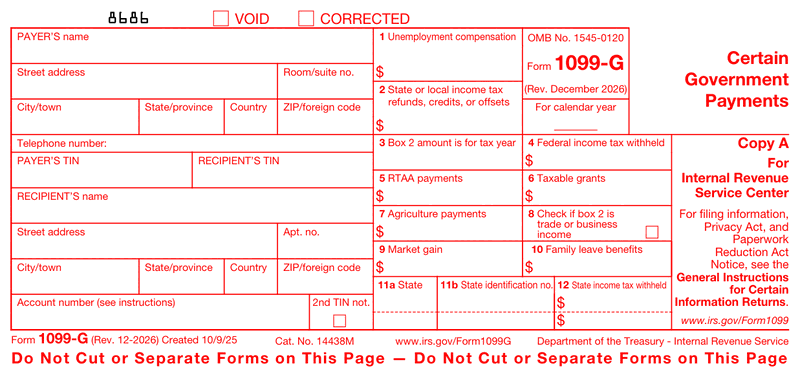
Every box on the 1099-G form, in plain terms. Check the revision date printed at the bottom left of your copy before matching amounts to any table, including this one, since the IRS renumbers boxes from time to time.
| Box | What it reports |
|---|---|
| 1 | Total unemployment compensation paid to you during the year |
| 2 | Refunds, credits, or offsets of state or local income tax |
| 3 | The tax year the Box 2 amount relates to, if not the current year |
| 4 | Federal income tax withheld from your payments |
| 5 | Reemployment trade adjustment assistance (RTAA) payments |
| 6 | Taxable grants from a federal, state, or local government |
| 7 | Payments from the Department of Agriculture |
| 8 | Checkbox: the Box 2 amount relates to a trade or business you operate |
| 9 | Market gain, which relates to repayment of certain Commodity Credit Corporation loans |
| 10 | Family leave benefits paid by a state paid family and medical leave program |
| 11a | The state issuing the payment |
| 11b | The payer's state identification number |
| 12 | State income tax withheld |
Boxes 1 and 2 carry the amounts most people are looking for. Boxes 4 and 12 show tax already withheld, which is money you have effectively prepaid and will get credit for. Box 3 tells you which year a refund came from, since a refund received in one year often relates to the previous year's return.
The numbering above changed recently, and this is the single most common source of confusion right now. The IRS added Box 10 for family leave benefits in the December 2026 revision and pushed the state boxes down a slot as a result. If you are holding a form that reports 2025 or earlier payments, it uses the older layout: no Box 10, and the state boxes are 10a, 10b, and 11 instead. Match the revision date at the bottom left of your copy to the right column before you post anything to your books.
Business Grants, Farm Payments, and the Box 8 Flag
The lower boxes are where business owners and their accountants should focus, because they rarely have anything to do with unemployment.
Box 6 reports taxable grants. If your business received a state or local economic development grant, a disaster relief payment, or a similar program disbursement, it typically lands here and is generally included in business income. The question of whether grants are taxable income to a business deserves a closer look, because the answer is not uniform across every program. Box 7 covers Department of Agriculture payments, and Box 9 reports market gain on Commodity Credit Corporation loans, both of which matter for farm operations reporting on Schedule F.
Box 8 is the one most often overlooked. It is a checkbox, not a dollar amount, and when it is checked it means the state tax refund in Box 2 relates to a trade or business you operate rather than your personal return. That changes where the amount belongs on your return, so flag it for whoever prepares your taxes instead of treating Box 2 as automatically personal.
Unemployment Compensation on Your 1099 G
Box 1 is the total of all unemployment benefits paid to you during the calendar year, and it is generally taxable income at the federal level. It goes onto your Form 1040 as part of your total income.
An important detail: Box 1 reflects what was paid, not what you received after deductions. Federal tax withheld from your benefits appears in Box 4 and does not reduce the Box 1 figure. The same applies to benefits later offset to repay an overpayment.
Self-employed people who collected benefits under expanded pandemic-era programs will find those amounts in Box 1 as well. If that describes your year, benefits can affect what you owe at each deadline, so review how to estimate quarterly taxes on 1099 income before your next payment. State treatment varies: some states fully tax unemployment benefits, some exempt them entirely, so the federal answer does not settle your state return.
State Tax Refunds and the Box 2 Rule
Box 2 is the box that causes the most unnecessary panic, because a state tax refund is often not federally taxable at all.
The rule turns on what you did in the prior year. You only report the Box 2 amount as federal income if you itemized deductions, deducted state and local income tax, and that deduction actually reduced your federal tax. If you took the standard deduction in the year the tax was paid, the refund is generally not federally taxable and you do not report it.
Box 3 tells you which tax year the refund relates to, which is what you need in order to look back at the correct return and check how you filed.
Is Your 1099 G Taxable?
It depends on which box the money appears in. Unemployment compensation in Box 1 is federally taxable, and taxable grants in Box 6 usually are too. A state tax refund in Box 2 is only federally taxable if you itemized and deducted that tax in a prior year and the deduction actually lowered your federal tax.
| Payment type | Box | Generally federally taxable? |
|---|---|---|
| Unemployment compensation | 1 | Yes |
| State or local tax refund | 2 | Only if you itemized and deducted it previously |
| RTAA payments | 5 | Yes |
| Taxable government grant | 6 | Yes, usually as business income |
| USDA agricultural payment | 7 | Yes |
| CCC loan market gain | 9 | Yes |
| State paid family leave benefits | 10 | Yes |
State paid family leave benefits are included in your federal gross income. Revenue Ruling 2025-4 requires states to file with the IRS and furnish a Form 1099 reporting these payments once they reach the applicable reporting threshold, and the IRS then added Box 10 to Form 1099-G to carry that reporting. Worth noting: those benefits are not treated as wages for federal employment tax purposes, so they are taxable income without being payroll wages. State disability benefits are usually not taxable, with one notable exception: when disability payments substitute for unemployment benefits, they become taxable. Check the box the amount landed in rather than assuming based on the program name. If the income does turn out to be taxable, our guide to 1099 tax deductions covers what you can offset against it.
Reconciling Form 1099-G With Your Business Records
Treat the form as a claim to be verified, not a settled fact. Agencies make errors, and you are the one who absorbs the consequence at filing time.
Match each amount against your own records: bank deposits for grant funds, your prior-year return for any Box 2 refund, and your benefit payment history for Box 1. If your books and the form disagree, resolve the difference before filing. Keep the form, your supporting deposit records, and any agency correspondence together, since these are exactly the documents requested if the return is later examined.
For businesses that received grant funding across multiple programs, confirm each grant is either reflected on a 1099-G or recorded as income some other way. Grants that never generated a form are still generally taxable, and the absence of a document is not the absence of an obligation.
What to Do If Your 1099 G Is Wrong or Fraudulent
Unemployment identity theft is common enough that a form reporting benefits you never claimed is a realistic scenario. Work through these steps:
- Do not ignore it. The IRS already has the agency's copy. Silence looks like underreporting.
- Contact the issuing agency and request a corrected form. This is the only party that can amend what was reported. Do it in writing where possible and keep the confirmation.
- File with the income you actually received. Do not report fraudulent amounts as if they were yours, and do not delay filing while waiting for the correction to process.
- Watch for an IRS CP2000 notice. This automated letter flags a mismatch between your return and third-party reports. It is a proposed adjustment, not a bill, and you respond with your documentation and the record of your correction request.
The same process applies to ordinary errors, such as a benefit amount that is overstated or a refund attributed to the wrong year.
Create a Form 1099 G Online
If you need a clean copy of a form for your own records, a 1099 g generator produces a properly formatted document from the figures you supply, the same way our 1099 generator handles other forms in the series.
This helps when a paper copy was lost or a state portal has archived an older year. Enter the payer details, recipient information, and amounts exactly as the issuing agency reported them.
One clear limit: a generated copy reproduces what an agency actually paid you, for your own recordkeeping. It does not replace the agency's official filing with the IRS. If the agency's number is wrong, the fix is a corrected form from that agency, not a different number on your copy.
Need other documents while you are organizing your records? Browse our professional pay stub templates and create what you need with accurate calculations built in.
Which Form 1099-G Revision Applies to Your Tax Year
Searching for a "1099-G form 2025" or a "1099-G form 2026" turns up one document, because one document is all there is. Form 1099-G is continuous use: the IRS issues revisions, not annual editions. The year in your search names the tax year of the payments being reported, not a separate form to go find. The current revision is December 2026, and that is the one used to report 2026 payments in early 2027. It is not a drop-in for earlier years, because the box layout shifted, so match the revision to the year you are reconciling rather than assuming the newest copy fits.
The dates do move year to year, and only because of where they fall on the calendar. Agencies must get recipient statements out by February 2, 2026 for 2025 payments and by February 1, 2027 for 2026 payments. Their filings with the IRS run later: for 2025 payments, paper March 2, 2026 and e-file March 31, 2026; for 2026 payments, paper March 1, 2027 and e-file March 31, 2027. Those filing dates are worth knowing, because they tell you when the IRS actually holds the figures it will match your return against.