








Which Forms Form 8809 Extends
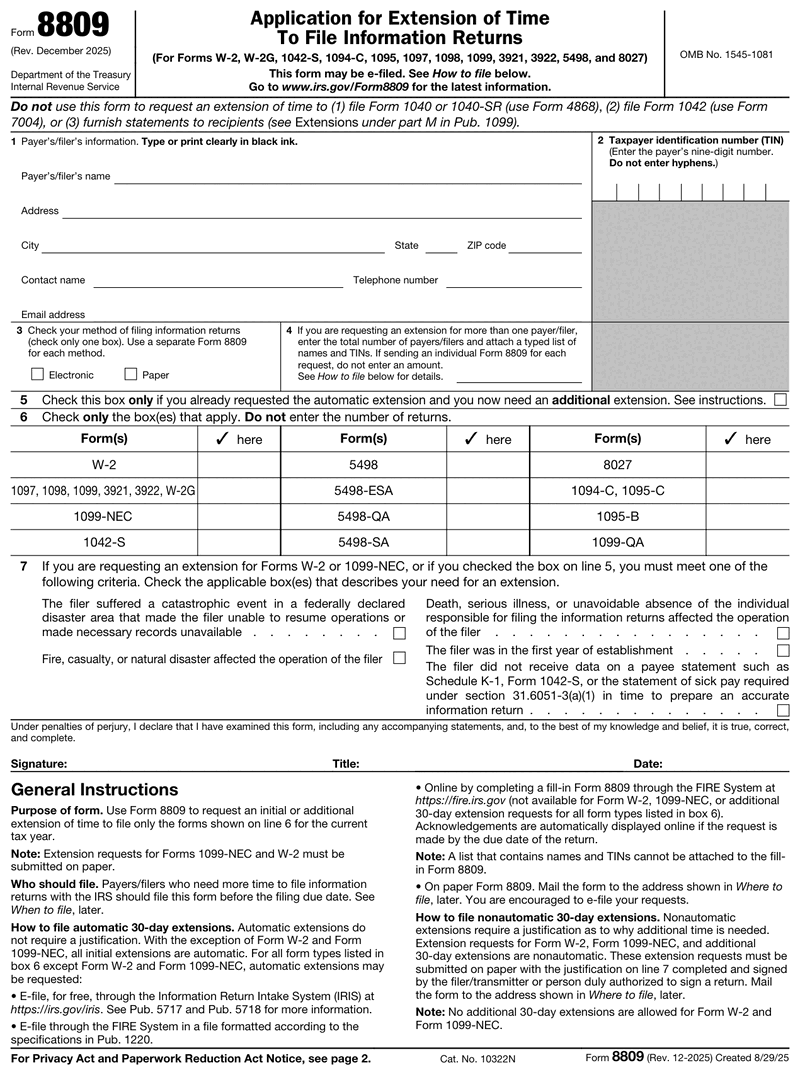
One extension request can cover several form groups at once. Check every box in line 6 that applies. If you are not certain which contractor form you are actually filing, settling the 1099-MISC versus 1099-NEC question first matters here, because only one of them loses the automatic extension. The table below shows what each group gets.
| Form group | Extension type |
|---|---|
| W-2 | Not automatic. Paper request only, hardship criterion required |
| 1099-NEC | Not automatic. Paper request only, hardship criterion required |
| 1097, 1098, 1099, 3921, 3922, W-2G | Automatic 30 days |
| 1042-S | Automatic 30 days |
| 5498, 5498-ESA, 5498-QA, 5498-SA | Automatic 30 days |
| 1099-QA | Automatic 30 days |
| 8027 | Automatic 30 days |
| 1094-C, 1095-C | Automatic 30 days |
| 1095-B | Automatic 30 days |
Automatic means exactly that. No explanation, no justification, no waiting on an approval decision. You file the request by the deadline and the extension applies. Everything on this list except W-2 and 1099-NEC works that way.
If you file Form 8027 on paper, there is one extra step: attach a copy of your timely filed extension request to the return itself.
Form 8809 Due Dates for the 2027 Filing Season
The rule is simple and unforgiving. The request must be filed by the due date of the returns it covers. You also cannot file it before January 1 of the year the return is due, so there is a fixed window.
Deadlines for tax year 2025 returns closed earlier in 2026. The table below is the forward-looking set for tax year 2026 returns, with weekend and holiday rolls already applied.
| Information return | Paper deadline | E-file deadline |
|---|---|---|
| W-2 | February 1, 2027 | February 1, 2027 |
| 1099-NEC | February 1, 2027 | February 1, 2027 |
| 1097, 1098, 1099 (other) | March 1, 2027 | March 31, 2027 |
| W-2G | March 1, 2027 | March 31, 2027 |
| 3921, 3922 | March 1, 2027 | March 31, 2027 |
| 1094-C, 1095 | March 1, 2027 | March 31, 2027 |
| 8027 | March 1, 2027 | March 31, 2027 |
| 1042-S | March 15, 2027 | March 15, 2027 |
| 5498 | June 1, 2027 | June 1, 2027 |
Three of those dates moved. January 31 and February 28 both fall on a Sunday in 2027, and May 31 is both a Monday and Memorial Day, so each rolls to the next business day.
Here is where filers get burned on the form 8809 due date. If you use a single 8809 extension to cover form types with different deadlines, the earliest one governs. Request an extension for Forms 1098 and 5498 together and the whole request is due by the 1098 date in March, not the 5498 date in June. Filing two separate forms avoids the problem entirely.
How to File Form 8809 Electronically
The e-file route runs through the IRS Information Return Intake System (IRIS), which the IRS provides at no charge. The older FIRE system still accepts a fill-in Form 8809, but it is being retired, and IRIS becomes the only information return e-file system after January 1, 2027. Requests for W-2 and 1099-NEC must go in on paper.
That transition is underway right now, and the dates are worth putting on your calendar. The IRS stops accepting new Information Returns Applications for Transmitter Control Codes on July 21, 2026. Existing applications can still be updated through December 2026, after which they go read-only. If your team has been filing through FIRE, you need an IRIS Application for TCC before the 2027 season opens.
Two more rules shape which route you take. First, if you file 10 or more information returns in total, electronic filing is mandatory. If you genuinely cannot comply, the waiver request is Form 8508, and it is paper only. Second, line 3 asks for your filing method, and you need a separate request for each one. Filing some returns electronically and others on paper means two requests, not one.
For the paper route, the Form 8809 IRS mailing address is the Department of the Treasury, Internal Revenue Service Center, Ogden, UT 84201-0209. The IRS Form 8809 PDF on IRS.gov is fillable, so you can complete it on screen before printing and mailing. The Form 8809 instructions are printed on the form itself rather than in a separate document, so the version you download is the complete reference. One note on W-2s specifically: e-filing specifications for those come from the Social Security Administration, not the IRS.
Filers moving records electronically should also know which specification applies to them. Publication 1220 governs the 1099, 1098, 3921, 3922, 5498, and W-2G families, while Publication 1187 covers Form 1042-S. The 8809 instructions point to both, and your transmitter or software provider will expect you to know which one your filings fall under.
The W-2 and 1099-NEC Exception
These two forms follow different rules, and the gap between them and everything else is wide. If your year-end volume is mostly Form W-2 filings, this is the section that governs your calendar. There is no automatic extension for either one. To request more time you have to meet one of five criteria and check the matching box on line 7:
- The filer suffered a catastrophic event in a federally declared disaster area.
- Fire, casualty, or natural disaster affected the filer's operation.
- Death, serious illness, or unavoidable absence of the person responsible for filing affected operations.
- The filer was in its first year of establishment.
- The filer did not receive data on a payee statement, such as a Schedule K-1 or Form 1042-S, in time to prepare an accurate return.
Those requests must be submitted on paper, and there is no second bite. Other form types can get an additional 30 days beyond the first extension. W-2 and 1099-NEC get one 30-day extension at most, if approved at all.
The practical takeaway for planning: treat February 1, 2027 as fixed for both forms. Build your process to hit it rather than counting on an extension that may never come.
Requesting One Form 8809 Extension for Multiple Payers
Accounting firms and multi-entity businesses routinely file for several payers at once. Line 4 handles that without a separate form for every entity: enter the total number of payers and attach a typed list of their names and TINs.
There is a constraint attached to that, and it drives your filing route. A list cannot be attached to the online fill-in version of the form. So the moment you are covering multiple payers on a single request, the fill-in path stops working and you are looking at an electronic file submission or paper.
Two things are worth confirming before you send a consolidated request. Every TIN on the list has to be correct, because one bad number can put that payer's extension in question while the rest go through, so verify any entity where you are unsure how to find the EIN before the list goes out. And the earliest-due-date rule still applies across the whole request, so a single payer with 1099-NEC obligations pulls the entire filing forward.
What Form 8809 Does Not Extend
Four common filings fall outside this form, and assuming otherwise creates real exposure.
Recipient statements. The extension covers your deadline to file with the IRS. It does nothing for the deadline to furnish copies to your recipients. Extending that is a separate request handled under part M of Publication 1099. Filers who assume one covers both end up late on statements while their IRS filing is comfortably on time. The exposure grows with headcount, so businesses issuing to a mix of W-2 employees and 1099 contractors should track the two dates separately.
Form 1042. A form 1042 extension goes on Form 7004, not this one. Only Form 1042-S, the recipient-level statement, is covered by the 8809. The two forms sound alike and are handled completely differently.
FATCA reporting. Extensions for Form 8966 go on Form 8809-I. The numbering makes the two look like siblings, but the Form 8809 I application is filed separately and does not ride along with your other information returns.
Individual returns. Form 1040 and 1040-SR extensions use Form 4868.
Common Form 8809 Mistakes That Get Requests Rejected
Most rejected requests fail on mechanics rather than eligibility. Four issues account for the bulk of them.
Hyphens in the TIN. Line 2 asks for nine digits with no hyphens. Entering the number the way it appears on your EIN letter is the single most common formatting error on the form.
One form covering two filing methods. Line 3 is not optional. Electronic and paper filings each need their own request.
A missing signature. Automatic extensions do not need one. Nonautomatic requests, meaning W-2, 1099-NEC, and any additional 30-day request, require a signature, title, and date. An unsigned nonautomatic request is not a valid request.
Filing after the deadline. This is the one with no remedy. The IRS cannot grant an extension for a request that arrives after the returns were due. There is no late-filed extension and no retroactive relief.
Sloppy information return filing draws attention you do not want, and late or mismatched returns sit alongside the other IRS audit red flags that raise a business's profile. A filed extension is the cheapest way to stay clear of that list.
Using a Form 8809 Generator
An 8809 generator handles the parts of the form that cause rejections. Fields are guided, the TIN is formatted correctly by default, and the box 6 groups are laid out so you check the right ones for the returns you actually file. For a form filed once a year under deadline pressure, that removes the failure points that matter.
Pricing is straightforward with no subscription, which suits a document most businesses touch once or twice a year. The same applies to the returns the extension buys you time for, whether that means running a 1099 generator or preparing the underlying wage records.
One boundary worth stating plainly. A form 8809 fillable tool produces a completed, correctly formatted document. Transmission is still a separate step, through IRIS or through the mail to Ogden, depending on your filing method and which forms you are covering. Any tool that suggests otherwise is overselling.
The wage records feeding those returns deserve the same treatment. Our paystub templates keep employee documentation consistent across pay periods, which is what makes year-end reporting a data-entry task instead of a reconstruction project.
Which Form 8809 Revision Do You Need?
There is no annual Form 8809. The IRS does not reissue it each filing season, so a search for a 2025 Form 8809 or a 2026 Form 8809 is looking for a document that does not exist. The current revision is December 2025, and the one it replaced was August 2020.
The year in those searches belongs to the information returns you are extending, not to the extension form itself. If your team is buying more time on tax year 2026 returns filed in early 2027, you file that same December 2025 revision, and the dates that govern you are the underlying return due dates in the table above.
Nothing about the deadlines changed when the revision did. The due-date chart in the December 2025 revision is identical line for line to the chart in the August 2020 version, and the 30-day extension structure is unchanged. The updates are procedural: IRIS was added as a free e-file channel alongside FIRE, the header changed from "This form may be filled out online" to "This form may be e-filed," and an explicit note was added that extension requests for Forms 1099-NEC and W-2 must be submitted on paper. If your team has an older copy on file, swap it out, but do not expect a different calendar.