



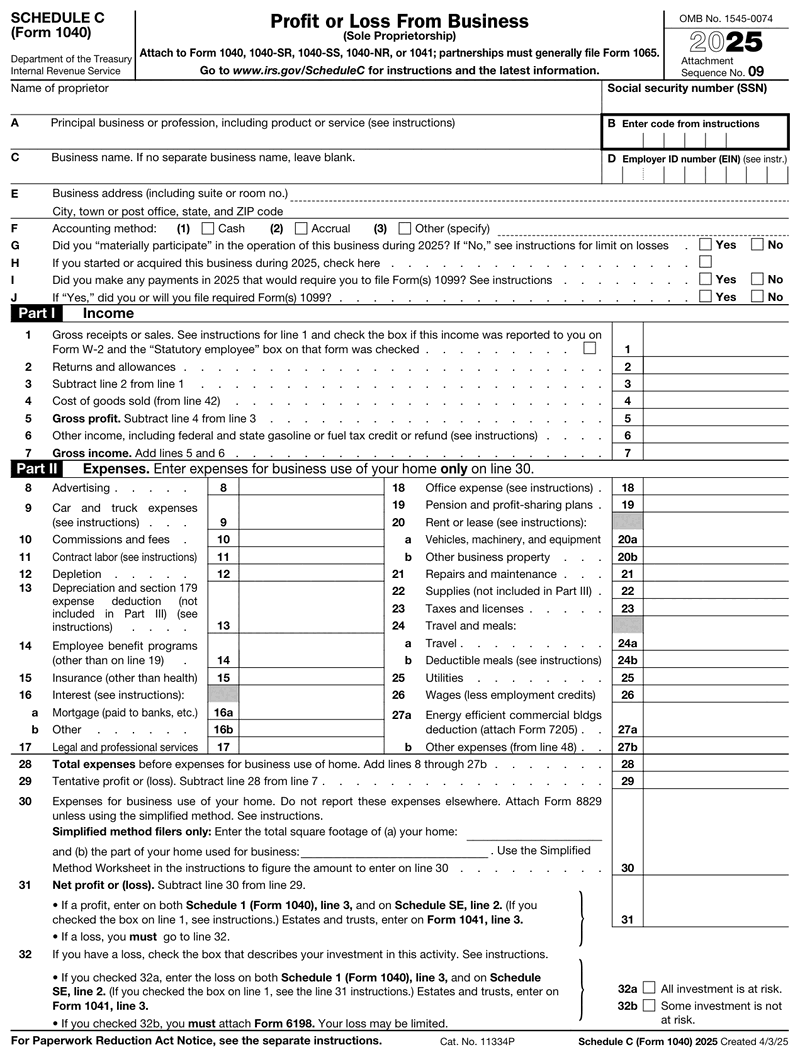





How to Complete Schedule C: Step by Step
The IRS Schedule C instructions can look dense, but the form follows a clear order. Work through it in parts, and each number builds on the last. Here's the sequence that matters.
Part I: Report Your Income
Start with gross receipts, the total your business took in. Subtract returns, allowances, and your cost of goods sold to reach gross profit. Add any other business income, and Part I gives you a single income figure. For gig work, this is where your 1099-NEC and 1099-K totals go.
Part II: Deduct Your Expenses
Here you group your spending into the expense categories the IRS recognizes: advertising, supplies, insurance, contract labor, and more. Total them up, and the form subtracts that total from your income. Accurate expense entry here is what lowers your taxable Schedule C income, so don't leave legitimate deductions on the table.
Parts III to V and Net Profit
These final parts capture cost of goods sold detail, vehicle information, and any other expenses that don't fit above. Everything lands on Line 31: your net profit or loss. That single number is the whole point of the form. A generator runs the Gross Profit to Total Expenses to Net Profit chain for you, so one mistyped line doesn't cascade through the rest.
Generate your Schedule C now and let the math take care of itself.
Business Expense Deductions You Can Claim
Every legitimate deduction lowers both your income tax and your self-employment tax, which is why this section deserves your attention. Track your business expenses through the year and this part fills itself in. Common deductible expense categories include:
- Advertising and marketing
- Car and truck expenses
- Contract labor and commissions
- Supplies and office costs
- Insurance and legal fees
- Home office use
Two deductions trip up business owners most often. For a home office, you can use the simplified method, which is $5 per square foot up to 300 square feet, for a $1,500 cap. Or you can use the regular method on Form 8829 and deduct the actual percentage of your home used for business.
For vehicle costs, you choose between the standard mileage rate and your actual expenses. The 2026 rate changed mid-year: 72.5 cents per mile from January 1 through June 30, then 76 cents from July 1 through December 31, so split your log at the changeover. Whichever you pick, keep a mileage log to back it up.
Schedule C and Self-Employment Tax
Here's the part that surprises new business owners. On top of regular income tax, your net profit is subject to self-employment tax of 15.3%. That breaks down into 12.4% for Social Security and 2.9% for Medicare. It covers the payroll taxes an employer would normally split with you.
The tax applies to your net profit, not your gross revenue, which is another reason accurate deductions matter. There's some relief built in: you can deduct half of your self-employment tax as an adjustment on your Form 1040. If your Schedule C taxes are significant, that deduction softens the blow.
How Schedule C Fits Into Your Tax Return
Schedule C doesn't stand alone. Once you have your net profit on Line 31, that figure moves to Schedule 1, then onto your Form 1040 as part of your total income. Your self-employment tax gets calculated separately on Schedule SE and added to what you owe.
Understanding this flow helps you plan. Your business tax return is really several forms working together, and the Schedule C income you report drives the numbers on all of them. When you know where each figure lands, filing season holds fewer surprises. Attach your completed IRS Form Schedule C to your Form 1040, and you're done.
Deadlines, Penalties, and Record-Keeping
Filing Deadlines and Estimated Tax
Schedule C is due with your Form 1040, normally April 15. For income earned in 2026, that means filing by April 2027. If you expect to owe $1,000 or more, the IRS wants quarterly estimated payments through Form 1040-ES during the year, not one lump sum at filing. Need more time? Form 4868 buys an automatic extension to file, though not to pay.
Penalties Worth Avoiding
Late filing costs 5% of unpaid tax per month, up to a cap. Failure to pay adds 0.5% per month. An accuracy-related penalty runs 20% of the underpayment, and fraud penalties reach 75%. Filing on time and reporting honestly keeps every one of these off your bill.
Records to Keep
Hold onto receipts, bank statements, and your mileage log. Many self-employed owners also keep their own pay stub templates on hand to document the money they draw from the business and prove income when a lender or landlord asks. Keep business and personal accounts separate so your numbers stay clean if the IRS ever asks.
Common Schedule C Mistakes to Avoid
A few errors show up again and again, and each one can cost you money or attention from the IRS:
- Mixing personal and business spending in one account
- Skipping a mileage log, then guessing at vehicle deductions
- Claiming 100% business use on a car or home you also use personally
- Forgetting to issue a 1099-NEC to any contractor you paid $2,000 or more (the threshold rose from $600 for payments made after December 31, 2025)
- Missing quarterly estimated payments and eating an underpayment penalty
Avoid these five, and you've cleared the most common trouble spots.
Which Schedule C Revision Do You Need?
Schedule C is reissued every tax year, so the copy you attach has to match the year your business earned the money, not the year you sit down to file. Searches for "schedule c form 2025" and "schedule c form 2026" point at two genuinely different documents, and the differences land in the expense lines your bookkeeping feeds.
| Tax year | What changed on the form | Due with your Form 1040 |
|---|---|---|
| 2025 (filed in 2026) | Interest splits two ways: 16a Mortgage, 16b Other. Line 27a became "Energy efficient commercial bldgs deduction (attach Form 7205)," with 27b "Other expenses" | April 15, 2026 |
| 2026 (filed in 2027) | Real line change on the draft: interest splits three ways, 16a Mortgage, 16b Vehicle loan, 16c Other | April 15, 2027 |
That new line 16b is for business vehicle loan interest only. The personal car loan interest deduction is claimed on Schedule 1-A, not on Schedule C, so keep a personal auto loan off your business return. The 2026 layout is still a draft, so confirm the line numbers against the final before you file.
The deadline itself never varies by schedule. Schedule C has no due date of its own, it inherits the one belonging to the Form 1040 it attaches to. Filing Form 4868 moves both to October 15, 2026 or October 15, 2027. There is no separate Schedule C extension.