



Form 2106 at a Glance

  • Only four groups can still file Form 2106 after the 2018 tax law change.
  • For reservists, performing artists and fee-basis officials the deduction is above the line, so it lowers AGI even if you take the standard deduction. Impairment-related work expenses are the exception: those go on Schedule A and need itemising.
  • Vehicle costs can be claimed by standard mileage or actual expenses, never both.
  • Reimbursements already excluded from W-2 Box 1 cannot be claimed a second time.
  • Contemporaneous mileage logs are what hold up under IRS review.
blue dollar money icon 100% Money-Back Guarantee

We understand that satisfied customers are loyal customers and we strive to provide you with high quality documents.

blue unlock secure payment icon 100% Secure Payment

Our secure payment method provides you with the utmost security, the ease and the peace of mind you deserve.

blue conversation bubble icon 100% Customer Satisfaction

Having our customers at the core of our business, we make sure that our experienced customer care team is on call 24/7.

Most people who look up Form 2106 discover the same thing: they're no longer allowed to use it. The 2018 tax overhaul eliminated the unreimbursed employee expenses deduction for most W-2 workers, and IRS Form 2106 now belongs to four narrow groups. This page shows which groups those are, what employee business expenses still qualify, and how to complete the form. The pay records you issue are what those claims get checked against.

What Is Form 2106?

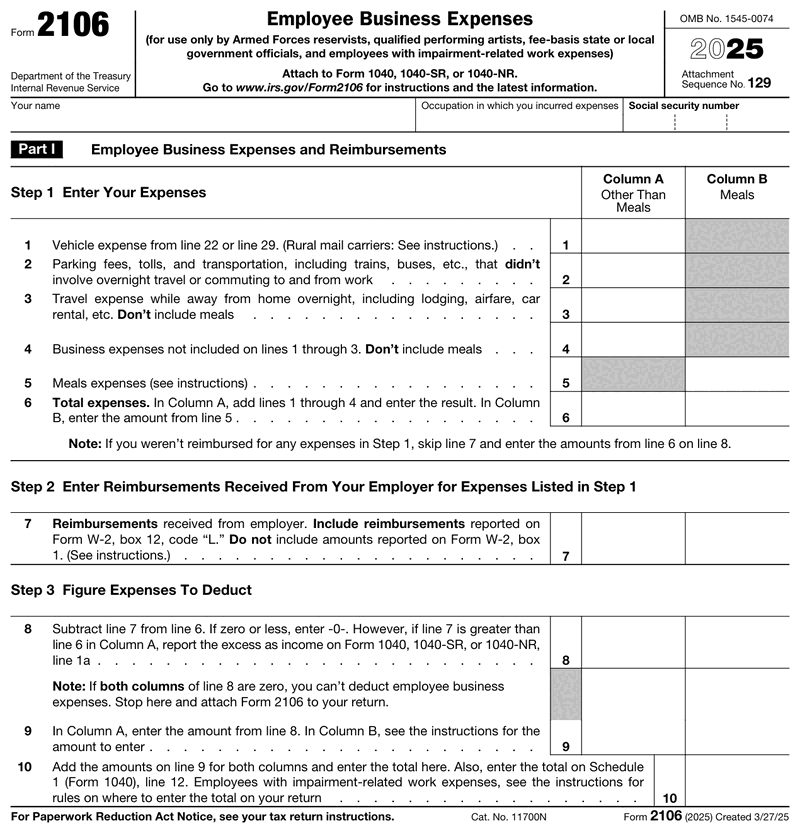
Form 2106, Employee Business Expenses, is the IRS form employees use to deduct ordinary and necessary job costs their employer did not reimburse. The total from line 10 carries to Schedule 1 (Form 1040), line 12, reducing your adjusted gross income whether or not you itemize deductions.

You'll sometimes see it called tax form 2106. Its full title, Form 2106 Employee Business Expenses, describes what the tax document does: it tallies what you spent doing your job and converts the eligible portion into a deduction.

That detail matters. Because the result lands on Schedule 1 as an adjustment to income rather than an itemized deduction, it reduces your AGI even if you claim the standard deduction. For those who still qualify, that's the biggest reason to file.

Who Can File Form 2106 in 2026?

Only four groups can still file Form 2106: Armed Forces reservists traveling more than 100 miles from home, qualified performing artists, fee-basis state or local government officials, and employees with impairment-related work expenses. The 2018 Tax Cuts and Jobs Act eliminated this deduction for all other W-2 employees.

Here's what actually qualifies you:

  • Armed Forces reservists. You're in a reserve component and travel more than 100 miles from home for reserve duty. A National Guard member driving 150 miles to monthly drills qualifies; one driving 40 miles doesn't.
  • Qualified performing artists. You need all four: performing arts work for at least two employers, wages of $200 or more from each of at least two of them, job expenses above 10% of your performing arts gross income, and AGI of $16,000 or less before this deduction. Married filers generally must file jointly.
  • Fee-basis state or local government officials. You're paid wholly or partly on a fee basis rather than a fixed salary. Officials on a straight salary don't qualify.
  • Employees with impairment-related work expenses. Attendant care and similar costs that let you do your job.

If none of those four describe you, the form isn't available.

What Employee Business Expenses Can You Deduct?

Deductible employee business expenses are ordinary and necessary job costs you paid personally without reimbursement: vehicle and local transportation, travel away from home, lodging, parking and tolls, meals subject to limits, and required tools, supplies, or union dues. Commuting between home and your regular workplace never qualifies.

Three conditions, all required: the cost is ordinary and necessary for your work, you paid it yourself, and your employer didn't cover it. Unreimbursed job expenses failing any one don't belong on the form.

For most filers, vehicle costs dominate, and the two methods below produce very different numbers.

Why Make Your Form 2106 Here?

Guided fields

Plain-English questions in the order the form expects them, with format checks as you type.

Automatic math

Totals, taxes and carryovers calculate themselves. No arithmetic, no transposition errors.

Print-ready PDF

Preview the finished document free, then download it the moment your payment goes through.

Form 2106 preview

How Do I Create My Form 2106?

  • Enter your details

    Answer guided, plain-English fields. The math is calculated for you.

  • Preview your form

    Check a live preview of the finished document before you pay.

  • Download your PDF

    Get a print-ready PDF the moment your payment goes through.

What
people
say

5.0 Rating

559 Reviews

white tick in green background icon Verified User
smiley-face Todd Osgood

Excellent service and provides me with what I need for my techs

Published May 01, 2023
white tick in green background icon Verified User
smiley-face Jay Price

I love this website! Its the most reliable & Ive been using it for a few years now. Its the best one out there. Thanks :)

Published Apr 26, 2023
white tick in green background icon Verified User
smiley-face Jeffrey Kuhl

Perfect

Published May 11, 2023
white tick in green background icon Verified User
smiley-face Sharolene Bantaculo

they are very helpful.

Published Jul 22, 2023
white tick in green background icon Verified User
smiley-face Mark Patterson

Fast - Easy

Published May 05, 2023

Everything To Know About Form 2106


Vehicle Basis and Mileage Methods on Form 2106

What Is Vehicle Basis on Tax Return Forms?

Vehicle basis is what you paid for a vehicle, reduced by any depreciation already claimed. It matters only under the actual expense method on Form 2106 Part II, because depreciation is calculated from it. A $30,000 vehicle used 60% for business has an $18,000 business basis.

Searching for vehicle basis meaning turns up plenty of jargon, so here's the practical version: basis isn't static. Each year you claim depreciation, your basis drops, which affects future deductions and any gain when you sell. Record the purchase price, date, and business-use percentage.

Standard Mileage vs. Actual Expense Method

You get one choice per vehicle, and you can't claim both.

Method How it works Best for
Standard mileage Multiply business miles by the IRS rate for that tax year Lower-cost vehicles; simpler records
Actual expense Deduct the business-use share of gas, insurance, repairs, and depreciation Expensive or heavily used vehicles; requires the basis figure and every receipt

For tax year 2026 the standard mileage rate changed mid-year: 72.5 cents per mile from January 1 through June 30, then 76 cents from July 1 through December 31. It was 70 cents for 2025. Rates change annually and the IRS has revised them mid-year, so confirm the figure for your filing year on the IRS standard mileage rates page rather than reusing last year's number. IRS Publication 463 covers both methods in detail.

Form 2106 Instructions: How to Fill Out the Form

You can download the current-year 2106 form and the official IRS Form 2106 instruction booklet at no cost from the IRS.

Before you start, gather:

  • Total business miles and total miles driven for the year
  • Vehicle purchase date and cost, if you're using actual expenses
  • Receipts for travel, lodging, meals, and other job costs
  • Any reimbursement amounts your employer paid you

Then work through it:

  • Part I, Step 1. Enter expenses by category: vehicle, parking and tolls, travel, meals, and other business costs.
  • Part I, Step 2. Subtract employer reimbursements that weren't already included in your W-2 wages.
  • Part I, Step 3. Calculate the allowable deduction. Line 10 carries to Schedule 1 (Form 1040), line 12.
  • Part II. Complete this only for vehicle expenses. Section B covers standard mileage; later sections handle actual expenses and depreciation.

The form attaches to your Form 1040, so no signatures are needed beyond those on your return. E-filing carries it through automatically.

What Employers and HR Teams Should Know About Form 2106

Employees file this form, but employers largely determine how much of it they can use. The deciding factor is how your reimbursement plan is structured.

Accountable vs. Non-Accountable Plans

Under an accountable plan, employees substantiate costs and return any excess advance. Those reimbursements aren't wages, they stay out of Box 1 of the W-2, and the employee can't deduct them again.

Under a non-accountable plan, you pay a flat allowance with no substantiation. That amount is wages, it lands in Box 1, and an eligible employee may be able to claim the underlying expense.

That choice has real consequences for a reservist or fee-basis official on your payroll. HR should be ready to provide accurate W-2s, a written reimbursement policy, and per-employee expense records that reconcile to what you reported. If your pay records need tightening up, PayStubs.net helps you keep that documentation consistent.

Common Form 2106 Mistakes to Avoid

  • Claiming commuting miles. Driving from home to your regular workplace isn't deductible, regardless of distance. Reservists deduct travel to reserve duty, not the daily commute to a civilian job.
  • Double-claiming a reimbursement. If your employer already excluded it from Box 1 under an accountable plan, claiming it again is a duplicate deduction.
  • Using the form while self-employed. Independent contractors report business expenses on Schedule C. Form 2106 is for employees only.

One habit prevents most vehicle problems: log each trip the same day with the date, destination, business purpose, and miles. Reconstructed logs built in April are the most common reason vehicle claims fail on audit.

Which Form 2106 Revision Your Employees Need

The IRS reissues Form 2106 every year, so "form 2106 2025" and "form 2106 2026" really are different documents. Match the revision to the tax year the expenses were paid in, not the year the return gets filed. One thing did not move: OBBBA section 70110 made the 2%-floor disallowance permanent, so the expected TCJA sunset after 2025 did not reopen the form to ordinary employees. If a staff member asks whether they can claim again, the answer is still no unless they fall into one of the four eligible groups.

What does change by year is the vehicle math. The standard mileage rate splits mid-year in 2026, and the passenger automobile depreciation caps that limit an actual expense claim moved up:

Tax year of the expenses Due with the Form 1040 On extension (Form 4868) First-year auto depreciation cap, with / without the section 168(k) allowance
2025 April 15, 2026 October 15, 2026 $20,200 / $12,200
2026 April 15, 2027 October 15, 2027 $20,300 / $12,300

For payroll and HR the effect lands on your records, not your filings. Keep 2025 and 2026 expense and reimbursement totals on separate lines for any reservist or fee-basis official on your payroll. An employee working from one blended figure cannot complete either revision cleanly.

Form 2106 Questions, Answered

Can you claim mileage on taxes if not self-employed?

Only if you fall into one of the four groups still permitted to file Form 2106: reservists, qualified performing artists, fee-basis officials, or employees with impairment-related expenses. Every other W-2 employee lost this deduction in 2018. Self-employed filers claim mileage on Schedule C instead.

What are employee business expenses?

An employee business expense is an ordinary and necessary work cost you pay personally without reimbursement. Common examples include business travel, lodging, vehicle use, parking, tolls, required tools and supplies, and union dues. Commuting between your home and your regular workplace never counts.

Is there a 2106 generator I can use?

The official fillable Form 2106 and its instructions are available at no charge from the IRS at irs.gov. Whichever tool you use, reconcile the figures against your W-2 and your own mileage and expense records before filing, since you are responsible for what the form reports.

Do I still file Form 2106 if I take the standard deduction?

For reservists, qualified performing artists and fee-basis officials, yes: the deduction is an adjustment to income on Schedule 1 (Form 1040), line 12, so it lowers your adjusted gross income whether you itemize or take the standard deduction. Impairment-related work expenses are the exception, because those go on Schedule A as an itemized deduction instead.

When is Form 2106 due?

Form 2106 is attached to your Form 1040 rather than filed separately, so it follows the same deadline: generally April 15, or October 15 if you have an approved extension. Keep your mileage logs and receipts for at least three years after filing.

Preview free, pay at download.

If you run payroll, the records behind those figures matter as much as the form. Use our pay stub generator to produce accurate, itemized pay documentation your team can reconcile against their W-2. Preview your stub free and pay only when you download it, with no subscription.

No subscription — you pay per document, only when you download.

  • Guided fields with automatic math
  • Free live preview before any payment
  • 100% money-back guarantee
Experiencing a problem?

Fill out our contact form and we will get back to you soon.

Contact Us
Lost your order?

No need to panic! You can resend your order for free.

Resend Your Order

Jaden Hi! How can I help you?

Hello from our chat team!

To best assist you, please fill out the form, and we'll get back to you swiftly.
Start the chat