



Schedule E at a Glance

  • Report supplemental income and loss here: rental real estate, royalties, and income from partnerships, S corporations, estates, and trusts.
  • Rental profit isn't subject to the 15.3% self-employment tax, which is the main advantage over reporting on Schedule C.
  • Active participants can deduct up to $25,000 in rental losses, phased out between $100,000 and $150,000 of modified adjusted gross income.
  • The 2026 return is due April 15, 2027, or October 15, 2027 with an extension.
blue dollar money icon 100% Money-Back Guarantee

We understand that satisfied customers are loyal customers and we strive to provide you with high quality documents.

blue unlock secure payment icon 100% Secure Payment

Our secure payment method provides you with the utmost security, the ease and the peace of mind you deserve.

blue conversation bubble icon 100% Customer Satisfaction

Having our customers at the core of our business, we make sure that our experienced customer care team is on call 24/7.

Rent checks, royalty payments, and a K-1 from a partnership all land in the same place at tax time. Get the numbers wrong on Schedule E and you'll either overpay or invite a closer look from the IRS.

Our Schedule E generator fills the current form online, totals each column, and returns a filing-ready PDF. Our paystub templates handle the payroll side if you pay a manager or helper. Preview it free, pay only at download, no subscription.

What Is Schedule E (Form 1040)?

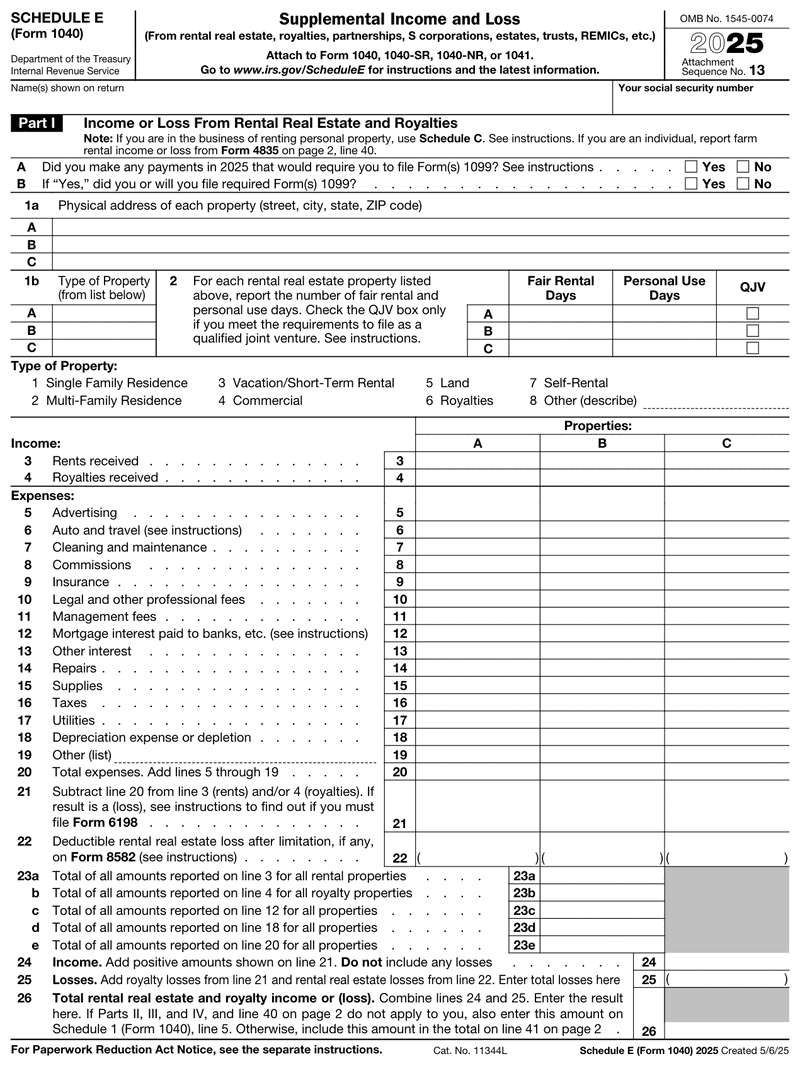
Schedule E (Form 1040) is the IRS form titled Supplemental Income and Loss. You attach it to your 1040 to report rental real estate, royalties, and income from partnerships, S corporations, estates, and trusts. Its five parts total your supplemental income, and that figure carries to your Form 1040.

Every Schedule E tax form uses the same layout, and the IRS titles each part plainly. Part I is Income or Loss From Rental Real Estate and Royalties. Part II is Income or Loss From Partnerships and S Corporations, and Part III is Income or Loss From Estates and Trusts. Part IV deals with REMICs, which most filers never touch, and Part V totals everything into one number.

Naming trips people up. The Schedule E form also shows up as Sch E, as the E schedule, and as plain Form E in some software menus. Certain packages label it Form 1040 Schedule E. You'll see the 1040 Schedule E pairing most often, since the schedule exists only as an attachment to that return and never as a standalone filing, but every one of these labels points to the same two-page form. So what is Schedule E doing in practice? It's where income and loss from property and entity interests gets settled before reaching your total income. The official IRS Schedule E page carries the current version and line instructions.

Who Files Schedule E?

You file Schedule E if you earn income you did not actively work for. That covers landlords with long-term leases, Airbnb hosts who only clean between guests, partners and S corp shareholders holding a Schedule K-1, and owners of oil, gas, or mineral royalties.

The practical test is whether money arrives from an asset rather than from your labor. A duplex under a signed lease qualifies, and so does a small stake in a real estate partnership that mails you a K-1 every February. One form handles several rental properties, since Part I gives you three property columns before you need a second copy.

Rental Income and Expenses (Part I)

Part I is where most of the work happens. Report gross rents for each property, then deduct the costs of running it. Each property column ends in its own income or loss line, and Part V combines them. Only the net figure is taxed, so accurate expense tracking directly lowers your bill. Schedule E rental income includes rent, tenant-paid utilities, and any forfeited security deposit you keep.

Deductible Rental Expenses by Line

Each cost has an assigned line, and putting it in the right one keeps your return clean:

  • Advertising (line 5), auto and travel (line 6), cleaning and maintenance (line 7)
  • Commissions (line 8), insurance (line 9), legal and professional fees (line 10)
  • Management fees (line 11), mortgage interest (line 12), other interest (line 13)
  • Repairs (line 14), supplies (line 15), taxes (line 16), utilities (line 17)
  • Depreciation (line 18), which spreads the building's cost over 27.5 years

Repairs vs. Improvements

Here's the distinction the IRS watches most closely. Fixing a leaking pipe or repainting a bedroom is a repair, deductible in full on line 14. Replacing the roof or gutting the kitchen is an improvement, depreciated on line 18 instead. Deducting an improvement all at once is a well-known audit red flag, so classify it before filing.

The 14-Day Personal-Use Rule

Rent a property for 14 days or fewer during the year and the income is tax-free. You don't report it at all. Cross that line and personal use beyond the greater of 14 days or 10% of rental days turns the place into a vacation home, capping deductions at rental income and blocking any loss.

Why Make Your Form 1040 Schedule E Here?

Guided fields

Plain-English questions in the order the form expects them, with format checks as you type.

Automatic math

Totals, taxes and carryovers calculate themselves. No arithmetic, no transposition errors.

Print-ready PDF

Preview the finished document free, then download it the moment your payment goes through.

Form 1040 Schedule E preview

How Do I Create My Form 1040 Schedule E?

  • Enter your details

    Answer guided, plain-English fields. The math is calculated for you.

  • Preview your form

    Check a live preview of the finished document before you pay.

  • Download your PDF

    Get a print-ready PDF the moment your payment goes through.

What
people
say

5.0 Rating

559 Reviews

white tick in green background icon Verified User
smiley-face Mark Patterson

Fast - Easy

Published May 05, 2023
white tick in green background icon Verified User
smiley-face Michael Tesfaye

I am so impressed but how prompt and accurate the service was

Published May 05, 2023
white tick in green background icon Verified User
smiley-face Todd Osgood

Excellent service and provides me with what I need for my techs

Published May 01, 2023
white tick in green background icon Verified User
smiley-face Sharolene Bantaculo

they are very helpful.

Published Jul 22, 2023
white tick in green background icon Verified User
smiley-face James Oliver

Great

Published Apr 22, 2023

Everything To Know About Form 1040 Schedule E


Passive Loss Rules and the $25,000 Allowance

A rental that runs at a loss doesn't automatically shelter your salary. The IRS treats rentals as a passive activity, and passive loss generally offsets only passive income.

One exception matters to most landlords. If you actively participate, meaning you approve tenants and make management decisions, you can deduct up to $25,000 of rental losses against ordinary income. That allowance phases out between $100,000 and $150,000 of modified adjusted gross income, and real estate professionals escape the cap entirely. Losses you can't use carry forward and offset future Schedule E income or the gain when you sell. IRS Publication 527 covers the details.

Schedule E vs. Schedule C for Rental Income

The dividing line is services, not property type. Provide basic landlord duties and you stay here. Provide hotel-like services and the activity becomes a business reported on Schedule C, where it picks up the 15.3% self-employment tax.

Your situation Form Self-employment tax
Long-term lease, you handle repairs Schedule E No
Airbnb, you clean between guests Schedule E No
Airbnb with daily housekeeping or meals Schedule C Yes
Managing properties for other owners Schedule C Yes

That difference is worth real money on the same revenue. If you run a service business alongside the rentals, keep its income documented separately, the way a self-employed pay stub separates contractor earnings from everything else.

Partnership, S Corp, and Trust Income (Parts II and III)

Own a slice of an operating business and the income shows up here rather than in Part I. Part II of the Schedule E Form 1040 attachment reports partnership and S corporation income from the K-1 you receive. Part III does the same for an estate or trust interest.

Two mechanics matter. Each entry splits into passive and non-passive columns, and that choice controls whether a loss is usable this year. You also can't deduct a loss beyond your basis in the entity, so track basis annually rather than reconstructing it later. Portfolio owners routinely file Parts I and II together.

How to Create Schedule E Online

Working from the blank PDF means recalculating every column by hand. Our generator removes that step:

  • Enter the address and type for each property.
  • Add gross rents or royalties received.
  • Enter expenses by category, and the tool assigns each to its line.
  • Review the totals, which flow automatically into Part V.
  • Download the finished Schedule E 1040 attachment as a PDF.

You get a completed form ready to file, with the math already done. To follow the official line-by-line Schedule E instructions while you work, keep the IRS page open alongside the tool, then skip the manual totals entirely.

Schedule E Deadlines and 2026 Tax Year Updates

Your 2026 return is due April 15, 2027. File Form 4868 and the deadline moves to October 15, 2027, though any tax owed is still due in April. Rental profit often triggers quarterly payments too, so it's worth knowing how to estimate quarterly taxes early.

Three changes shape this filing season. Full bonus depreciation is back and permanent for qualifying property acquired after January 19, 2025. The 20% qualified business income deduction for rentals that rise to a trade or business is now permanent, and 2026 adds a $400 minimum deduction for filers with at least $1,000 of qualified business income. Platform-collected rent reverts to the $20,000 and 200-transaction threshold for 1099-K reporting.

Record-Keeping for Rental Property Owners

Good records turn a stressful filing into a routine one. Keep leases, invoices, receipts, and mileage logs for at least three years after you file, since that's the standard IRS assessment window.

Track depreciation basis separately for every property from the day you buy it. That number drives your gain when you sell, and rebuilding it a decade later is painful. A dedicated bank account per portfolio also keeps personal and rental spending from mixing. If your rental operation pays you or a helper, a paystub generator produces the pay documentation to file alongside these records, and PayStubs.net keeps it in one place.

Which Schedule E Year Do You Need?

Schedule E is reissued every year, so the year printed at the top has to match the year the rent, royalties, or K-1 income actually came in. Searching "Schedule E form 2025" means the copy that attaches to a 1040 filed in early 2026. "Schedule E form 2026" means the one you file by April 15, 2027. Grab the wrong year and the line numbers still line up, but the rates behind them won't.

Nothing structural separates the two. What moves is the arithmetic you feed into them.

Item Tax year 2025 Tax year 2026
Business mileage (line 6) 70 cents flat 72.5 cents January 1 through June 30, 2026, then 76 cents from July 1, 2026
Section 179 limit $2,500,000, phasing out at $4,000,000 $2,560,000, phasing out at $4,090,000
Return due April 15, 2026 April 15, 2027

The split mileage rate is the one that catches owners running several units. If you or a property manager drive between them, the 2026 log has to be totaled in two blocks, before and after June 30, not as a single annual figure.

Form 1040 Schedule E Questions, Answered

What is a Schedule E used for?

Three groups rely on it most: landlords reporting rental profit, investors reporting K-1 income from partnerships and S corporations, and owners collecting mineral or book royalties. The common thread is supplemental income and loss, meaning money you earn without materially working for it.

What is Schedule E on a tax return?

It's an attachment to Form 1040, never a standalone filing. You complete it alongside your return, and the net total from Part V flows onto Schedule 1 before landing in your total income on the 1040 itself. Filing electronically, most software attaches it automatically.

Do you pay taxes on rental income?

Yes, but only on the net figure. Deduct mortgage interest, repairs, insurance, and depreciation from gross rents first, and tax applies to what's left. Profit here also avoids the 15.3% self-employment tax, a meaningful advantage over the same money reported on Schedule C.

Can I deduct a rental loss?

Often, but not always. Rentals are passive activities, so losses generally can't offset wage income. If you actively participate, you may deduct up to $25,000 in losses, phased out between $100,000 and $150,000 of modified adjusted gross income. Disallowed losses carry forward to future years.

Do I need a separate form for each rental property?

No. One copy holds three properties, using columns A, B, and C on a single Part I. If you own more than three, attach additional copies and report the combined totals only once, on the final copy, to avoid double-counting your income.

Preview free, pay at download.

When you're ready, our Schedule E form generator fills the current form, runs the totals, and delivers a filing-ready PDF. Preview it free, and pay only when you download.

No subscription — you pay per document, only when you download.

  • Guided fields with automatic math
  • Free live preview before any payment
  • 100% money-back guarantee
Experiencing a problem?

Fill out our contact form and we will get back to you soon.

Contact Us
Lost your order?

No need to panic! You can resend your order for free.

Resend Your Order

Jaden Hi! How can I help you?

Hello from our chat team!

To best assist you, please fill out the form, and we'll get back to you swiftly.
Start the chat