



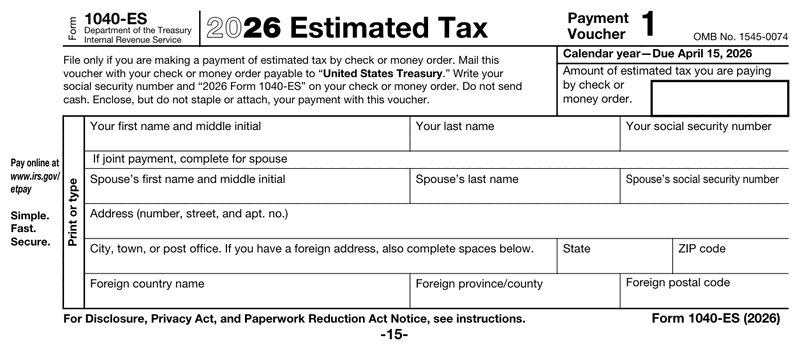





How to Calculate and File Your Quarterly Tax Payments
Project your adjusted gross income, subtract deductions to get taxable income, then apply the tax rates to get income tax. Now add self-employment tax, which is the step most people miss: 15.3% on net earnings up to the Social Security wage base, 2.9% Medicare above it. Subtract credits and any expected withholding, then divide what is left by four. That is your quarterly payment.
Your prior-year return is the fastest baseline, and most self-employed filers work from last year's numbers rather than forecasting from scratch.
Three steps to file Form 1040 ES:
- Complete the estimated tax worksheet in the form package.
- Record the amount on the voucher for the current period.
- Submit the payment by the due date using one of the methods below.
Income rarely holds steady, so recalculate mid-year if a large contract lands or falls through. You can adjust the remaining quarterly tax payments upward or downward without penalty, and claiming every deduction you qualify for lowers the estimated tax payment you owe.
Safe Harbor Rules: When You Won't Owe a Penalty
You can avoid underpayment charges entirely by hitting one of three safe harbor thresholds. Estimate your year honestly and pay at least 90% of what you end up owing for 2026. Or cover 100% of the tax shown on your 2025 return. If your 2025 adjusted gross income topped $150,000 ($75,000 if married filing separately), that second option rises to 110%.
The prior-year route is the practical one for anyone with unpredictable income. You already know last year's number, so you can lock in four equal payments and stop guessing. Earn more than expected and you'll settle the difference at filing, but the penalty never applies.
How Underpayment Penalties Actually Work
The penalty isn't a flat fine. The IRS treats the shortfall as an underpaid balance and charges interest on it for each quarter it stayed unpaid, at a rate the service resets quarterly.
Two consequences follow. Making a late estimated tax payment still helps, because the clock stops when the money arrives. And skipping Q1 hurts more than skipping Q4, since it accrues for longer. The final calculation happens with Form 2210, filed with your federal tax return.
How to Pay: Mail, IRS Direct Pay, or EFTPS
Three routes, and they don't post at the same speed:
- Mail a voucher. Print the voucher, attach a check, and postmark it by the due date. Slowest to clear.
- IRS Direct Pay. Debits your bank account with no enrollment and confirms the same day.
- EFTPS. The IRS's own electronic payment system. Enrollment takes several days, but you can schedule all four payments in advance.
Neither Direct Pay nor EFTPS charges a processing fee. Card payments do. For most business owners, enrolling in EFTPS once and scheduling the whole year is the lowest-maintenance option.
Building Estimated Taxes Into Your Business Cash Flow
Treat quarterly taxes as a recurring business expense, not a surprise bill. Move 25% to 30% of every client payment into a separate account the day it lands. When the due date arrives, the money is already there.
First-year contractors get caught by this more than anyone. They carry a W-2 habit into self-employment, assume tax gets settled in April, and reach the deadline with nothing set aside. The IRS wants its share throughout the year.
Keeping clean income records makes the estimate accurate. Our pay stub templates give you a consistent tax document for every payment you take in, and the same records do double duty when you need to show proof of income for a lender or a lease.
Create Your 1040 ES Form With Our Generator
The generator fills the worksheet and produces all four vouchers from the figures you enter. You get a clean, correctly formatted document to file and to keep.
What it does: calculates the quarterly amount, formats your form to match the IRS layout, and gives you a downloadable copy for your records. Preview it free, then pay once at download. There's no subscription.
One honest limit: the generator prepares your paperwork, it doesn't transmit money to the IRS. Submit the payment through Direct Pay, EFTPS, or mail, then keep the copy with your tax records.
Which Edition of Form 1040-ES Do You Need?
The year in "1040-ES form 2025" or "1040-ES form 2026" is the tax year you are paying for, not the year you file. Both are live at once: your business may still be settling 2025 while paying 2026 installments.
| Paying for | Standard deduction (MFJ / HOH / single) | SALT cap | Skip Q4 by filing and paying in full by |
|---|---|---|---|
| Tax year 2025 | $31,500 / $23,625 / $15,750 | $40,000 ($20,000 MFS) | February 2, 2026 |
| Tax year 2026 | $32,200 / $24,150 / $16,100 | $40,400 ($20,200 MFS) | February 1, 2027 |
Two printed figures on the IRS PDFs are wrong. The 2025 package went to print before the July 2025 law and still shows a $30,000 / $22,500 / $15,000 standard deduction chart. The 2026 package still prints a $40,000 SALT cap phasing down over $500,000; an IRS correction dated 25-FEB-2026 supersedes it, and the cap phases down over $505,000 ($252,500 MFS) and never falls below $10,000 ($5,000 MFS).
New to the 2026 edition: under clarified USPS rules the postmark is the date your envelope is processed at a facility, not the day you dropped it off. Build in that lag if you mail vouchers.
Unchanged: the four installments, the safe harbor rules, and the absence of any extension.