



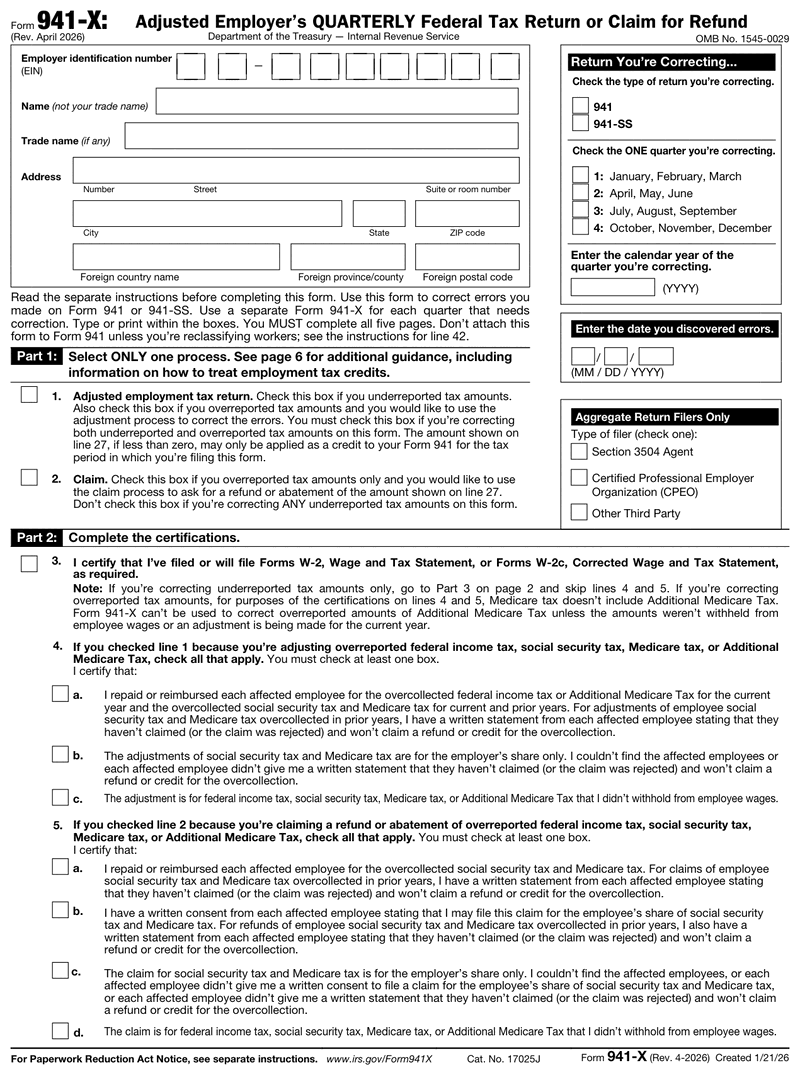





How to Fill Out Form 941-X: Step by Step
Before you open the form, pull the originally filed Form 941 and the payroll records behind it. Most businesses export these from QuickBooks, Gusto, ADP, or whichever platform runs payroll. Working from the filed return rather than rebuilding totals by hand is what keeps the corrected column defensible.
The Form 941-X instructions run long, but the sequence is short:
- Identify the return. Enter your EIN, business name, and address, then check the quarter and calendar year you're correcting. Repeat your name and EIN on every page.
- Select one process in Part 1. Adjusted employment tax return, or claim. You cannot check both.
- Complete the certifications in Part 2. These confirm whether you filed or will file Forms W-2 or W-2c, and whether you repaid or reimbursed employees.
- Enter corrections in Part 3. Each line takes the amount you originally reported, the corrected amount, and the difference. Show negative amounts with a minus sign.
- Explain your corrections in Part 4. Write plainly what went wrong and how you calculated the fix. Vague explanations invite correspondence.
- Sign in Part 5. An unsigned form is not filed.
How to Fill Out 941X for Employee Retention Credit
ERC corrections use the same Part 3 mechanics, entering the originally claimed credit against the corrected figure. Check eligibility first, though. The 941-X instructions no longer support new claims for the third and fourth quarters of 2021, and several ERC-related lines are now reserved.
Where to Mail 941X: IRS Addresses by State
Knowing where to mail Form 941-X comes down to one thing: the state where your business is located. The 941-X mailing address is not split by whether you enclose a payment, which trips up employers used to the Form 941 addressing rules.
| If your business is in | Mail Form 941-X to |
|---|---|
| Connecticut, Delaware, District of Columbia, Florida, Georgia, Illinois, Indiana, Kentucky, Maine, Maryland, Massachusetts, Michigan, New Hampshire, New Jersey, New York, North Carolina, Ohio, Pennsylvania, Rhode Island, South Carolina, Tennessee, Vermont, Virginia, West Virginia, Wisconsin | Department of the Treasury, Internal Revenue Service, Cincinnati, OH 45999-0005 |
| Alabama, Alaska, Arizona, Arkansas, California, Colorado, Hawaii, Idaho, Iowa, Kansas, Louisiana, Minnesota, Mississippi, Missouri, Montana, Nebraska, Nevada, New Mexico, North Dakota, Oklahoma, Oregon, South Dakota, Texas, Utah, Washington, Wyoming | Department of the Treasury, Internal Revenue Service, Ogden, UT 84201-0005 |
| No legal residence or principal place of business in any state | Internal Revenue Service, P.O. Box 409101, Ogden, UT 84409 |
| Exempt organizations and government entities, regardless of location | Department of the Treasury, Internal Revenue Service, Ogden, UT 84201-0005 |
Two exceptions are worth flagging. If your business has no US location, where to mail 941-X changes to the Ogden P.O. box above. And if you use a private delivery service, send the form to the Ogden Submission Processing Center at 1973 Rulon White Blvd., Ogden, UT 84201, even when your state would otherwise file in Cincinnati. Private carriers can't deliver to P.O. boxes.
Mail isn't your only option. The IRS encourages electronic submission, and where to file 941X online is the Modernized e-File system. E-filing returns an acknowledgment, which is easier to document than certified mail.
941-X Deadlines for 2026
For underreported amounts, the due date depends on when you discovered the error, not when you made it:
| Error discovered in | Form 941-X due |
|---|---|
| January to March 2026 | April 30, 2026 |
| April to June 2026 | July 31, 2026 |
| July to September 2026 | November 2, 2026 |
| October to December 2026 | February 1, 2027 |
Two of those dates shift because the standard deadline lands on a weekend. October 31, 2026 is a Saturday and January 31, 2027 is a Sunday, so each rolls to the next business day. Published deadline tables often show the fourth-quarter date with the wrong year, so check it against the calendar.
Overreported amounts follow a different clock. You generally have three years from the date the Form 941 was filed, or two years from the date you paid the tax, whichever is later. Returns for a calendar year count as filed on April 15 of the following year. File in the last 90 days of that window and you must use the claim process.
Need clean payroll documentation behind the numbers you're correcting? Our pay stub templates keep employee records consistent quarter to quarter.
2026 Changes to the 941X Tax Form
Public Law 119-21, the One Big Beautiful Bill Act, closed the door on late COVID-era employee retention credit claims. The credit can't be allowed or refunded for the third and fourth quarters of 2021 unless the claim was filed on or before January 31, 2024. Assessment periods for those two quarters also stretched to six years.
That same law changed federal income tax withholding for qualified tips and qualified overtime compensation. Employees can now deduct part of that income on their returns, which affects how you withhold going forward. If a worker hands you an updated Form W-4, use it. Both remain subject to Social Security and Medicare tax.
Working from an older printout? Several lines on the IRS 941X are now reserved for future use: 18a, 26a, 30, 31a, 31b, and 32, plus 24, 33a, 33b, and 34. They covered COVID-era credits and deferrals whose correction windows have closed.
Common Form 941-X Mistakes to Avoid
- Combining quarters. Use one 941-X form per quarter. This is one of the more expensive common payroll mistakes to unwind. Errors in Q3 and Q4 mean two separate filings.
- Filing late without Schedule B. If you file after the due date, attach an amended Schedule B or risk an averaged failure-to-deposit penalty.
- Paying later than you file. Pay underreported amounts when you file to keep the correction interest-free.
- Discarding records early. Keep employment tax records at least four years, including the pay stubs behind each tax filing. For COVID-era ERC wages paid after June 30, 2021 and before January 1, 2022, keep them at least seven.
Create Your 941X Form Online
Our 941X generator walks through the form field by field, carries your original and corrected figures into the right columns, and calculates the differences so Part 3 reconciles. Accurate payroll deductions on the source records make that reconciliation quick. You get a clean, filing-ready PDF.
One point of clarity: this is a document preparation tool, not an e-file service. We build the form. You submit it, either by mail to the service center for your state or electronically through the IRS.
Pricing is straightforward. Preview your completed form free, pay once at download, and skip the subscription. See the official Form 941-X instructions if you need the IRS line-by-line reference alongside it.
Which Form 941-X Revision Do You Need?
There is no annual Form 941-X. The IRS does not print a 2025 edition and a 2026 edition, so a search for "941-X 2025" and a search for "941-X 2026" land on the same document: Rev. April 2026, which the instructions describe as usable "for all years for which the period of limitations on corrections hasn't expired." The year you enter at the top of the form is the quarter you are correcting, not the version you download.
That distinction changes how you time the filing. Form 941-X carries no tax-year deadline at all. For underreported tax the clock starts in the quarter your payroll team discovered the error, not in the period being corrected, so an old quarter and a recent one caught in the same week share a single due date.
One place the payroll year does still count: the federal income tax withholding deductions for qualified tips and qualified overtime compensation apply to tax years after 2024 and before 2029, and there are limits on using 941-X to correct prior years for them.