








FUTA vs. SUTA: The Credit Employers Miss
Before the phrase "credit reduction" makes sense, you need SUTA. SUTA stands for State Unemployment Tax Act, and it's the state level unemployment tax you pay into your state's benefit fund. It's separate from the federal tax, filed with the state, at a rate your state assigns based on your industry and claims history. Some states label it SUI tax instead, but it's the same obligation.
The two are linked by that 5.4% credit. The federal government assumes you're paying state unemployment tax, so it discounts the federal rate accordingly. Pay your state tax in full and on time and you keep the whole credit at 0.6% federal.
Pay late, pay short, or operate in a state that has borrowed from the federal government and not repaid it, and the credit shrinks. Your federal bill rises to cover the difference. That's the entire mechanism, and it explains why a state level payment problem shows up on a federal return months later.
940 Form Instructions: What Each Part Asks For
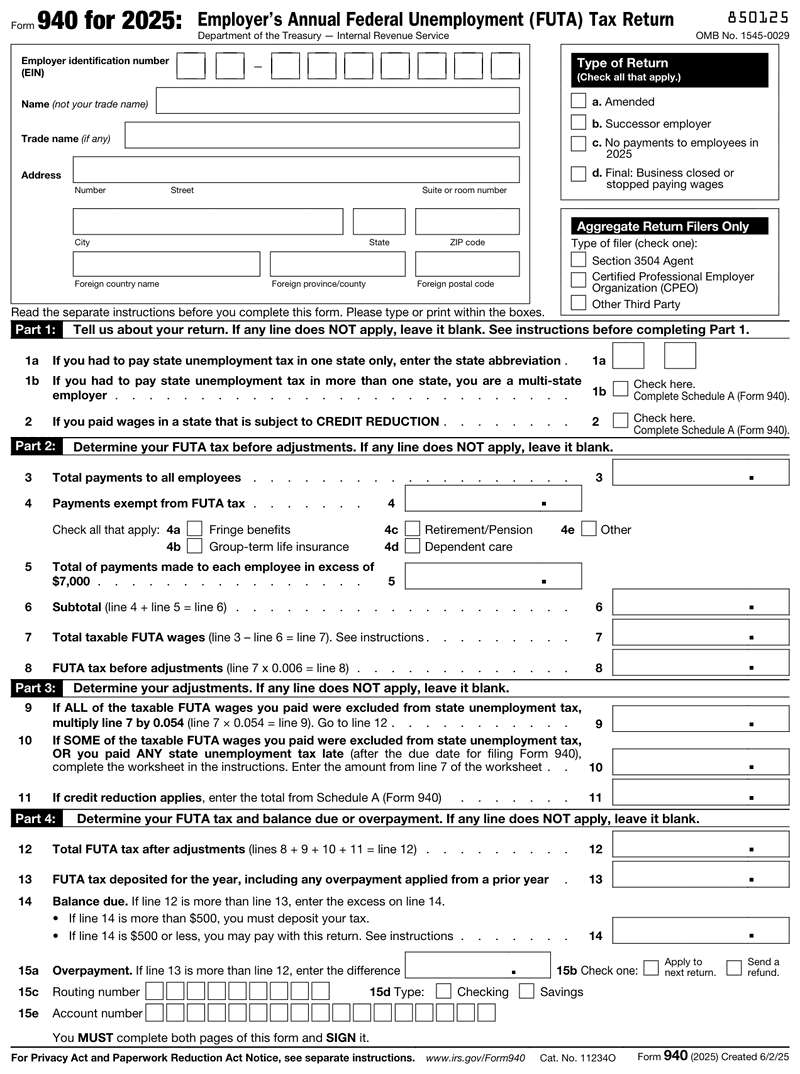
The return runs seven parts across two pages. The official IRS 940 instructions walk through every line. Here's what each part is actually asking, so you know which records to pull before you start.
Part 1: Your State Information
Line 1a is for employers who paid state unemployment tax in a single state. Line 1b flags multi state employers, and line 2 flags wages paid in a credit reduction state. Either of the last two means you're attaching Schedule A.
Part 2: FUTA Tax Before Adjustments
This is the wage math. Line 3 is total payments to all employees. Next comes line 4, which covers payments exempt from FUTA, such as certain fringe benefits and retirement contributions. Line 5 is the portion of each employee's wages above $7,000. Lines 6 through 8 subtract the exempt and excess amounts to reach your taxable wages, then apply the 0.6% rate (0.006), which is the net FUTA rate once you take the full 5.4% state credit. Part 3 is where an employer who does not qualify for the full credit adds the difference back, up to the gross 6.0%.
Part 3: Adjustments
Line 9 applies when all your FUTA wages were excluded from state unemployment tax. Use line 10 for partial exclusions and late state payments. Line 11 is the credit reduction adjustment carried over from Schedule A.
Part 4: Balance Due or Overpayment
Line 12 is your total tax after adjustments. Line 13 is what you already deposited during the year. The difference is either a balance due on line 14 or an overpayment on line 15 that you can apply forward or have refunded.
Part 5: Quarterly Liability
You only complete this if line 12 exceeds $500. It breaks your annual liability into the four quarters. That's how the IRS checks your deposits arrived on schedule rather than in one year end lump.
Parts 6 and 7: Designee and Signature
Part 6 authorizes a third party to discuss the return with the IRS. Part 7 is the signature. An unsigned return is not a filed return, which is a surprisingly common reason for a late filing notice. Full line by line detail lives in the IRS Form 940 instructions.
Pulling Your 940 Form Numbers From Payroll Records
Every figure in Part 2 comes from records you already have. The reason the 940 form feels difficult is that most businesses go looking for those records in February instead of maintaining them through the year.
You need three things per employee:
- Total gross wages paid during the calendar year
- Any payments exempt from FUTA
- The amount by which each person's wages exceeded $7,000
Itemized pay stubs give you all three, because each one carries gross pay, the breakdown of what's included, and a year to date running total.
That year to date column is the shortcut for line 5. Instead of adding up every check, read the final stub of the year for each employee and subtract $7,000. The remainder is that person's excess. Four employees means four numbers, not four hundred.
Before filing, reconcile two ways. First, your line 3 total payments should tie to your year end payroll summary. Second, cross check against the four Forms 941 you filed during the year. The wage bases differ, so the totals won't match exactly, but a large unexplained gap usually means a missing pay run or a duplicate entry.
Need consistent pay documentation for your team? Our pay stub generator keeps every employee's gross wages and year to date totals itemized, which is exactly what these lines ask for.
When Is the 940 Form Due?
The 940 form is due January 31 following the tax year, or the next business day if that date falls on a weekend. Tax year 2026 returns are due February 1, 2027. Depositing all FUTA tax on time extends the deadline to February 10.
That shift comes from the calendar. January 31, 2027 falls on a Sunday, pushing the standard deadline to Monday, February 1, 2027.
The extension is worth understanding because it's automatic and free. If you deposited every dollar of FUTA tax when it was due during the year, you get 10 extra calendar days to file. For the 2026 tax year that means February 10, 2027. You don't apply for it. You simply qualify by having stayed current on deposits, which is one more reason to treat the quarterly threshold below as a real deadline.
Quarterly FUTA Deposits and the $500 Threshold
Filing and paying are two different obligations, and the second one runs quarterly. Once your cumulative FUTA liability passes $500, you must deposit it by the last day of the month following the end of that quarter.
If your liability stays under $500 in a quarter, you carry it forward and add it to the next quarter's total. Many small employers never cross $500 all year and deposit once with the return.
The practical habit: check your cumulative FUTA liability at the end of every quarter, not once at year end. Deposits go through the Electronic Federal Tax Payment System. Missing a required deposit triggers a separate penalty from the late filing penalty, and it also costs you the automatic filing extension.
Where to File Form 940 and Where to Mail It
Where to file 940 returns depends on two things: the state your business operates in, and whether you're enclosing a payment. Electronic filing is the faster route and gives you a dated confirmation of receipt. That's your evidence if a notice ever arrives claiming the return was late.
Paper Filing and the 940 Mailing Address
The IRS routes paper returns to separate processing centers based on those same two factors, so the 940 mailing address isn't the same for every filer. That catches employers out in a specific way: file without a payment one year, enclose a check the next, and the same business sends its return to two different addresses.
Employers asking where to mail form 940 should check the current IRS address table rather than reusing last year's envelope, because processing centers get reassigned. Bookmark the Form 940 IRS filing page and confirm it each January. The current table is published on the IRS where to file page.
Schedule A: Multi-State Employers and Credit Reduction
Schedule A attaches to your return in two situations. You paid wages in more than one state, or you paid wages in a credit reduction state. Growing businesses hit the first trigger the moment they hire a remote employee in a new state.
A credit reduction state is one that borrowed from the federal unemployment account and hasn't repaid it. Employers there lose part of the 5.4% credit, so their federal rate climbs.
For tax year 2025, the IRS Schedule A lists two jurisdictions: California at 1.2% and the U.S. Virgin Islands at 4.5%. New York was on earlier years' lists and is not on this one, which is why copying a list from an old article is risky.
The cost is concrete. A California employer pays 0.6% plus the 1.2% reduction, so 1.8% on the first $7,000 per employee. That's $126 per employee instead of $42, an extra $84 each. Across 20 employees it's $1,680 you won't see coming if you budget at the standard rate. Employers there should read it alongside their other California payroll tax obligations. The list is republished annually, so verify it for the year you're filing.
Penalties for Filing the 940 Form Late
Filing the 940 form late generally costs 5% of the unpaid tax for each month the return is late. That includes part of a month, and the penalty caps at 25%. Paying late runs a separate 0.5% per month on the unpaid balance, and interest accrues on top of both.
Late deposits carry their own graduated penalty. It climbs with how late the deposit is, then jumps again once the IRS issues a notice and you still haven't paid.
Put it in business terms. On a $168 annual liability the penalties are small. On a multi state payroll with a five figure FUTA bill, a return that sits unfiled for a quarter turns into a meaningful number. That's entirely avoidable with a calendar reminder. Late filing sits alongside the other common payroll mistakes that cost small employers real money.
Form 940 vs. Form 941: What's the Difference?
Form 940 is filed annually and reports FUTA tax, which the employer pays entirely. Form 941 is filed quarterly and reports income tax withholding plus Social Security and Medicare taxes, which employers and employees share. Those are the FICA taxes that show up on a pay stub. Most employers with staff file both: four 941s and one 940 each year.
| Form 940 | Form 941 | |
|---|---|---|
| Frequency | Annual | Quarterly |
| Tax reported | Federal unemployment (FUTA) | Withheld income tax, Social Security, Medicare |
| Who pays | Employer only | Employer and employee |
| Wage base | First $7,000 per employee | No FUTA style cap |
The 940 vs 941 question usually comes up because both are "payroll tax forms" and both go to the IRS. Filing one does nothing for the other. If you're researching form 940 and 941 together, plan for five filings a year, not one.
Correcting a Filed 940 Form
There's no separate 940-X. To correct a filed 940 form, you file another Form 940 for the same year with the amended return box checked in the top right.
Use the form revision for the year you're correcting, not the current year's form. A 2025 correction goes on the 2025 revision, because the rates and credit reduction figures are baked into each year's version.
Amended returns must be paper filed, and where to mail 940 corrections follows the same state based address table as an original return. Include a statement explaining what changed and why.
Recordkeeping and Audit Readiness
The IRS expects employment tax records to be kept for at least four years after the tax becomes due or is paid, whichever is later. That clock runs from the filing, not from the pay period, so a 2026 return keeps its supporting records live well into 2031.
Keep these together, organized by year:
- Payroll registers and individual pay stubs showing gross wages per employee
- State unemployment filings and proof of payment, since these support your 5.4% credit
- EFTPS deposit confirmations for every quarterly FUTA payment
- The filed 940 form itself, plus Schedule A if you attached one
The credit documentation is the part businesses skip and later regret. If your right to the 5.4% credit is ever questioned, you'll need proof. Records showing state unemployment tax was paid in full and on time settle it. Reconstructing a year of wage data from bank statements after the fact is the expensive path.
When a Payroll Provider Files for You: Who Is Still Liable
Handing payroll to a provider or accountant doesn't hand off the liability. As the employer, you generally remain responsible for the tax being reported and deposited correctly, even when someone else prepares and submits the return.
Authorization takes a few forms. A reporting agent is appointed on Form 8655 and can sign and file on your behalf. The third party designee in Part 6 is narrower and only lets someone discuss that specific return with the IRS.
The practical control is verification. Ask your provider for deposit confirmations each quarter rather than assuming payments went out, and confirm the return was actually accepted. If a provider misses a deposit, the notice comes to you, and so does the penalty.
Using a 940 Generator to File Faster
A 940 generator handles the arithmetic and formatting. That means applying the $7,000 cap per employee, subtracting exempt payments, running the credit calculation, and laying the figures out on the correct lines.
What it can't do is invent your inputs. You still supply gross wages per employee, exempt payments, your state or states, and the FUTA deposits you already made. Which brings it back to payroll records. Accurate stubs through the year turn the 940 form into a data entry task rather than a reconstruction project. Working from consistent pay stub templates is what keeps those figures clean from January onward.
Which Tax Year Version of the 940 Form You Need
Form 940 is reissued annually, so the year printed on the form has to match the year you paid the wages. This matters most when you are filing late or catching up on a skipped year: 2025 payroll goes on the 2025 form, not on whatever version is currently posted.
If you are searching for "940 form 2026" right now, expect to land on the 2025 document. The 2026 Form 940 and its instructions had not been published as of July 21, 2026, and the IRS still shows 2025 as the current revision. The new version posts ahead of the January filing window.
| Wages paid in | File by | If every FUTA deposit was made on time | Credit reduction states |
|---|---|---|---|
| 2025 | February 2, 2026 | February 10, 2026 | California 1.2%, U.S. Virgin Islands 4.5% |
| 2026 | February 1, 2027 | February 10, 2027 | Not published yet |
One caution for multi-state payroll: the credit reduction list is set per tax year, and the 2026 list is not out. California carried a 0.9% reduction for 2024 and 1.2% for 2025, so the rate moves even when the state stays on the list. Do not build a 2026 accrual off the 2025 percentages.