



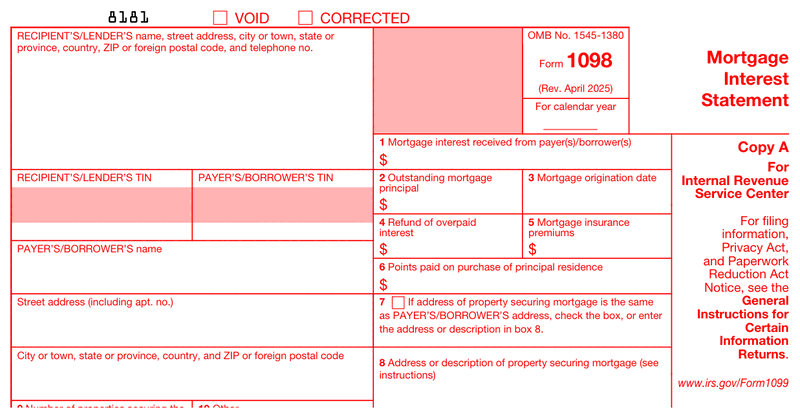





What's on Form 1098, Box by Box
The form is short, and only a few boxes affect your return:
- Box 1: Mortgage interest received. The headline number, and the total 1098 mortgage interest you paid for the year.
- Box 2: Outstanding mortgage principal. Your loan balance as of January 1, which determines whether the debt limit applies. Loans originated or acquired partway through the year show the balance as of that date instead.
- Box 3: Mortgage origination date. Loans taken out before and after December 15, 2017 follow different deduction limits.
- Box 4: Refund of overpaid interest. Interest refunded from a prior year, which may reduce your deduction.
- Box 5: Mortgage insurance premiums. Your lender reports this whenever it reaches $600. The deduction had lapsed for tax year 2025, which is why Schedule A line 8d on that year's form reads "Reserved for future use." It is reportable again for tax year 2026: the December 2026 instructions drop the earlier conditional wording and require Box 5 unconditionally, so premiums reported for 2026 are deductible again.
- Box 6: Points paid on purchase of principal residence. Often deductible in the year you bought the home.
Here is the part most explanations leave out. Box 1 and Box 6 do not just sit on the form. They flow to Schedule A, Line 8a, where the deduction is claimed. Interest not reported on a 1098 goes on Line 8b, and unreported points on Line 8c.
One practical tip: do not wait for the mail. Most major mortgage servicers post the form to your online account in early to mid January, ahead of the January 31 deadline.
How to Claim the Mortgage Interest Deduction
This is an itemized deduction, so it only helps if your total itemized deductions exceed your standard deduction. Plenty of homeowners receive a form 1098 every year and still take the standard deduction because it works out better.
If you do itemize, the math is straightforward. Say Box 1 shows $18,000 in mortgage interest. That $18,000 moves to Schedule A, Line 8a, and combines with your other itemized deductions such as state and local taxes and charitable contributions. The total then carries to your Form 1040.
There is a ceiling. For mortgages taken out after December 15, 2017, interest is deductible on up to $750,000 of home acquisition debt, or $375,000 if you are married filing separately. Older loans are generally grandfathered under a higher $1,000,000 limit, or $500,000 if married filing separately. The One Big Beautiful Bill made this framework permanent, so the $750,000 cap still applies for the 2027 filing season, covering tax year 2026. The same law also made the suspension of home equity loan interest permanent.
When You Are the One Issuing a 1098 Form
Most people receive this form. Some have to send it. Any business that receives $600 or more in mortgage interest from an individual in the course of its trade or business must file one. That covers lenders and servicers, and it can include a seller who financed a property sale and collects the interest.
If that is you, three dates matter. The standing rule is borrower copies by January 31, paper filings to the IRS by February 28, and electronic filings by March 31. Weekends shift two of those in the 2027 season: borrower copies are due Monday, February 1, 2027, and paper filings move to Monday, March 1, 2027, with e-filing still March 31. One more thing worth knowing is that the e-file threshold now counts all your information returns together, so if you file 10 or more of any type combined, electronic filing is mandatory and the paper date never applies to you. You will also need the payer's taxpayer identification number (TIN), usually collected on a W-9.
One rule catches people out. Copy A, the version that goes to the IRS on paper, must be the official scannable form or filed electronically. A black and white version printed from a website can trigger penalties.
Organizing Your 1098 Records With PayStubs.net
Searching for a 1098 generator usually means one of two things: you are a borrower trying to make sense of a statement your lender already sent, or you are the one who has to issue the form and wants the numbers behind it in order.
One constraint is worth knowing up front, and it applies to any 1098 you prepare outside the IRS system: the Copy A that goes to the IRS has to be the official scannable version or an electronic filing. If you are a borrower rather than a lender, the 1098 you are waiting on comes from the servicer that collected the interest, not from you.
What we do generate is the income documentation that sits around it: pay stubs and W-2 forms, built with our paystub and tax document tools. If you run a small business, finance a property sale, or manage rental property, keeping those records in one place is what makes filing season quick once the mortgage interest numbers come due.
Special Situations to Watch For
A few scenarios change how you handle a form 1098 mortgage:
- Rental property. Interest on a full rental is not an itemized deduction. It is a rental expense netted against rental income on Schedule E, line 12. If the place is part home and part rental, you split the interest between Schedule A and Schedule E.
- Multiple mortgages. A main home and a second home each generate their own form, and the debt limit applies across both combined.
- Your loan was sold or transferred. You may get two forms for one year, one from each servicer. Add them together rather than assuming one replaced the other.
- Co-borrowers. The form usually goes to the primary borrower only, so co-owners split the interest by what each actually paid.
1098 vs. 1098-T vs. 1098-E
This is the most common mixup with this tax form 1098. These 1098 forms share a number but report completely different things:
- 1098 reports mortgage interest paid to a lender. That is the form this page covers.
- 1098-T reports tuition and related expenses, issued by a college or university.
- 1098-E reports student loan interest payments, issued by your loan servicer.
If you arrived here looking for tuition or student loan information, the standard 1098 is not the form you need. Only this one connects to the home mortgage interest deduction.
Which Version of Form 1098 Do You Need?
There is no annual Form 1098. Unlike forms that print a tax year across the top, it is continuous-use, so a search for "1098 form 2025" or "1098 form 2026" is asking about the tax year of the interest you collected, not about two different documents. The current form revision is April 2025, and it serves both years.
The wrinkle that catches filing teams out is that the form and its instructions carry different revision dates. The instructions were reissued at December 2026 and state plainly: use the April 2025 revision of Form 1098 and those instructions to file 2026 information with the IRS in early 2027. Anyone hunting for a "December 2026 Form 1098" will not find one. Pull the April 2025 form, pair it with the December 2026 instructions, and you are current.
One instruction did change substantively, and it sits in Box 5. The April 2025 instructions told filers to check IRS.gov/Form1098 to see whether section 163(h)(3)(E) had been extended before reporting mortgage insurance premiums. The December 2026 instructions drop that condition and read flatly: enter the total premiums of $600 or more paid (received) for the tax year being reported, including prepaid premiums, for qualified mortgage insurance. Box numbers are unchanged, so nothing in your box mapping needs to move.