



Key Takeaways

  • Form 4797 reports gains and losses from the sale of business property, including equipment, vehicles, and rental real estate.
  • Depreciation you previously claimed is often recaptured and taxed as ordinary income under Sections 1245 and 1250.
  • The form attaches to your annual return (Form 1040, 1065, or 1120) and is due with it.
  • Personal capital assets go on Schedule D and Form 8949, not this form.
  • An online generator handles the Part III math and outputs a print-ready PDF.
blue dollar money icon 100% Money-Back Guarantee

We understand that satisfied customers are loyal customers and we strive to provide you with high quality documents.

blue unlock secure payment icon 100% Secure Payment

Our secure payment method provides you with the utmost security, the ease and the peace of mind you deserve.

blue conversation bubble icon 100% Customer Satisfaction

Having our customers at the core of our business, we make sure that our experienced customer care team is on call 24/7.

When you sell business property, whether it is a delivery van, a piece of equipment, or a rental building, that gain does not flow onto your return the way a paycheck does. It goes on Form 4797.

What Is Form 4797?

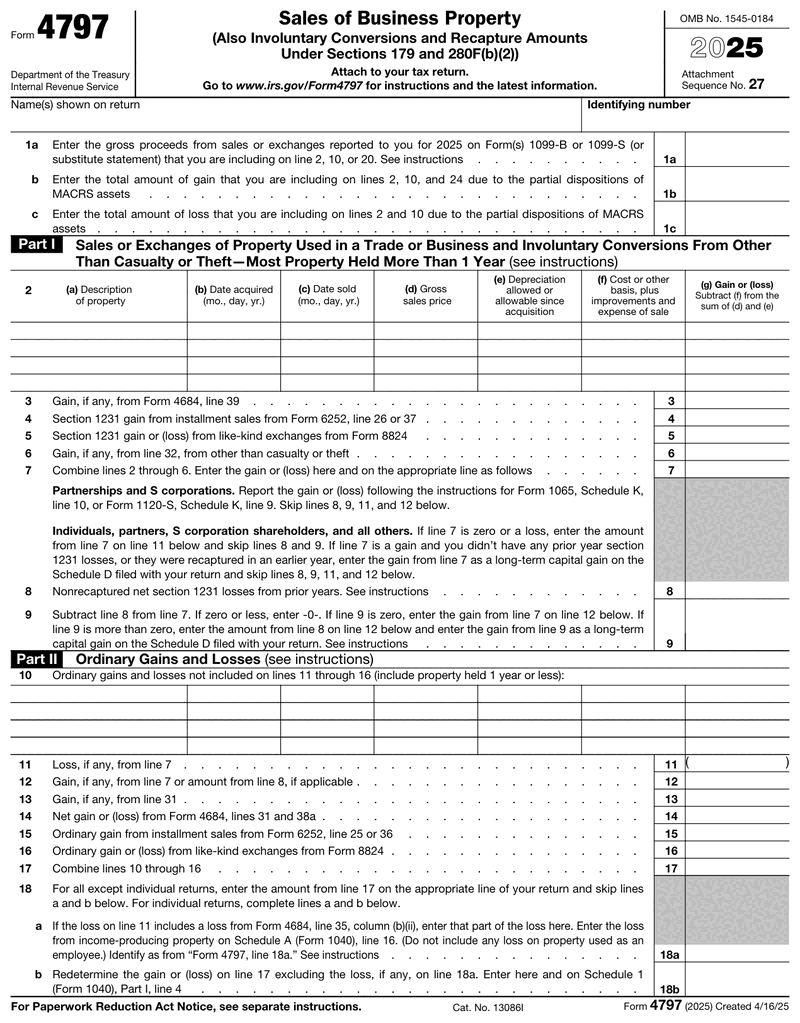
Form 4797, "Sales of Business Property," is the Internal Revenue Service (IRS) form used to report gains and losses from selling or disposing of depreciable property used in a trade or business, such as equipment, work vehicles, or rental real estate. It also handles depreciation recapture and involuntary conversions, separating those transactions from your personal capital gains. In short, it standardizes reporting business property sales so the IRS can tax each asset correctly.

So what is Form 4797 used for in practice? It reports the sale of business assets, calculates how much of your gain is ordinary income versus capital gain, and feeds the result to your main return. The IRS built this tax form 4797 for asset disposals tied to a business, which is why its official title is the IRS Form 4797 Sales of Business Property. If you have heard bookkeepers call it the sale of business assets form, that is the same document. Think of it as the bridge between your fixed-asset ledger and your tax return.

Who Must File Form 4797?

From startup founders to finance leaders, any taxpayer who sold or disposed of property used in the operation of a business during the tax year must file it. That includes business owners, landlords, self-employed professionals, partnerships, and corporations selling depreciable equipment, a company vehicle, or rental real estate. If the property was held for personal use only, you report it on Schedule D instead.

Holding period matters. Property held for more than one year generally qualifies for favorable Section 1231 treatment, while property held one year or less is treated differently. A freelance photographer selling camera gear, an e-commerce LLC selling a delivery van, and a landlord selling a rental all file the IRS form 4797. If you are self-employed, the sale can also change what you owe in estimated quarterly taxes.

Why Make Your Form 4797 Here?

Guided fields

Plain-English questions in the order the form expects them, with format checks as you type.

Automatic math

Totals, taxes and carryovers calculate themselves. No arithmetic, no transposition errors.

Print-ready PDF

Preview the finished document free, then download it the moment your payment goes through.

Form 4797 preview

How Do I Create My Form 4797?

  • Enter your details

    Answer guided, plain-English fields. The math is calculated for you.

  • Preview your form

    Check a live preview of the finished document before you pay.

  • Download your PDF

    Get a print-ready PDF the moment your payment goes through.

What
people
say

5.0 Rating

559 Reviews

white tick in green background icon Verified User
smiley-face Jeffrey Kuhl

Perfect

Published May 11, 2023
white tick in green background icon Verified User
smiley-face Ashley Brandt

Excellent

Published Jun 10, 2023
white tick in green background icon Verified User
smiley-face Mark Patterson

Fast - Easy

Published May 05, 2023
white tick in green background icon Verified User
smiley-face Michael Tesfaye

I am so impressed but how prompt and accurate the service was

Published May 05, 2023
white tick in green background icon Verified User
smiley-face Sherry Logan

Paystubs.net is the best! They take care of all my pay-stub needs.

Published May 26, 2023

Everything To Know About Form 4797


Property Types and IRC Section Codes

The section code that applies depends on the type of property used in your business. Here is how the main codes map to real assets, and what each one does to your tax bill:

IRC Section Property Type Plain Example How the Gain Is Taxed
1231 Depreciable business property and real property held over 1 year Rental building, machinery Net gain: capital gain; net loss: ordinary
1245 Depreciable personal property (equipment, vehicles) Delivery van, laptop, tools Recapture taxed as ordinary income
1250 Depreciable real property (buildings) Warehouse, office Excess depreciation recaptured as ordinary
1252 Farm land with soil/water expenses Farmland improvements Portion recaptured as ordinary
1254 Oil, gas, geothermal property Drilling costs Recapture as ordinary
1255 Cost-sharing conservation payments Section 126 property Recapture as ordinary

Most small businesses deal mainly with Sections 1231 and 1245, since those cover equipment and vehicles. Section 1250 only comes into play if you own the building itself.

Depreciation Recapture: How Your Gain Is Taxed

Depreciation recapture is the part of your gain that the IRS taxes as ordinary income rather than at lower capital-gains tax rates, so it helps to know the different types of taxes that can apply to a single sale. Because you already deducted depreciation to lower earlier taxable income, the IRS reclaims a portion when you sell. Recapture raises your taxable income for the year, so plan ahead if you also want to lower your taxable income with other deductions.

Here is a clean, non-farm form 4797 example. Your business buys a machine for $20,000 and claims $8,000 in depreciation, leaving an adjusted basis of $12,000. You sell it for $18,000, producing a $6,000 gain. Because that $6,000 is below the total depreciation claimed, all $6,000 is recaptured as ordinary income under Section 1245. Reporting gains this way, rather than as a plug number, protects your tax savings and keeps your return accurate and audit-ready.

How to Fill Out Form 4797 (Parts I-IV)

The Form 4797 instructions divide the form into four parts:

  • Part I: Long-term Section 1231 gains and losses on property held over one year.
  • Part II: Ordinary gains and losses (including property held one year or less).
  • Part III: Depreciation recapture, the math-heavy section for Sections 1245, 1250, 1252, 1254, and 1255.
  • Part IV: Recapture of Section 179 and listed-property deductions.

The form is due with your annual return (Form 1040, 1065, or 1120), so there is no separate deadline. Before you start, gather your records: the placed-in-service date, the current depreciation schedule, your cost basis, and the sales agreement. The same paperwork supports your other write-offs, much like the records behind 1099 tax deductions. Keep everything for up to six years, and file any pay stub for tax filing alongside them.

Avoid the common mistakes that trigger IRS notices:

  • Misjudging the holding period (selling at 11 months forfeits Section 1231 treatment).
  • Forgetting depreciation recapture entirely.
  • Skipping Form 8594 when you sell an entire business.
  • Treating the reported gain as an estimate instead of tying it to your ledger.

IRS.gov hosts the current 4797 form as a fillable form 4797 pdf, and the IRS Form 4797 instructions there walk through every line if you need that level of detail.

Form 4797 vs. Schedule D vs. Form 8949

Choosing the right form is simple once you know the asset type:

You Sold Use This Form
Business or rental property (real property, equipment) Form 4797
Personal capital assets (stocks, personal-use items) Schedule D and Form 8949
A home with a home-office or rental portion Possibly both (split business vs. personal use)

These reporting forms work together, so a mixed-use sale can appear on more than one.

Create Form 4797 Online with PayStubs.net

Every guide explains the 4797 tax form, but few show you a faster way to produce it. An online 4797 generator pre-fills your identifying information, walks you through Parts I to IV, and reduces the line-by-line math errors that make Part III the top source of filing mistakes. It works much like our 1099 generator, then outputs a clean, print and PDF-ready copy for your records. Use it alongside professional tax advice, not as a replacement for it.

Which Form 4797 You Need, and Why the Due Date Depends on Your Entity

The IRS does reissue Form 4797 annually, so "form 4797 2025" and "form 4797 2026" really are different documents, and you should match the form year to the tax year the sale happened in. The difference between them is smaller than it looks: nothing material changed in the rules, but line numbers shifted on the 2026 draft. Line 1a's cross-references move from "line 2, 10, or 20" (2025) to "line 2, 11, or 22" (2026). Do not carry line positions over from a prior year's working papers.

The deadline is where businesses get caught out. Form 4797 has no due date of its own. It inherits the date of the return it attaches to, so the answer depends on how your entity files, not on the tax year:

Parent return When the 4797 is due
Form 1040, 1120, 1041 April 15
Form 1065, 1120-S March 15

When the 15th falls on a weekend, the date rolls to the next business day. Extend the parent return and the 4797 moves with it: October 15 for individuals filing Form 4868, and September 15 for partnerships and S corps filing Form 7004. Any page quoting one flat "Form 4797 deadline" is wrong for whichever entity type it left out.

Form 4797 Questions, Answered

What is Form 4797 used for?

It reports the sale or exchange of property used in a business, including depreciation recapture and involuntary conversions. It calculates how much of your gain is ordinary income versus capital gain and passes that figure to your annual tax return.

What is the difference between Form 4797 and Schedule D?

Form 4797 reports sales of business and rental property, while Schedule D (with Form 8949) reports personal capital assets like stocks. If a sale involves both business and personal use, such as a home office, parts of the transaction may appear on both.

When is the form due?

It has no separate deadline. The form attaches to your annual return (Form 1040, 1065, or 1120) and is filed on the same date, including any extension. Keep supporting records for up to six years in case of an IRS review.

Where can I get the Form 4797 PDF?

The official version and instructions are available on IRS.gov. If you would rather submit a completed copy, an online generator can produce a filled, print-ready version for your records.

Is the gain taxed as ordinary income or capital gains?

Your profit usually splits into two buckets. The depreciation you recaptured is taxed at your regular rate, while any leftover net Section 1231 gain can qualify for lower long-term treatment. The holding period and how much depreciation you claimed determine where the line falls.

Preview free, pay at download.

Form 4797 is how business owners and self-employed filers report the sale of business property, and getting it right means watching depreciation recapture and choosing the correct form for each asset. Gather your records, run the Part III math carefully, and confirm which gains are ordinary versus capital. When you are ready, create your Form 4797 online for an accurate, print-ready copy in minutes, and explore professional pay stub templates to keep the rest of your payroll documentation in order.

No subscription — you pay per document, only when you download.

  • Guided fields with automatic math
  • Free live preview before any payment
  • 100% money-back guarantee
Experiencing a problem?

Fill out our contact form and we will get back to you soon.

Contact Us
Lost your order?

No need to panic! You can resend your order for free.

Resend Your Order

Jaden Hi! How can I help you?

Hello from our chat team!

To best assist you, please fill out the form, and we'll get back to you swiftly.
Start the chat