








How to Create an 8300 Form Online
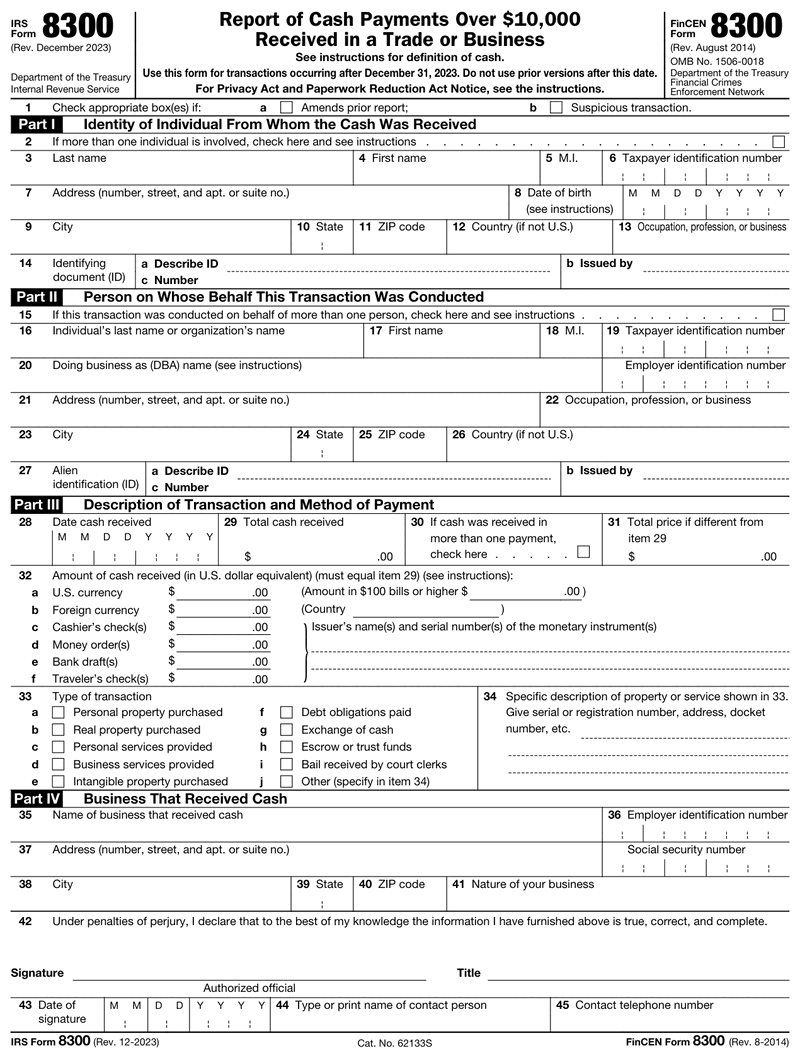
Our 8300 generator walks through the form in the same order the IRS lays it out. Nothing you enter has to be rearranged later. You supply the transaction details and the tool assembles a completed, correctly formatted return.
Gather four things before you start:
- Payer identification: legal name, address, date of birth, taxpayer identification number, and the ID document you used to verify them.
- Transaction details: the date the payment was made, the total amount, and how it broke down between currency and any qualifying instruments.
- A description of what the payment was for, specific enough to identify the goods or service.
- Your own business information, including your employer identification number.
Payer identification is where filings go wrong. You're required to report the payer's TIN, and you can't produce it after the fact if you never collected it. That step belongs in your sales process, not your accounting process.
Need matching payroll documentation for the same period? Our pay stub and W-2 builders draw on the same business records, which keeps your reporting consistent across the year.
Form 8300 Instructions: How to File
The form has four parts. Part I identifies the individual who handed over the money. Part II covers the person or business on whose behalf the transaction was conducted, if that's someone different. Part III describes the transaction itself, including the amount, the payment breakdown, and the date. Part IV identifies your business and carries the signature.
Most businesses now file electronically through FinCEN's BSA E-Filing System, which costs nothing to use and returns a confirmation you can save. E-filing became mandatory on January 1, 2024. It applies to any business that files at least 10 information returns of other types in a year. That mandate is still in force in 2026. Paper filing remains available below that threshold, and the official form 8300 instructions and current PDF are both on IRS.gov.
Collect the TIN at the counter, not afterward. A payer who refuses to provide a taxpayer identification number can face a $50 penalty under section 6723, but that's their exposure, not your excuse. You still have to file on time, and you're expected to have made a reasonable effort to collect it. If a customer flatly refuses, file anyway: write "customer refused" in the space for the payer's TIN, or note it in the Comments box if you're e-filing, and keep a record of what you asked for and when. Documenting the attempt is what supports a reasonable cause position later. Build a short intake step into any transaction that could reach $10,000. Capture name, address, ID type and number, and TIN. Doing it at the point of sale takes a minute. Doing it two weeks later means calling a customer to ask for their Social Security number.
Form 8300 Filing Deadline: The 15-Day Rule
You have 15 days from the date the payment was made. Not 15 business days, and not 15 days from month end or quarter close. If the fifteenth day lands on a weekend or legal holiday, the deadline rolls to the next business day.
That short window is why this filing doesn't fit a normal accounting rhythm. A payment received on the 3rd is due on the 18th, well before anyone reconciles the month. Businesses that handle large cash regularly flag the transaction the day it happens. Waiting for the books to catch up is too slow.
Related Transactions and Structuring Rules
A single payment isn't the only way to cross the threshold. Multiple cash payments from the same payer count together in two situations. The first is when they land within a 24-hour period. The second is when you know, or have reason to know, that each payment is one of a series of connected transactions.
That second rule is the one businesses underestimate, because it carries no time limit. Payments count as connected based on whether they belong to the same arrangement, not on how far apart they fall. A separate rule covers installments: if payments toward one purchase pass $10,000 within a year of the initial payment, you file.
Both rules produce the same practical question, so treat them as one decision path:
- Did one cash payment exceed $10,000? File within 15 days of that payment.
- Did several payments from the same payer add up to more than $10,000, either inside 24 hours or as a connected series? File within 15 days of the payment that pushed the total past the threshold.
Two examples make it concrete. A customer pays $8,000 in cash Monday morning and $3,000 more that evening: $11,000 within 24 hours, so you file. Or a buyer purchases an $18,000 ring with three $6,000 cash installments over two months. Those payments clearly belong to one purchase, so the third one triggers the filing.
Deliberately splitting payments to stay under $10,000 is called structuring. It's a federal crime for the payer and for any business that helps arrange it. If a customer asks you to break a payment up, complete the sale normally and file.
Penalties for Not Filing Form 8300
Penalties scale with intent, and the gap between an honest miss and a deliberate one is enormous.
| Failure | Penalty |
|---|---|
| Negligent failure to file a complete, correct return | $340 per return, up to $4,098,500 per year |
| Same failure, business with gross receipts of $5 million or less | $340 per return, up to $1,366,000 per year |
| Corrected within 30 days | $60 per return, up to $683,000 ($239,000 for smaller businesses) |
| Intentional disregard | Greater of $34,150 or the amount of cash received, up to $136,500, with no annual cap |
| Intentional failure to furnish the payer statement | Greater of $680 per statement or 10% of the aggregate amount, with no annual cap |
| Willful failure to file (criminal) | Fine up to $25,000 ($100,000 for a corporation) and up to five years in prison |
Note the 30-day correction window. Catching a missed filing quickly drops the per-return penalty from $340 to $60. That makes a self-audit worth running the moment you suspect a gap.
One caution on sourcing. The amounts above apply to returns required to be filed in 2026 and come from Rev. Proc. 2024-40, the annual inflation adjustment. The IRS reference guide page for this form is widely cited but has not been updated past returns due in 2024, so the figures you find there run low. Check the current revenue procedure before you calculate exposure. Also note that the criminal fine above is the tax-code number; the parallel Bank Secrecy Act provision at 31 U.S.C. 5331 reaches $250,000 for an individual and $500,000 for a corporation.
The Customer Notification Statement You Must Send
Filing the form is only half the obligation. You also have to give every person named on it a written statement. Businesses miss this one most often.
The statement is due by January 31 of the year following the transaction. It has to include four things:
- Your business name and address.
- A contact name and phone number.
- The total reportable cash you received from that person during the year.
- A note that you reported the information to the IRS.
A copy of the filed return doesn't satisfy this on its own. The statement is a separate document with its own deadline and, as the table above shows, its own penalty exposure. Build it into your January routine alongside W-2s and 1099s. It lands on the same date and draws on records you're already pulling.
Recordkeeping: Keep Form 8300 Records for Five Years
You're required to keep a copy of every 8300 you file for five years from the date of filing. The retention obligation covers three things:
- The filed form itself, plus the electronic confirmation if you e-filed.
- The written statement you sent the payer, and the date you sent it.
- Supporting documentation: the ID you used to verify the payer, the sales record or invoice, and any notes on how the payment broke down.
Five years is longer than many businesses keep routine sales paperwork, so these records need a deliberate home. Store them digitally with your other business tax records, organized by filing date, since that's the date the clock runs from. Standardized pay stub templates keep the payroll side of that archive just as consistent. If a filing is ever questioned, those documents show you identified the payer properly. They also show you reported the correct amount. Knowing the common IRS audit red flags helps you judge which records deserve the most care.
Which Industries and Businesses File Form 8300 Most
Certain businesses see large cash often. Their staff should be trained to spot a reportable transaction as it happens.
| Business type | Typical trigger |
|---|---|
| Auto, boat, and RV dealerships | Cash down payment or full purchase price |
| Jewelry, art, and collectibles dealers | A single high-value item paid in cash |
| Contractors and home builders | Large cash deposit on a project |
| Law firms | Cash retainer from a client |
| Real estate brokers | Cash applied to a purchase or closing |
| Pawnbrokers and precious metals dealers | Bulk cash purchase or sale |
| Travel agencies | Cash payment for a high-value booking |
| Sole proprietors and freelancers | A one-off large cash job, same rules apply |
That last row matters more than its size suggests. A solo contractor who takes $12,000 in cash for a kitchen remodel has the same obligation as a dealership. Most are far less likely to know it. If that describes you, keep a self-employed pay stub on file. A plan for quarterly taxes on 1099 income belongs in the same folder as your 8300 records. The trigger is the payment, not the industry. Any startup or small operation that accepts large cash files exactly what a company a hundred times its size files.
Does Cryptocurrency Count for Form 8300?
Not yet. Congress amended Section 6050I to treat digital assets as cash. But IRS transitional guidance in Announcement 2024-04 directs businesses not to count them toward the $10,000 Form 8300 threshold until final regulations are issued. That guidance still stands, so crypto payments remain unreportable for now.
Watch this rather than act on it. When Treasury finalizes the regulations, businesses and exchanges taking digital assets will need the same payer ID process they use for currency today. Building that habit now costs nothing. Until then, a $50,000 crypto payment creates no filing obligation, even though the same amount in currency clearly would.
The 8300 Is Separate From Your Payroll Reporting
Filing an 8300 doesn't replace any of your normal wage or contractor reporting. Treating it as a substitute is a costly mistake.
Pay a subcontractor $15,000 in cash for a job and you still file a 1099-NEC for it. W-2 and 1099 reporting runs on its own track. Pay employees in cash and those wages still run through payroll. They still get withheld on, and they still appear on a W-2 and on each worker's pay stub. This form covers cash you receive from a customer; payroll reporting covers money you pay out. Different directions, different obligations.
The overlap is documentation discipline. Both require you to know who paid you or whom you paid, how much, and when. Businesses that understand their own payroll deductions tend to keep clean 8300 records too, because the same habit drives both.
Which Form 8300 Version Do You Need?
There is no annual Form 8300. Searches for "form 8300 2025" or "form 8300 2026" turn up the same document, because the IRS does not reissue this return by tax year. The current revision is December 2023, and the form face states it plainly: "Use this form for transactions occurring after December 31, 2023. Do not use prior versions after this date." That one revision covers every 8300 your business files, whatever year the cash came in, until the IRS supersedes it.
The year in those searches refers to when you received the cash, not to a separate form. It doesn't set your deadline either. This return is transaction-triggered: the clock starts the day the payment lands and you file within 15 days. A business that received qualifying cash in March 2025 filed in March 2025, not in early 2026. There is no filing season here and no annual due date to look up. The only calendar date on the form is the January 31 statement to each person named on a report you filed during the prior year.
One threshold question comes up alongside the year question. The P.L. 119-21 increase from $600 to $2,000 amends section 6041 and does not touch the $10,000 trigger here, which sits in section 6050I and is statutory rather than inflation-indexed. Your reporting floor is unchanged for both years.