








What Expenses Are Deductible on Form 8829?
Form 8829 covers mortgage interest, real estate taxes, rent, insurance, utilities, repairs, and casualty losses. Direct expenses benefiting only your office are deducted in full in column (a). Indirect expenses covering the whole home go in column (b) and are prorated by your business percentage. Salaries and supplies belong elsewhere on Schedule C.
The direct versus indirect distinction drives the entire calculation, and the form can't list every cost you'll encounter. Here's the rule that settles it: if the expense would exist even if you didn't work from home, it's indirect and gets prorated. If it exists only because of the home office, it's direct and comes off in full.
Repainting the office is direct. Repainting the whole house is indirect. A dedicated business phone line is neither, since it belongs on Schedule C as one of the 1099 tax deductions you claim as a regular business expense rather than on this form.
That last point catches people. Treat this as an expenses form for the home itself, not for the business as a whole. The home business tax deductions it covers are limited to the cost of keeping up the property. Advertising, contractor payments, software, and equipment are ordinary operating costs that belong on Schedule C, and claiming them there and again here is a genuine audit risk. Costs with no tie to the physical space follow the same rule: home based business tax deductions like mileage or professional fees go on the business expense form lines of Schedule C, where they still lower your taxable income.
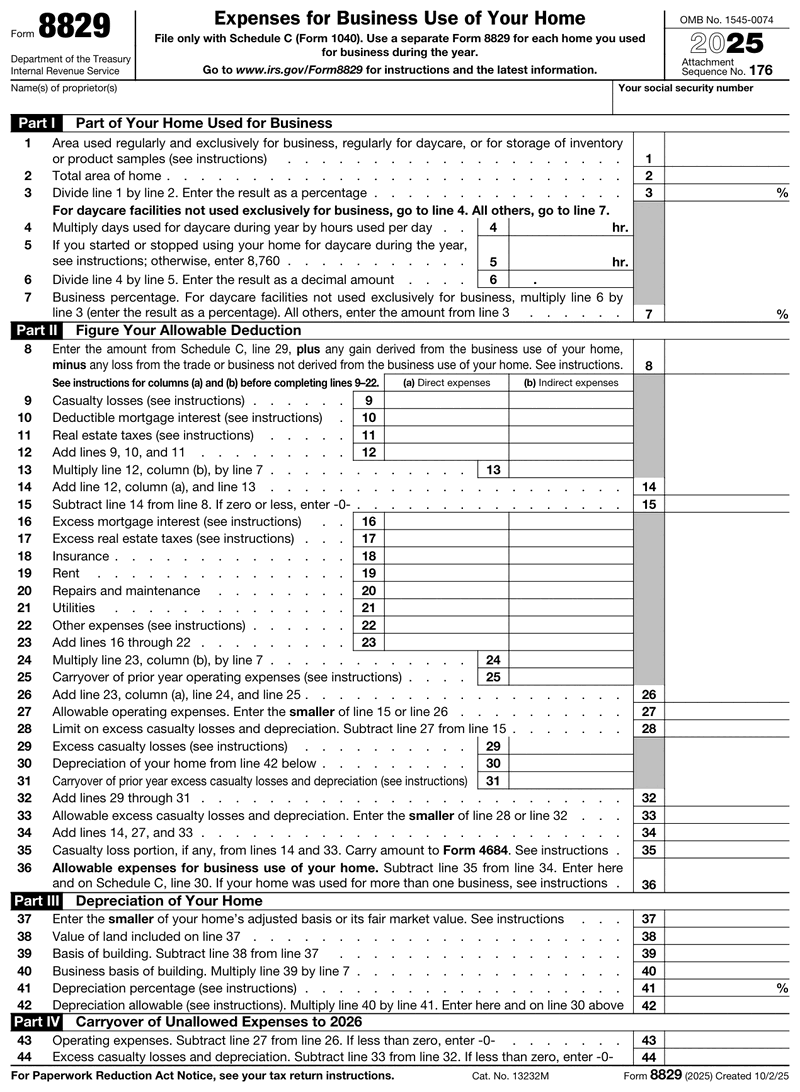
Form 8829 Instructions: How to Fill Out Each Part
The official IRS instructions cover every line, but here's the practical sequence. Keep the IRS forms 8829 instructions open in a second tab if you want the source text next to you while you work.
Part I: Your Business Percentage
Lines 1 through 3 do the core math. On line 1, enter the square footage used regularly and exclusively for business. On line 2, enter the total square footage of the home. Line 3 divides one by the other.
Lines 4 through 6 apply only to daycare providers who use space for both business and personal purposes. Line 4 captures total hours the facility was used for daycare during the year. If you started or stopped mid-year, line 5 prorates by multiplying 24 hours by the number of days the home was available.
Line 7 produces your business percentage. Every dollar figure downstream depends on it, so measure the space properly rather than estimating.
Part II: Figuring Your Allowable Deduction
Line 8 sets the ceiling: your gross income from the business use of the home. This is the cap that prevents the deduction from creating a loss. Filers who report freelance income without a 1099 should settle that figure before starting this part.
Lines 9 through 11 handle casualty losses, mortgage interest, and real estate taxes. Treatment differs depending on whether you itemize. If you claim the standard deduction, you skip lines 10 and 11 entirely and report those amounts on lines 16 and 17 instead.
Lines 16 and 17 capture excess mortgage interest and excess real estate taxes, meaning amounts that personal deduction limits kept off Schedule A.
Line 19 is the one renters need. Enter your rent in column (b), and it gets prorated by your business percentage just like any other indirect cost.
Lines 20 through 22 cover repairs, utilities, and any remaining operating expenses for the year. Line 25 brings forward unused operating expenses from last year's form.
Line 29 handles excess casualty losses beyond what line 9 allowed, line 30 pulls in the depreciation you calculate down in Part III, and line 31 carries forward prior-year excess casualty losses and depreciation.
Line 36 is the payoff. That figure goes on Schedule C, line 30. If the home served more than one business, allocate line 36 among them using any reasonable method.
Part III: Depreciation of Your Home
Owners have one more calculation. Line 37 asks for the cost basis of the home including land, or its fair market value when business use began, whichever is less. Line 38 asks for the land value separately, because land isn't depreciable. Line 39 subtracts it out, and line 40 applies your business percentage.
Line 41 is the depreciation percentage. If business use of the home first began during 2025, use the month it started:
| Month business use began | Percentage |
|---|---|
| January | 2.461% |
| February | 2.247% |
| March | 2.033% |
| April | 1.819% |
| May | 1.605% |
| June | 1.391% |
| July | 1.177% |
| August | 0.963% |
| September | 0.749% |
| October | 0.535% |
| November | 0.321% |
| December | 0.107% |
If the home was already in service for business before 2025, enter 2.564% instead. That figure also applies if you used the simplified method in 2024 and switched back.
Line 42 multiplies line 40 by line 41. Attach Form 4562 only if business use started in 2025 or you placed improvements in service during 2025.
Part IV: Carryover to Next Year
Two short lines here protect money you've already earned the right to deduct. Line 43 calculates unallowed operating expenses, and line 44 does the same for excess casualty losses and depreciation. Both amounts land on lines 25 and 31 of next year's form, so leaving this section blank quietly forfeits the deduction.
How Much Can I Deduct for Business Use of Home?
Your deduction depends on business-use percentage and method. A 200-square-foot office in a 2,000-square-foot home equals 10 percent, so you deduct 10 percent of indirect costs plus depreciation. The simplified method pays $5 per square foot up to 300 square feet, capping the deduction at $1,500.
Run both methods before choosing. Take that same 200-square-foot office, with $14,000 of mortgage interest, taxes, insurance, and utilities across the year, in a home with a depreciable building basis of about $273,000 once the land value is backed out:
| Actual expense method | Simplified method | |
|---|---|---|
| Indirect costs at 10% | $1,400 | Not used |
| Depreciation | ~$700 | Not allowed |
| Rate calculation | Not used | 200 sq ft x $5 |
| Deduction | ~$2,100 | $1,000 |
The actual method wins here by roughly $1,100, which is typical for owners with real mortgage and utility costs. The simplified option wins on effort, not dollars, and it caps out at $1,500 no matter how large your office is or how high your costs run.
Two limits apply regardless of method. The deduction can't exceed gross income from the business use of your home minus related business expenses. Under the actual method, the disallowed portion carries forward through Part IV. Under the simplified method, it's simply lost.
Feed the result into how you estimate quarterly taxes, since a $2,100 deduction changes what you remit each quarter.
What's New on Form 8829 for 2025
One change matters for the 2025 tax year. The overall limit on the deduction for state and local income, sales, and property taxes rose from $10,000 to $40,000 ($20,000 if married filing separately) for 2025, and it is $40,400 ($20,200 if married filing separately) for 2026. The cap rises 1% a year through 2029.
The increase phases down for higher earners. If your modified adjusted gross income exceeds $500,000 ($250,000 if married filing separately), the limit is reduced, though it never drops below $10,000 ($5,000 if married filing separately).
For this form, the effect shows up in the line 11 worksheet. A higher cap means more of your real estate taxes can sit on line 11 rather than shifting to line 17 as excess. The arithmetic changes; the structure doesn't.
One reminder for filers switching methods: if you used the simplified method in 2024 and are back on the full form for 2025, check lines 25 and 31 for carryover from your last filed return.
Common Form 8829 Mistakes to Avoid
Five errors account for most problems with the 8829 form:
- Overstating the business percentage. Counting a room that fails exclusive use, or measuring generously, inflates every downstream figure.
- Ignoring the net income limitation. The deduction can't create or deepen a business loss. Filers who force it end up amending.
- Mixing up the direct and indirect columns. Putting an indirect cost in column (a) deducts it at 100 percent instead of your business percentage.
- Skipping Form 4562. It's required in the first year of business use and when you place improvements in service.
- Using both methods for the same home. Electing the simplified method and filing the long form for the same property in the same year is contradictory, and you have to pick one when you file.
Recordkeeping and Audit Readiness for Your Home Office
The deduction is only as strong as the records behind it. Build the file as you go, not in April.
Keep a measured floor plan or a dated photo set establishing the office dimensions and its separation from living space. Store utility, mortgage, or rent statements by month. Code repair invoices as direct or indirect when they arrive, because reconstructing that split two years later is guesswork. The same discipline that makes a pay stub useful for tax filing applies here.
Retention matters. Ordinary records cover the standard three-year examination window, but anything establishing your home's cost basis should be kept as long as you own the property plus the recapture period, since depreciation claimed on the home used for business affects the gain when you sell.
Prior-year copies matter too. Part IV carryover amounts only work if you can produce last year's form, so a filer who discards old returns loses the deduction they were entitled to carry.
Income documentation is the other half of the file. Line 8 depends on gross income from the business, and owners who pay themselves irregularly often struggle to substantiate it. Our pay stub templates make it straightforward to document owner pay consistently through the year.
Related Forms You'll File With Form 8829
This form never travels alone. Expect these on the same tax return:
- Schedule C (Form 1040): receives your line 36 result on its line 30
- Form 1040: the individual return that Schedule C attaches to
- Form 4562: depreciation, required in the first year of business use or for new improvements
- Form 4684: casualty losses, fed by line 35
- Schedule SE: self-employment tax, which drops as the deduction reduces your net profit
- Schedule A: where the personal share of mortgage interest and real estate taxes goes if you itemize
The Schedule SE effect is worth noting. Because the deduction lowers net profit, it reduces both income tax and self-employment tax, which is why the actual method often outperforms its headline number. Owners documenting their own earnings with a self-employed pay stub will see the change flow straight through to that line.
Where and When to File Form 8829
There's no separate filing address. The form attaches to your return behind Schedule C and travels with it to the IRS, by e-file or on paper.
The deadline is April 15 for calendar-year filers. Form 4868 extends filing to October 15 but not payment, so remit what you owe by April to avoid interest and penalties.
Which Tax Year's Form 8829 Do You Need?
Form 8829 is reissued every year with the tax year printed on the form, so "form 8829 2025" and "form 8829 2026" really are two different documents. Pick by the year the home office expenses were incurred, not the year you sit down to file. A calendar-year business files the 2025 form in spring 2026.
The layout barely moves between them. Parts I and II on the 2026 draft carry the same line structure as the 2025 form, so choosing the right revision changes the arithmetic feeding line 11, not where anything gets entered. Treat the 2026 figures as draft until the final version posts.
| 2025 form (filed in 2026) | 2026 form (filed in 2027) | |
|---|---|---|
| SALT cap limiting line 11 | $40,000 ($20,000 if married filing separately) | $40,400 ($20,200 if married filing separately) |
| Return due date | April 15, 2026 | April 15, 2027 |
| Extended date via Form 4868 | October 15, 2026 | October 15, 2027 |
Neither date is a Form 8829 deadline in its own right. The form only travels attached to Schedule C, so it inherits whatever due date applies to the Form 1040 it rides on, and filing Form 4868 moves both together.