








What You Need to Complete Form 944
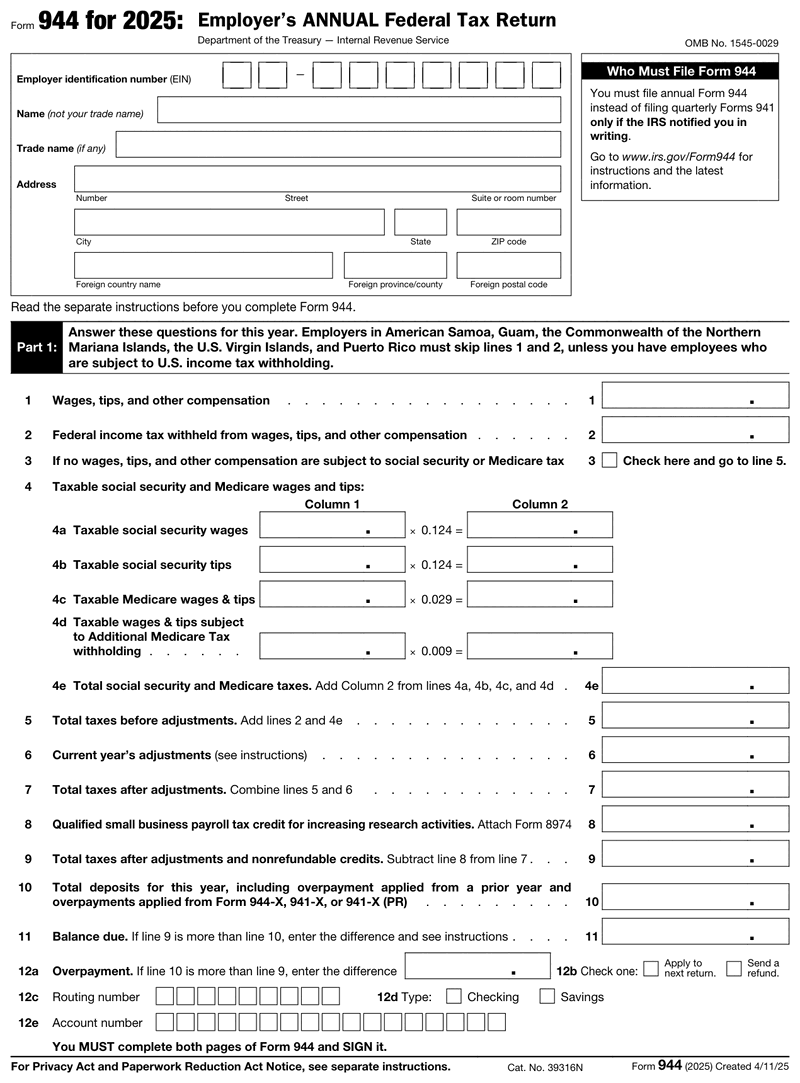
Gather these before you start. Hunting for them mid-filing is how businesses end up with transposed figures:
- EIN, legal business name, trade name, and address. The EIN has to match IRS records exactly.
- Total wages, tips, and other compensation paid across the full calendar year.
- Federal income tax withheld from those wages.
- Social Security and Medicare wage totals, which are narrower than gross wages.
- Deposits already made during the year, so the return reconciles to what you've paid.
Form 944 instructions treat taxable wages and gross wages as separate figures, and they usually are. Pull both from payroll records rather than reconstructing them from bank activity.
Using the 944 Form Generator
Our 944 generator takes those totals and handles the arithmetic. It applies the Social Security and Medicare rates to your taxable wage figures, carries the line totals down, and produces a print-ready form. Add your signature and submit it through your normal channel.
That fills a real gap. A blank fillable PDF leaves every calculation to you. A per-form e-filing service does the math but charges before you see your numbers. Working out your 944 online with our tool sits between the two: review the completed figures first, then decide how to file.
Need clean pay documentation for the employees behind those wage totals? Our pay stub templates keep payroll records consistent all year.
When Is the 944 Form Due?
Form 944 is due January 31 following the tax year it covers. When January 31 falls on a weekend or legal holiday, the deadline shifts to the next business day. For the 2026 tax year, January 31, 2027 is a Sunday, so the return is due Monday, February 1, 2027, or February 10 for timely depositors.
That February 10 extension isn't automatic. It applies only if every required deposit for the year was made on time and in full. Miss one, and your deadline is February 1.
Because the tax form 944 has a single annual deadline, set one mid-January reminder rather than carrying over quarterly habits.
Paying Your 944 Form Balance: Deposits and EFTPS
Small enough businesses skip deposits entirely. If your total tax for the year comes in under $2,500, you can generally pay the balance with the return rather than depositing through the year. Many IRS 944 filers qualify and never realize it.
Above that threshold, you deposit on the schedule the IRS assigns. That schedule comes from your lookback period, the second calendar year preceding the current one. Looking two years back sounds odd until you see the benefit: your deposit schedule is known before the year starts, so nothing changes mid-year.
For payments, use EFTPS, IRS Direct Pay, or e-file through the IRS Modernized e-File system.
Penalties for Filing or Paying Form 944 Late
Two separate penalties apply to a late 944 form, and they stack independently. Businesses often assume paying late and filing late are the same infraction.
Failure to file runs 5% of the unpaid tax per month or partial month the return is late, capped at 25%.
Failure to deposit is tiered by how late the deposit is: 2% at one to five days, 5% at six to fifteen days, 10% beyond that, and 15% once the IRS has issued a notice and demand and you haven't responded.
A third exposure is worth knowing. Taxes withheld from employees are trust fund taxes, held on their behalf. When those go unpaid, the IRS can pursue responsible individuals personally for the full amount. That liability follows the person, not the entity.
The takeaway for cash-tight years: filing on time without full payment always costs less than not filing at all.
Form 944-X and Your Other Payroll Filings
Form 944 doesn't stand alone. It sits inside a year-end set that has to reconcile:
Form 944-X
Use it to file corrections after the original return has gone in. It's an amendment, never a substitute for filing on time. If you haven't filed the 944 yet, file it, then correct it if needed.
Forms W-2 and W-3
The employee-facing side of the same wage data, due in the same late-January window. Your W-2 totals should tie back to what you reported on the 944.
Forms 940, 945-A, and 8974
Form 940 is your annual federal unemployment (FUTA) return, a separate filing on a similar schedule. Form 945-A applies if you're a semiweekly depositor. Form 8974 claims the qualified small business payroll tax credit for increasing research activities.
Treat these as one reconciliation exercise rather than five errands, and discrepancies surface while you can still fix them.
Record-Keeping and Audit Readiness for Your 944 Form
Keep employment tax records for at least four years after the tax becomes due or is paid, whichever is later. That means four filing years live in your records at any given time.
Keep the filed return, deposit confirmations, and the wage and withholding detail behind every line. Keep one more thing businesses routinely discard: the IRS notice that placed you on annual filing. It's your evidence that you were entitled to file annually rather than quarterly, and the first item worth producing if your filing frequency is ever questioned. Clean, consistent payroll records are also what keep you clear of the most common IRS audit triggers.
What's New on the 944 Form for 2026
The One Big Beautiful Bill Act (P.L. 119-21) created deductions for qualified tips (up to $25,000) and qualified overtime (up to $12,500, or $25,000 for married couples filing jointly) on employees' income tax returns.
Read that carefully, because it's an income tax change, not a payroll tax change. Tips and overtime pay stay subject to Social Security and Medicare tax, so your wage lines work the same way they did last tax year. What does change: when an employee hands you a revised Form W-4 in response, update their withholding.
Which Tax Year of Form 944 Do You Need?
Form 944 is reissued annually, and the year on the form is the calendar year of the wages it reports, not the year you file it. So "944 form 2025" means the return covering your 2025 payroll, filed in early 2026, and "944 form 2026" means the return you file in early 2027. Two filing years sit open on most payroll calendars at once, which is where the dates diverge:
| Wages reported for | Return due | Due date if every deposit was timely and in full |
|---|---|---|
| Tax year 2025 | February 2, 2026 | February 10, 2026 |
| Tax year 2026 | February 1, 2027 | February 10, 2027 |
One caveat if you're planning ahead. As of July 21, 2026, the IRS had not published the 2026 Form 944 or its instructions, and irs.gov still shows the 2025 revision as current. The February 1, 2027 date is derived from the standing statutory January 31 rule plus the weekend roll, so reconfirm it once the 2026 instructions post. The 2025 date is IRS-stated.
Neither year carries an extension, because none exists for this form. The February 10 date is a conditional allowance for employers who deposited everything on time and in full, not ten extra days you can request.