



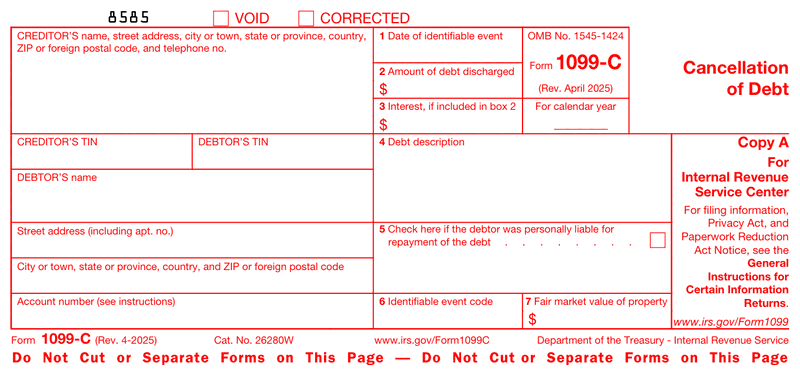





How to File Form 1099-C
Filing breaks down into four steps:
- Gather the creditor and debtor details, including both TINs.
- Complete Boxes 1 through 7, including the identifiable event code.
- Send Copy B to the debtor and Copy A to the IRS.
- File electronically if you're submitting 10 or more information returns.
Before You Start: What to Gather
Pull these six items together before you open the form. Stopping midway to hunt down a TIN is what turns a five-minute job into an afternoon:
- Creditor name, address, and phone number
- Your taxpayer identification number and the debtor's TIN
- The debtor's full name and mailing address
- The date of the identifiable event
- The exact amount of canceled debt, plus any interest included
- Fair market value of the property, if the debt was secured
Completing the Form Boxes
Box 1 takes the date of the identifiable event, not the date you decided internally to stop collecting. Box 2 holds the total canceled debt. The account number field at the top identifies which account the canceled debt came from. That matters when you file more than one form for the same debtor. Box 3 captures any interest included in that Box 2 figure. This matters because interest never reported as income is treated differently. Box 4 is a short description of the debt, such as a credit card account or an auto loan. Box 5 is the checkbox confirming the debtor was personally liable for repayment. Box 6 takes the identifiable event code covered in the next section. Box 7 records the fair market value of any property involved.
Copies A, B, and C: Who Gets What
Copy A goes to the IRS. Copy B goes to the debtor so they can report it on their return. Copy C stays in your files, alongside the rest of your tax filing records. Sending the wrong copy to the wrong party is a common error on a 1099c form. Label them before they leave your desk.
Submitting to the IRS
E-filing is required once you submit 10 or more information returns in a calendar year. Your W-2s and other 1099s count toward that threshold. Under 10, paper filing is still allowed. For the official form and current-year updates, the IRS Form 1099-C page is the authoritative source.
1099-C Identifiable Event Codes Explained
Every 1099 C needs a code in Box 6 explaining why the debt ended. The IRS uses eight:
| Code | Official Event | What It Means in Practice |
|---|---|---|
| A | Bankruptcy discharge (Title 11) | Court wiped the debt in bankruptcy |
| B | Other judicial debt relief | A court or receivership ended the obligation |
| C | Statute of limitations expired | The collection window legally closed |
| D | Foreclosure election | Lender took the property under a power-of-sale clause |
| E | Debt relief from probate | The estate process ended the debt |
| F | Agreement between the parties | You and the debtor settled for less |
| G | Creditor's decision to stop collecting | Internal policy to abandon collection |
| H | Other actual discharge before required | Anything else that genuinely discharged the debt |
Code F covers most negotiated settlements, and Code G covers most internal write-offs. Pick the one that matches what actually happened, since the code drives how the recipient handles it.
When to File a 1099 C: 2027 Deadlines
These dates apply to tax year 2026 forms, the ones you file in early 2027. Competitor pages are inconsistent here, so check the year label before trusting any deadline table:
| Task | Deadline |
|---|---|
| Recipient copy (Copy B) to the debtor | February 1, 2027 |
| Paper filing to the IRS | March 1, 2027 |
| Electronic filing to the IRS | March 31, 2027 |
The recipient deadline shifts to February 1 because January 31, 2027 falls on a Sunday. IRS deadlines that land on a weekend roll to the next business day. Build in a buffer rather than aiming at the exact date. If a TIN comes back wrong or an address bounces, you'll want the room to fix it before 1099 C filing closes.
When Is a 1099-C Form Not Required?
No 1099-C is required when the canceled amount is under $600. The form is also skipped when a related party owes the debt, or when certain foreign debts are involved. Interest that was never included in income is also excluded. These are filer exemptions, not a ruling on whether the recipient owes tax.
Two more exceptions catch business owners off guard. Debt canceled in a business bankruptcy may not trigger the form. Certain student loan discharges have their own rules. Mortgages and other secured business debt often involve a 1099-A instead, which the next section covers. Not sure whether a 1099 C applies? The IRS instructions for Forms 1099-A and 1099-C spell out each exception in detail.
Form 1099-C vs Form 1099-A
These two forms get confused constantly. Form 1099-A reports the acquisition or abandonment of secured property, meaning you took back the collateral. Form 1099-C reports that you forgave the balance.
When both happen in the same calendar year, you don't file twice. File a single 1099 C instead. Complete Boxes 4, 5, and 7 to capture the property details that would otherwise go on the 1099-A.
Insolvency and Form 982: When Canceled Debt Is Not Taxable
This is the part almost no competing page explains, and it's the question recipients ask most. Canceled debt reported on a 1099-C isn't automatically taxable income.
So what is insolvency in tax terms? A taxpayer is insolvent when total liabilities exceed the fair market value of total assets immediately before the cancellation. Someone with $80,000 in debts and $50,000 in assets is insolvent by $30,000. If a creditor then forgives $20,000, the entire amount can be excluded from income. It falls within that $30,000 insolvency gap.
The exclusion is capped at the amount of insolvency. Forgive $40,000 for that same taxpayer and only $30,000 gets excluded, leaving $10,000 as taxable income. Debt discharged in a Title 11 bankruptcy is excluded separately, regardless of solvency.
Recipients claim these exclusions by filing IRS Form 982 with their return. For anyone researching how to avoid paying taxes on debt settlement, Form 982 is the legitimate route. It requires documenting asset and liability figures as of the day before cancellation. Tax obligations don't disappear on their own here. The taxpayer has to claim the exclusion. Self-employed recipients should also fold the excluded amount into their quarterly tax estimates.
Debt Settlement Companies and 1099-C Forms
A large share of 1099-C recipients get one after working with a settlement firm and have no idea why. Debt settlement companies negotiate with creditors to close accounts for less than the full balance owed.
So what is Freedom Debt Relief doing in this picture, along with firms like National Debt Relief? They broker the deal. They don't issue the tax form. A credit card issuer, mortgage lender, or student loan servicer might forgive $600 or more in that settlement. The creditor files the 1099 C, not the settlement company.
This connects directly to the section above. Taxpayers who reach a settlement are often insolvent at that moment. That's exactly when the Form 982 exclusion applies.
Late Filing Penalties and State Requirements
Filing requirements come with teeth. Penalties are assessed per form and scale with how late the return arrives. Filings corrected within 30 days run roughly $60 per form. That climbs to around $340 per form after August 1. Annual caps vary by business size. Intentional disregard of the rules removes the cap entirely. Accuracy pays off beyond the penalty math, since inconsistent information returns are a known IRS audit red flag.
Form 1099-C is not part of the IRS Combined Federal/State Filing Program, so filing federally does not forward your data to any state. A state that requires 1099-C reporting needs a separate, direct submission on its own schedule. Confirm your state's rules before you assume federal filing covers you.
Which Revision of Form 1099-C Do You Need?
There is no annual Form 1099-C. When your team searches for a "1099-C form 2025" or a "1099-C form 2026," the year refers to the tax year of the cancellation you are reporting, not to a separate document you have to hunt down. The current revision is April 2025, and the combined Instructions for Forms 1099-A and 1099-C say so directly: "Use these instructions for tax year 2025 and subsequent years until a superseding revision is issued." One document covers both filing seasons. No boxes were renumbered, and the $600 threshold is unchanged in both years.
What does move is the calendar. For tax year 2025 cancellations, the statement to the debtor was due February 2, 2026, paper filing was due March 2, 2026, and e-filing closed March 31, 2026. The tax year 2026 dates shown on this page shift only because of weekend rolls, not because you are filing a different form.
One caveat worth passing to your debtors: the April 2025 instructions state that the qualified principal residence indebtedness exclusion and the section 108(f)(5) student loan exclusion "expire on December 31, 2025." That revision predates P.L. 119-21, so verify current law before relying on it.