





Who Gets a 1099 Form?
Your business issues a 1099 to the non-employees you pay: independent contractors, freelancers, vendors, and some attorneys and landlords. The trigger is simple. If you paid a non-corporate person or business at or above the reporting threshold for services during the tax year, you send them a 1099-NEC. Payments to most corporations, and personal payments unrelated to your business, are excluded.
People also search for "what is a 1099 employee," and the term is a bit of a misnomer. There is really no such thing as a 1099 employee. What people mean is a worker you pay as a contractor rather than as staff, so they get a 1099 instead of a W-2. If you control how, when, and where the work happens, that worker is probably an employee, which changes your filing obligations.
Plenty of people receive 1099s without ever running payroll. Workers on platforms like Uber, DoorDash, Upwork, and Etsy commonly get a 1099-NEC for services or a 1099-K for marketplace and app payments. Knowing who gets a 1099 on both sides helps you set expectations with the contractors you pay, and it explains why a vendor might ask you for one in January. On the receiving end, contractors can offset that income with 1099 tax deductions and usually need to plan for quarterly taxes on 1099 income.
Types of 1099 Forms
"1099" is a whole family of forms, not a single document. Each type reports a different kind of payment. Most businesses that hire help only ever touch the 1099-NEC, but it helps to know the rest so you file the right one.
| Form | What it reports | Who usually issues it |
|---|---|---|
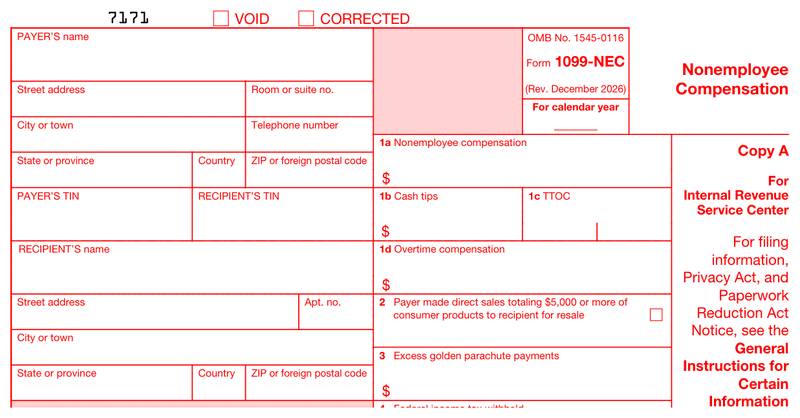
| 1099-NEC | Nonemployee compensation: fees paid to contractors and freelancers for services | Any business that hires contractors |
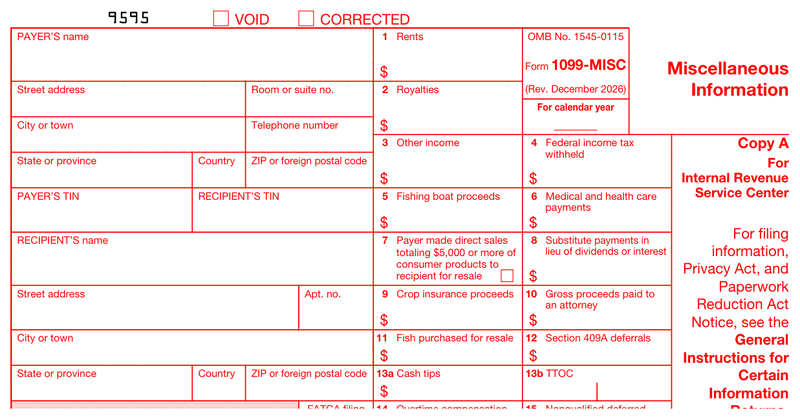
| 1099-MISC | Rents, royalties, prizes and awards, and other income | Landlords, payers of royalties, businesses with miscellaneous payouts |
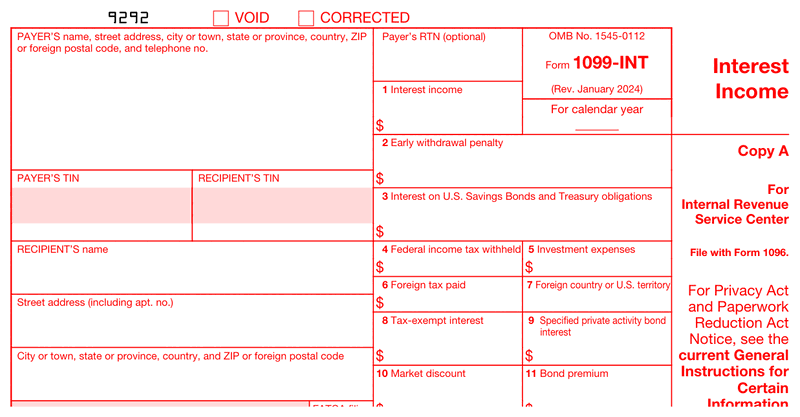
| 1099-INT | Interest income | Banks and other payers of interest |
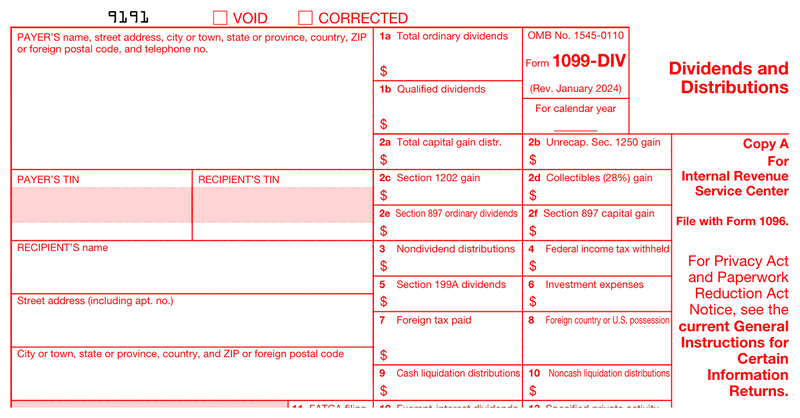
| 1099-DIV | Dividends and distributions | Corporations and brokerages |
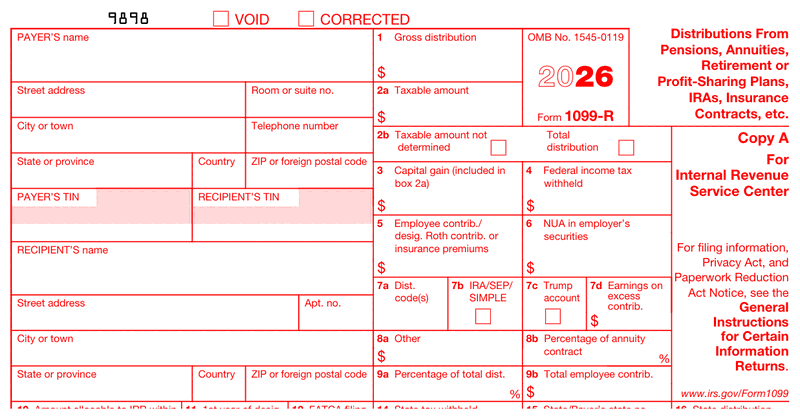
| 1099-R | Distributions from pensions, annuities, and retirement accounts | Plan administrators |
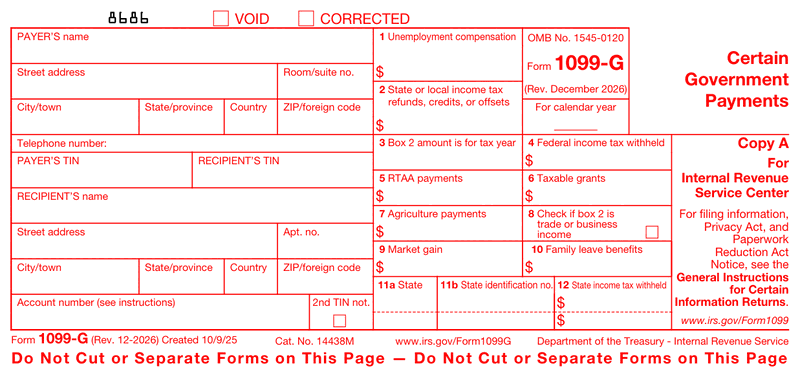
| 1099-G | Government payments such as unemployment and state tax refunds | Government agencies |
| 1099-K | Payment card and third-party network transactions | Payment apps and online marketplaces |
| 1099-DA | Digital asset (crypto and similar) broker transactions | Digital asset brokers |
The two most common business forms are the 1099-NEC and the 1099-MISC, and mixing them up is easy, so it is worth knowing exactly how the 1099-MISC and 1099-NEC differ. The short rule: use the 1099-NEC for services performed by a contractor, and use the 1099 MISC form for other payments like rent, royalties, or legal settlements. If your only payments are contractor fees, that 1099 misc form probably will not enter the picture at all.
One newer entry is worth flagging. The 1099-DA is a brand-new IRS form built to report digital asset sales handled by brokers, starting with the 2025 tax year. Most small businesses will never issue one, but if you or a contractor sold crypto through a broker, expect it to show up alongside the more familiar 1099 forms.
1099 Filing Thresholds
You do not send a 1099 for every dollar. Each type has a minimum dollar threshold, and knowing them keeps you from over-filing or missing a required form. Here are the common ones in a single place:
| Form | Reporting threshold |
|---|---|
| 1099-NEC | $2,000 or more in a tax year, raised from $600 after 2025 |
| 1099-MISC | $2,000 or more ($10 or more for royalties) |
| 1099-INT | $10 or more in interest |
| 1099-DIV | $10 or more in dividends |
| 1099-K | Payment-app and marketplace transactions above the current-year limit |
Watch the 1099-NEC line closely, because the number is changing. For payments made in the 2025 tax year and earlier, the threshold is $600. Under recent tax law, that threshold rises to $2,000 for payments made after 2025, and it is indexed for inflation after that. In plain terms: fewer small contractor payments will require a 1099 going forward, but the form itself is not going away. When you are unsure, err toward collecting a W-9 so you can file if you need to.
1099 Filing Deadlines: When to Send Each Form
The 1099 calendar is tight, and the recipient copy comes first. Send most 1099s to the recipient by January 31. File the 1099-NEC with the IRS by January 31 as well. For other 1099 types, the IRS deadline is February 28 on paper or March 31 when you file electronically.
| Copy | Deadline |
|---|---|
| Recipient copy (most 1099s) | January 31 |
| 1099-NEC to the IRS | January 31 |
| Other 1099s to the IRS (paper) | February 28 |
| Other 1099s to the IRS (e-file) | March 31 |
Missing a deadline brings per-form penalties that climb the longer you wait, so it pays to start early. A simple habit keeps you ahead: create one folder per tax year, labeled by payer or contractor name, and drop each W-9 and payment record in as you go. Set a calendar reminder for early January to reconcile totals, so you are issuing forms in the first week, not scrambling on the 30th.
How to File a 1099 Form
Filing is a short, repeatable workflow once you have the details on hand. Here is the issuer's path from payment to filed form:
- Collect a W-9 from every contractor before you pay them. It captures their legal name and Taxpayer Identification Number.
- Confirm the TIN is present and correct; for a business payee, you can look up their EIN to be sure. This one step prevents most downstream penalties.
- Total each contractor's payments for the tax year and compare against the reporting threshold.
- Prepare the right form, usually a 1099-NEC for services, using those totals.
- Send the recipient copy by January 31, and file the IRS copy by its deadline.
You can file 1099 online or on paper, but electronic filing is faster and, for many businesses, required. The IRS now requires electronic filing once you have 10 or more information returns in total for the year, counting W-2s and 1099s together. E-filing also gives you a confirmation you can keep with your records.
Create a 1099 Form Online
You do not need preprinted red-ink stock or accounting software to produce a clean form. Our 1099 form generator walks you through it on screen:
- Enter your business (payer) information: name, address, and EIN.
- Enter the recipient's details from their W-9, including their TIN.
- Choose the form type (1099-NEC or 1099-MISC) and enter the payment amount and category.
- Preview the completed form to check every box.
- Download a print-ready PDF, then send the recipient copy and keep your own.
Need it two ways? You can pull a blank or printable 1099 form to fill in by hand, or generate a completed one to send right now (our 1099 generator guide walks through both). Either way, you preview the result first and pay only at download, with no subscription. If you also run payroll for W-2 staff, our pay stub generator and pay stub templates handle that documentation in the same place. When you are ready to issue this year's forms, create your 1099 online and skip the trip to the office supply store.
1099 vs W-2: Contractor or Employee
The 1099-versus-W-2 question is really a worker-classification question, and getting it right protects your business. A W-2 goes to employees and reports wages with taxes already withheld. A 1099 goes to non-employees and reports gross payments with nothing withheld.
| 1099 (contractor) | W-2 (employee) | |
|---|---|---|
| Who receives it | Independent contractors, freelancers, vendors | Employees on your payroll |
| Taxes withheld | None; the recipient handles their own | Income, Social Security, and Medicare withheld |
| What it reports | Nonemployee compensation and other payments | Wages and withheld taxes |
| Your control over the work | Limited; they set their own methods | You direct how and when the work is done |
If you decide when, where, and how the work gets done, you are likely looking at an employee who needs a W-2, not a contractor who gets a 1099; our guide to handling both W-2 and 1099 workers covers the overlap. Misclassifying a worker can lead to back taxes and penalties, so when the line is blurry, document your reasoning.
Missing or Incorrect 1099s and Backup Withholding
Here is what happens when a form goes out with a missing or wrong Taxpayer Identification Number. If a contractor will not provide a valid TIN, the IRS requires you to withhold 24% of their payments as backup withholding and remit it. That is money held back from their check and extra work for you.
File 1099s with missing or incorrect TINs and you can face per-form penalties, plus a CP2100 or CP2100A notice from the IRS flagging the mismatch. Neither is fun to unwind mid-season. If you spot an error after filing, issue a corrected 1099 promptly rather than waiting for a notice.
The cleanest fix is upstream: collect a complete W-9 before the first payment and verify the TIN then. Backup withholding exists so the IRS can still collect tax when a payee's number is missing or wrong, and a good W-9 habit keeps that 24% out of the picture entirely.
What's New on the 2026 1099 Form
Two updates make the current 1099 form worth a second look before you file. First, the reporting threshold for the 1099-NEC and 1099-MISC is rising from $600 to $2,000 for payments made after 2025, with inflation indexing after that. Fewer small payments will trigger a form, though you still file for anything at or above the limit.
Second, digital-asset reporting has arrived. The 1099-DA now captures crypto and other digital asset sales handled by brokers, starting with the 2025 tax year. Most businesses will never issue one, but it is part of the family now.
The takeaway for your records is short: always file on the current-year 1099, and do not rely on last year's thresholds when you decide who needs a form.
Which 1099 Tax Year Are You Filing?
If you are issuing these, confirm the payment year before you build the batch. A 1099 for tax year 2025 covers payments you made during 2025 and was due to recipients by February 2, 2026. A 1099 for tax year 2026 covers payments made this year and is due by February 1, 2027.
| Tax year | Payments made | Furnish to recipient | Reporting threshold |
|---|---|---|---|
| 2025 | during 2025 | February 2, 2026 (passed) | $600 |
| 2026 | during 2026 | February 1, 2027 | $2,000 |
That threshold change is the one to watch. For payments made after December 31, 2025, the nonemployee compensation reporting threshold rose from $600 to $2,000, indexed for inflation after 2026. A contractor you would have had to report last year may fall below the line this year, so run the check against the right year rather than assuming last year's answer still holds. Searches for 1099 form 2025 point at the old rule and 1099 form 2026 at the new one.