How to Calculate Federal Withholding for Employees (2026)
By Jaden Miller , September 15 2026

Every time you run payroll, federal law requires you to withhold the correct amount and send it to the IRS. This guide explains exactly how to calculate federal withholding in 7 steps. Use our paystub generator to create pay stubs with all federal withholding line items automatically calculated for your team.
Federal withholding covers three separate components: federal income tax (FIT), Social Security, and Medicare. It covers 2026 rates, a complete worked example, and the IRS Publication 15-T method used by every major payroll platform. Get the calculation wrong and you're looking at IRS penalties. Get it right and your employees won't face a tax-bill surprise in April.
Key Takeaways
- Federal withholding includes federal income tax, Social Security (6.2%), and Medicare (1.45%) per pay period
- Use IRS Publication 15-T to determine FIT based on the employee's W-4 and gross wages
- The 2026 Social Security wage base is $184,500 per employee
- Withhold an additional 0.9% Medicare on wages over $200,000 for single filers
- Use the IRS Tax Withholding Estimator at irs.gov/W4App to verify accuracy
What Is Federal Income Tax Withholding?
Federal income tax withholding is the amount your employer deducts from each paycheck on behalf of the IRS. The withheld amount is applied to your annual income tax liability. Employers calculate it using the employee's Form W-4, gross wages, and IRS Publication 15-T withholding tables for each pay period.
As an employer, you act as a collection agent for the IRS. Your employees earn wages throughout the year, and their income tax obligation grows with every paycheck. Instead of a lump-sum payment at filing, the IRS requires you to collect it incrementally on their behalf. For a business owner, knowing how to calculate federal withholding correctly is a core payroll compliance requirement.
Federal income tax withholding operates on a pay-as-you-go system. It's separate from FICA taxes (Social Security and Medicare), though all three appear as distinct line items on your employees' pay stubs. The withheld amount depends on three factors: gross wages, the employee's tax brackets based on annual income, and the instructions on their W-4 form.
The W-4 Form and Filing Status
Before you calculate federal withholding for a new hire, you need their completed Form W-4. This document tells you exactly how much to withhold. Collect it on or before the employee's first day of work.
The 2020+ W-4: Five Steps
The current W-4 (redesigned in 2020) uses a five-step format. Step 1 captures personal information and filing status: single, married filing jointly, or head of household. Steps 2 through 4 are optional and address multiple jobs, dependents, and other income adjustments. Step 5 is the signature.
Most employees only complete Steps 1 and 5. That's all that's required for standard withholding.
Older W-4 Forms: The Allowance System
Some employees have a pre-2020 W-4 on file. These use withholding allowances rather than the current format. Each allowance reduces the employee's taxable wages by $4,300 for the 2026 tax year. You don't need to require employees to update an older W-4 unless their circumstances change.
Default withholding: If an employee doesn't submit a W-4, withhold at the single filing status with no adjustments.
Record retention: Keep every W-4 on file for at least four years after the tax becomes due or is paid. Make W-4 collection part of your standard new-hire onboarding packet.
How to Calculate Federal Withholding for Your Employees

Here's the 7-step federal withholding process: start with gross pay and subtract pre-tax deductions. Check the W-4 filing status. Apply IRS Publication 15-T tables for FIT, withhold 6.2% for Social Security, and 1.45% for Medicare. Total all three per paycheck. That's the complete process.
Here's how to calculate federal withholding at each step — starting with the first two below. Steps 3 and 4 are covered in the next section.
Step 1: Calculate Gross Pay Per Pay Period
Gross pay is the starting point for every withholding calculation. For hourly employees, multiply hours worked by the hourly rate. For salaried employees, divide the annual salary by the number of pay periods in the year.
Common pay schedules:
- Biweekly (every two weeks): 26 pay periods per year
- Semi-monthly (twice a month): 24 pay periods per year
- Weekly: 52 pay periods per year
Example: A salaried employee earning $65,000 per year on a biweekly schedule receives a gross pay of $2,500 per paycheck.
Step 2: Subtract Pre-Tax Deductions
Pre-tax deductions reduce the employee's taxable wages before you apply any withholding. Common pre-tax deductions include:
- 401(k) or 403(b) retirement contributions
- Health, dental, and vision insurance premiums under an employer-sponsored plan
- Health Savings Account (HSA) contributions
- Flexible Spending Account (FSA) contributions
Example: Gross pay of $2,500, minus a $200 401(k) contribution, leaves $2,300 in taxable wages. This is the figure you carry into the FIT calculation. Knowing how to calculate federal withholding starts with getting these two inputs right. For a detailed breakdown of each deduction type and its tax impact, see our guide to payroll deductions explained.
How to Calculate Federal Withholding Using IRS Publication 15-T
IRS Publication 15-T is the IRS's official withholding resource, available free at irs.gov. Here's how to calculate federal income tax withholding with it: start with the employee's adjusted taxable wages, then check their W-4 for filing status and adjustments. Apply either the wage bracket method (look up withholding amount directly) or the percentage method (calculate using graduated rates).
Step 3: Determine Filing Status from the Employee's W-4
Filing status determines which withholding rate schedule applies. There are three: Single or Married Filing Separately, Married Filing Jointly (or Qualifying Surviving Spouse), and Head of Household.
For employees using a 2020+ W-4:
Check whether Box 2(c) is checked (Step 2 on the form). If checked, apply the higher "Step 2 checkbox" rate schedules from Publication 15-T. If not, apply the standard rate schedules and subtract the withholding adjustment:
- Married Filing Jointly: subtract $12,900 from adjusted annual wages
- All other filing statuses: subtract $8,600
For employees using an older W-4:
Subtract: number of allowances × $4,300. Then apply the corresponding rate table.
If an employee claims exempt on their W-4, don't withhold FIT. They must re-submit by February 15 of each year to maintain exempt status. For any employee who doesn't claim exempt, you'll calculate federal withholding using one of the two methods below.
Step 4: Apply the Wage Bracket or Percentage Method
IRS Publication 15-T provides two methods to calculate federal withholding for income tax.
Wage Bracket Method: Look up the employee's adjusted taxable wages in the tables. Each table is organized by filing status and pay frequency. The table gives a flat dollar withholding amount. This method works for wages within the published range (generally below $100,000 per pay period).
Percentage Method: Follow these steps:
- Start with the employee's adjusted wage amount per pay period
- Annualize: multiply by the number of pay periods
- Subtract the standard deduction for their filing status: $16,100 (single, 2026) or $32,200 (MFJ, 2026)
- Apply the 2026 federal income tax brackets to calculate tentative annual withholding
- Divide by pay periods to get the per-paycheck FIT amount
Worked example (single filer, biweekly, $2,300 taxable wages):
Annualized wage: $2,300 × 26 = $59,800. After the $16,100 standard deduction, taxable income is $43,700. Applying 2026 brackets (10% on $12,400 = $1,240; 12% on $31,300 = $3,756), tentative annual withholding is approximately $4,996. Divided by 26 pay periods: approximately $192 per paycheck.
For supplemental wages (bonuses, commissions, and overtime paid separately), withhold at a flat 22% rate. Download Publication 15-T free from irs.gov.
How to Calculate Social Security and Medicare Tax

The next step in how to calculate federal withholding is FICA: Social Security and Medicare. Here's how to calculate withholding tax for each of these components. Unlike FIT, FICA is not affected by the W-4. It applies at the same flat rate to every employee.
Step 5: Social Security Tax at 6.2%
Social Security tax is 6.2% of the employee's gross wages (before pre-tax deductions). The 2026 wage base is $184,500 (up from $176,100 in 2025). Once an employee hits that threshold, stop withholding for the rest of the calendar year.
Example: $2,500 gross pay × 6.2% = $155.00 per biweekly paycheck.
Employer match: You contribute an additional $155.00 on top of what you withhold. A combined $310.00 goes toward Social Security each pay period, split equally between you and your employee.
Social Security and Medicare together make up FICA. Both appear as separate pay stub line items. For detail on how FICA shows up on payroll documentation, see our guide to what FICA tax means on a paystub.
Step 6: Medicare Tax at 1.45% (+0.9% Additional)
Medicare tax is 1.45% of the employee's total gross wages. There's no wage base cap: it applies to every dollar the employee earns.
Example: $2,500 gross pay × 1.45% = $36.25 per biweekly paycheck.
Additional Medicare Tax (0.9%): Once an employee's wages exceed $200,000 in the calendar year, withhold an extra 0.9% on amounts above that threshold. The $200,000 trigger applies per employee regardless of filing status. For a full breakdown, see the Medicare tax guide.
Step 7: Total All Withholdings
Here's how to calculate federal withholding for one complete employee paycheck.
Employee profile:
- Filing status: Single
- Annual salary: $65,000
- Pay schedule: Biweekly (26 periods per year)
- Gross pay per period: $2,500
- Pre-tax 401(k) deduction: $200
- Taxable wages (for FIT): $2,300
Per-paycheck withholding:
| Tax | Calculation | Amount |
|---|---|---|
| Federal Income Tax | 2026 Pub 15-T, single/biweekly, $2,300 taxable | ~$192.00 |
| Social Security | $2,500 × 6.2% | $155.00 |
| Medicare | $2,500 × 1.45% | $36.25 |
| Total withheld | ~$383.25 |
After withholding, this employee takes home approximately $2,116.75 per paycheck ($2,500 gross minus $200 pre-tax 401k minus $383.25 in withholding).
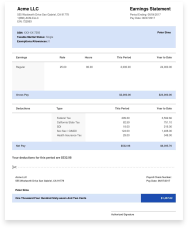
These three deductions (Federal Income Tax, Social Security, and Medicare) appear as distinct line items on every pay stub you generate. Documenting them accurately protects both you and your employees if the IRS questions a filing. Use our pay stub templates to ensure each withholding line is correctly labeled.
Self-Employment Tax for Contractors and Business Owners
For self-employed individuals, how to calculate federal withholding works differently: there's no employer doing it automatically. They manage it themselves through self-employment tax (SECA). The rate is 15.3%: 12.4% for Social Security and 2.9% for Medicare, applied to net self-employment income.
Key points for 2026:
- Deduct half of your SE tax from gross income on Form 1040 to reduce adjusted gross income
- Quarterly estimated tax payments are required if annual SE tax liability will exceed $1,000
- The 2026 Social Security wage base ($184,500) applies to SECA as well
Hiring contractors: If you pay 1099 contractors, you don't withhold any taxes for them. They pay SE tax directly via quarterly estimated payments. You're responsible for issuing Form 1099-NEC by January 31 for any contractor paid $600 or more during the year. For any contractor who needs income documentation, a self-employed pay stub can serve as proof of earnings.
State and Local Tax Withholding
Knowing how to calculate federal withholding is necessary, but most states require additional withholding on top of federal. Nine states have no state income tax: Alaska, Florida, Nevada, New Hampshire, South Dakota, Tennessee, Texas, Washington, and Wyoming. In every other state, register with the state revenue department and apply the state's withholding tables to each paycheck. To see how state obligations interact with your federal requirements, see our breakdown of how state tax affects federal tax.
State Unemployment Tax (SUTA): Most employers owe SUTA, a state unemployment insurance tax paid entirely by the employer. Rates vary by state and by your company's claim history. For an overview of how different tax types interact, see our breakdown of 3 types of taxes employees typically see on their pay stubs.
How Much Federal Tax Should I Withhold?
The right withholding amount keeps your tax bill or refund close to zero at filing. Use the IRS Tax Withholding Estimator at irs.gov/W4App for a precise answer. A general rule of thumb: aim for a refund or balance due of no more than $1,000 per year.
Once you know how to calculate federal withholding correctly, the next question is whether the amount is right for each employee's total annual income picture. Understanding how to calculate tax withholding and verifying it are two different steps. The IRS Tax Withholding Estimator is free and takes about five minutes. It accounts for income sources, deductions, and credits to generate a personalized recommendation on how much should be withheld for federal taxes.
When to update withholding:
- Marriage, divorce, or birth of a child
- A second job or significant income change
- A large refund or unexpected tax bill at filing
Employer tip: Point new hires to the estimator during onboarding. It helps them set accurate withholding from day one and reduces complaints when April arrives.
2026 Federal Withholding Rates at a Glance
Understanding how to calculate federal withholding starts with knowing the current rates. Use this table any time you need to calculate federal tax withholding for your employees. These figures are updated for the 2026 tax year and reflect current IRS guidance.
| Tax | Rate | 2026 Wage Base / Threshold |
|---|---|---|
| Federal Income Tax | Per IRS Publication 15-T | Based on W-4 + pay period frequency |
| Social Security (employee) | 6.2% | Wages up to $184,500 |
| Medicare (employee) | 1.45% | No wage base cap |
| Additional Medicare | +0.9% | Single: $200,000+ / MFJ: $250,000+ |
| FUTA (employer only) | 0.6% | First $7,000 per employee |
| Supplemental wages | 22% flat | Bonuses, commissions, overtime paid separately |
Source: IRS Publication 15-T (2026) and IRS.gov.
You Might Also Like
- Pay Stub for Tax Filing
- Adjusted Gross Income on W-2
- How to Estimate Quarterly Taxes for 1099 Workers
- Managing Employee Pay Stubs
- Provision for Income Taxes
Conclusion
Now that you know how to calculate federal withholding for your employees, the process is straightforward. Collect a W-4 from every hire. Calculate gross pay and subtract pre-tax deductions. Apply IRS Publication 15-T for FIT. Then add Social Security (6.2%) and Medicare (1.45%) to get the total per paycheck.
Three figures to keep on hand: the 2026 Social Security wage base is $184,500. Medicare has no cap. FIT follows each employee's W-4 filing status. Total all three per paycheck and you've done it right.
Ready to put accurate withholding on paper? Use our paystub generator to create professional pay stubs for your entire team, with all federal withholding line items calculated and displayed automatically.
---
Word Count: ~2,090 words (body, excluding Key Takeaways ~65 words and FAQs ~275 words)
Last Updated: 2026-03-18



Frequently Asked Questions
Similar Articles



We’ve helped numerous individuals and businesses create professional documents! Create yours today!