1099 Pay Stub Guide for Business Owners and Contractors (2026)
By Jaden Miller , October 10 2026

A 1099 pay stub is a self-generated record of what a contractor earned and set aside for taxes in a given pay period. Clients don't issue one, so the contractor or the business keeping the books builds it. Here's what it contains, what a client should provide instead, and how to produce one with PayStubs.net that holds up.
Key Takeaways
- Clients paying independent contractors don't issue stubs, but contractors can create their own.
- For 2026 payments, clients send a Form 1099-NEC once a year at the $2,000 threshold.
- A solid stub shows gross income, a self-employment tax set-aside, net pay, and year-to-date totals.
- Every figure should trace back to an invoice or a bank deposit.
Do 1099 Employees Get Pay Stubs?
Usually not. Clients paying independent contractors don't run payroll, so no employer-issued stub exists. Contractors receive payment records and, for 2026 payments of $2,000 or more, a Form 1099-NEC after year-end. Many contractors create their own stubs to document income for lenders and landlords.
As a business owner, you've probably noticed the gap, and our explainer on what a 1099 employee is covers the basics. A worker's payment history lives in invoices and bank transfers, while a once-a-year Form 1099-NEC doesn't help a landlord who wants recent pay. The threshold rose from $600 to $2,000 for payments made in 2026, and income below it is still taxable.
| W-2 employee | 1099 contractor | |
|---|---|---|
| Who issues pay records | Employer payroll | No one by default |
| Taxes taken out | Withheld each pay period | None; contractor sets money aside |
| Year-end form | W-2 | 1099-NEC |
For a deeper comparison, see our guide to W-2 and 1099 workers.
Why Contractors Need Their Own Records

Proof of income is the main reason. Rental applications and loan underwriting expect recent, consistent earnings, and a self employed worker has no HR department to supply them. Lenders read a stub the way they read a check stub from a regular job, so yours should be just as clear. A stub also forces a monthly look at your numbers, so quarterly estimated tax payments don't catch you off guard.
For you as a business owner, per-client records show which relationships generate the most revenue. If you want a faster route, our 1099 contractor pay stub tool builds the stub and the tax math in one pass, while our pay stub templates cover your employees.
What Goes on a 1099 Pay Stub
Reviewers check each line against bank statements. Every field needs a source.
| Field | What to enter | Why a reviewer checks it |
|---|---|---|
| Payer and client name | Business or person who paid you | Confirms who the income came from |
| Pay period | Dates the work covers | Matches invoice dates |
| Hours worked | For hourly billing only | Supports the gross income figure |
| Gross income | Total billed and received | Compared with bank deposits |
| Self-employment tax | Set-aside for Social Security and Medicare | Shows tax awareness |
| Income tax set-aside | Your own estimate | Optional, labeled as an estimate |
| Net pay | Gross minus set-asides | What you actually keep |
| Current total (YTD) | Running totals for the year | Shows consistency over time |
The IRS self-employment tax rules set the rate at 15.3%: 12.4% for Social Security and 2.9% for Medicare. It applies to 92.35% of net earnings, which works out to about 14.1% of net profit. In 2026 the Social Security portion stops at $184,500 of earnings, while Medicare has no cap. Net earnings of $400 or more trigger the tax.
What Does a 1099 Pay Stub Look Like?

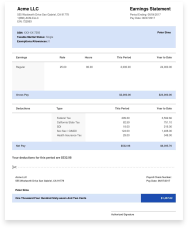
A worked example makes it concrete. Say a contractor billed and collected $4,000 in September 2026, with no business expenses and a steady $4,000 each month so far.
| Line | This period | Year to date |
|---|---|---|
| Gross income | $4,000.00 | $36,000.00 |
| Self-employment tax set-aside (15.3% of 92.35%) | $565.18 | $5,086.64 |
| Federal income tax set-aside (10% estimate) | $400.00 | $3,600.00 |
| Net pay | $3,034.82 | $27,313.36 |
The math: $4,000 x 92.35% = $3,694.00, then x 15.3% = $565.18. The income tax line is the contractor's own choice, not withholding, so label it an estimate. Actual liability depends on your tax deductions and bracket.
How to Create a 1099 Pay Stub
Start with source documents, not a blank template. These steps keep every number defensible.
- Gather the invoice and the matching deposit for the pay period.
- Record gross income and your payer's name.
- Calculate the self-employment tax set-aside using the 92.35% rule.
- Add an estimated income tax line if you want one.
- Subtract set-asides for net pay, then update the year-to-date column.
- Save the PDF in a folder by year and client.
Choose a cadence that fits your work: per payment, monthly, or quarterly in line with the 1040-ES due dates of April 15, June 15, September 15, and January 15. Keep one stub per client if a lender asks who pays you. Use one combined stub if a single total is enough. Managing many contractors? Batch the same steps monthly so nothing slips.
1099 Pay Stub Template vs. a Generator
A blank spreadsheet looks free, but you still do the work. That means the tax math, the year-to-date totals, and the formatting. One wrong formula and the stub no longer matches your bank statement. A 1099 generator handles those calculations and produces consistent output every pay period, which matters when you issue documents for several workers.
Compliance: What Your Business Should Provide Contractors
A business isn't required to run contractors through payroll. The cleaner approach is a payment statement with each payment. Add a 1099-NEC at year-end once the $2,000 threshold applies. Don't withhold payroll taxes or issue employee-style stubs. That can blur the line the IRS classification rules draw between contractors and employees. Check your own situation with a tax professional, and review 1099-MISC vs. 1099-NEC so you file the right form.
For contractors, keeping it legitimate means stubs must match deposits, amounts shouldn't repeat in suspicious round numbers, and income is never inflated. Misrepresenting earnings on a lease or loan application can be fraud.
Proof-of-Income Toolkit and Record-Keeping
Pair stubs with supporting documents so a reviewer sees one consistent story:
- Filed tax return with Schedule C
- Each client's 1099-NEC
- Three to six months of bank statements
Keep records at least three years, or six if you underreported income by more than 25%. For contractor taxes, see how to estimate quarterly taxes on 1099 income.
You Might Also Like
- 1099 Tax Deductions
- How to Report Freelance Income Without a 1099
- Self Employed Pay Stub
- Proof of Income Generator
- Self Employed Taxes for Dummies
Conclusion
A reliable stub turns scattered invoices into clear proof of income, and a clean payment record keeps your business on the right side of contractor rules. Build each one from source documents, and keep your files organized by client and year.
Ready to save time? Use our paystub generator to create accurate records for every contractor in minutes.



Frequently Asked Questions
Similar Articles



We’ve helped numerous individuals and businesses create professional documents! Create yours today!