What Is a 1099 Employee? A Simple Guide for Beginners (2026)
By Jaden Miller , March 2 2026
If someone just called you a "1099 employee" and you have no idea what that means, don't worry. You're not alone. So what is a 1099 employee, exactly? It's a term people use for independent contractors, freelancers, and self-employed workers who aren't on a company's payroll. This guide breaks down everything about what is a 1099 employee in plain English so you can feel confident. Need pay documentation right now? Try our pay stub generator free pdf to get started.
Key Takeaways
- A "1099 employee" is actually an independent contractor, not a traditional employee
- Unlike W-2 workers, you handle your own taxes, including the 15.3% self-employment tax
- You won't get a traditional pay stub, but you can create one yourself for loans, rentals, and records
- The IRS uses 3 tests to determine if you're an employee or contractor
- Starting in 2026, the 1099-NEC filing threshold increases from $600 to $2,000
What Is a 1099 Employee?
A 1099 employee is actually an independent contractor, not a traditional employee. The name comes from Form 1099-NEC, which clients use to report payments. Unlike W-2 employees, 1099 workers handle their own taxes, set their own schedules, and don't receive employer benefits like health insurance or retirement plans.
Here's the thing: there's no such thing as a "1099 employee" in the eyes of the IRS. What is a 1099 independent contractor? It's the correct term for someone who works for themselves or on contract. Nobody puts you on their payroll. You might be a freelance graphic designer, an Uber driver, a consultant, or a gig worker in the gig economy. Think of it this way: an employee is on the team full-time; a contractor is hired for the game.
What Is a 1099 Employee vs a W-2 Employee?

The main difference is how you're taxed and who controls your work. W-2 employees have taxes withheld by their employer and receive benefits like health insurance and paid time off.
A 1099 employee pays their own taxes (including 15.3% self-employment tax), sets their own hours, and doesn't receive employer-provided benefits. If you're unfamiliar with the W-2 form, it's the tax document regular employees receive.
-
Taxes:
-
W-2 Employee: Employer withholds taxes from paycheck
-
1099 Contractor: You pay taxes yourself
-
-
Benefits:
-
W-2 Employee: May receive health insurance, PTO, and retirement benefits
-
1099 Contractor: No benefits provided by the client
-
-
Schedule:
-
W-2 Employee: Work schedule set by the employer
-
1099 Contractor: You decide your own schedule
-
-
Payroll taxes:
-
W-2 Employee: Taxes split with the employer
-
1099 Contractor: You pay the full 15.3% self-employment tax
-
-
Workers’ compensation:
-
W-2 Employee: Covered by employer
-
1099 Contractor: Typically not covered
-
-
Unemployment insurance:
-
W-2 Employee: Eligible
-
1099 Contractor: Not eligible
-
Now you know what is a 1099 employee vs a W-2 employee. Don't panic if you're 1099. It just means more flexibility and a bit more responsibility when it comes to taxes.
How Does 1099 Work?
The IRS uses three tests to determine worker classification: behavioral control (can the company direct how you work?), financial control (do you control your business expenses and rates?), and type of relationship (is there a written contract or benefits?). Failing these tests may mean you're actually an employee.
Understanding what is a 1099 employee starts with knowing how the IRS classifies workers. Here's how does 1099 work in practice. The IRS looks at three specific factors.
Behavioral Control
Can the company tell you HOW to do your work? If your client gives you a deadline but lets you decide when and how you complete the project, that points to contractor status. If they control your daily schedule and give detailed instructions, that looks more like an employee.
Financial Control
Do you pay your own business expenses? Can you set your own rates and work for multiple clients? If yes, you're likely a contractor. Employees typically use company equipment and receive a set wage.
Type of Relationship
Is there a written contract? Does the company provide benefits like health insurance? A contract with a defined project scope suggests contractor status. Benefits and an open-ended relationship suggest employment.
If you're unsure, file Form SS-8 with the IRS for an official determination. The Department of Labor's 2024 final rule also introduced a 6-factor economic reality test.
How Does 1099 Pay Work?
As a 1099 worker, you invoice clients and receive payment without any tax withholding. You're responsible for paying 15.3% self-employment tax (12.4% Social Security plus 2.9% Medicare). You also make quarterly estimated tax payments to the IRS.So how do you pay independent contractors? Clients can send 1099 pay through direct deposit, checks, PayPal, or other methods. The key difference: nothing gets taken out for taxes. If you need to know how to pay taxes as a 1099 employee, the answer is quarterly estimated payments. You'll pay 1099 contractors through direct deposit, checks, or digital platforms.
Here's the self-employment tax breakdown:
- Social Security: 12.4%
- Medicare: 2.9%
- Total self-employment tax: 15.3%
On top of that, you'll owe federal and state income tax. Set aside about 25% to 30% of your income for taxes.
Tax Forms You Need to Know About
There are two key forms for 1099 workers. Form W-9 is what you fill out before starting work with a client. Form 1099-NEC is what clients send you by January 31 showing total payments. Starting in 2026, the IRS only requires a 1099-NEC for payments of $2,000 or more. If you need a 1099 form self employed, here's what to know. You can also learn about the different types of taxes you'll encounter.
Form 1099-NEC
Your client sends this by January 31 each year showing total payments. Looking for a printable 1099 form independent contractor? You can download blank forms from the IRS website. The 2026 filing threshold is now $2,000 (up from $600). This form reports non-employee compensation to the IRS.
Form W-9
Before you start working with a new client, they'll ask you to fill out a W-9. This gives them your name, address, and Taxpayer Identification Number. Think of the W-9 as your introduction form and the 1099-NEC as your year-end summary.
Deadlines That Matter
Clients must send your 1099-NEC by January 31. You'll need to make quarterly estimated tax payments in April, June, September, and January.
Do 1099 Employees Get Pay Stubs?
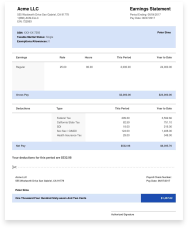
No, 1099 workers don't automatically receive pay stubs like W-2 employees do. There's no 1099 pay stub example waiting in your inbox. Since there's no employer running payroll, no pay stub is generated. However, you can create your own 1099 pay stub using a pay stub generator. You'll likely need one when applying for mortgages, rentals, or auto loans. Learn more about what pay stubs are and why they matter.
Do independent contractors get pay stubs from their clients? No. But you can create a pay stub for 1099 employee income yourself. Landlords want proof of income for apartments. Mortgage lenders need pay documentation. Auto loan companies may ask for a pay stub for independent contractor income verification.
A self employed pay stub solves these problems. A contractor pay stub or even a 1099 check stub also works as valid income proof.
New to pay stubs? Our easy-to-use tool walks you through every step.
How to Create a 1099 Pay Stub
Creating one takes about 2 minutes with an online generator. You'll need your gross income for the pay period, your business name, the payment dates, and your self-employment tax rate (15.3%). Enter the details into a 1099 paystub generator like PayStubs.net, and download your completed stub instantly.
Here's how to create a 1099 pay stub in five steps. The process is faster than you think:
- Gather your gross income for the pay period
- Enter your business information including your name and business name
- Note the payment period and dates
- Review the tax calculations. The generator handles self-employment tax automatically
- Download your completed independent contractor pay stub as a PDF
Learning how to make a pay stub for self employed income follows this same process. It works for other roles too, like creating a nanny pay stub or any freelancer income documentation.
What Goes on a 1099 Pay Stub
Every document needs the right details to be valid. A 1099 pay stub template includes these elements:
- Contractor/business name (instead of an employer name)
- Gross pay for the period
- Self-employment tax (you cover the full 15.3%)
- Any business deductions
- Net pay (your take-home amount)
Looking for an example? Use our paystub generator to see exactly what one looks like. Whether you need documentation for a loan or self employment pay stubs for tax records, the right tool makes it simple. Browse our paystub templates to find the right format.
What Happens If You're Misclassified?
Now that you understand what is a 1099 employee, here's a risk to watch for. Sometimes companies wrongly classify employees as 1099 contractors to avoid paying payroll taxes, benefits, and workers' compensation. This is called employee misclassification. Understanding what is a 1099 employee helps you spot when something doesn't add up.
If your "contractor" role feels a lot like a regular job (set hours, company equipment, one client only), you might be misclassified. That matters because you could be missing out on overtime pay, health insurance, and unemployment insurance. File Form SS-8 with the IRS to request an official determination. If you need to access old pay records, here's how to access pay stubs from current or former employers.
You Might Also Like
- Is a Pay Stub Proof of Residency?
- Do You Get a 1099 for Life Insurance Proceeds?
- Do Minors Have to Pay Taxes?
- Tax Loopholes You Should Know About
- Is PTO Taxed?
- Best Buy W2: How To Get Yours
Conclusion
Now you fully understand what is a 1099 employee and how it all works. Being a 1099 employee (or more accurately, an independent contractor) might feel confusing at first. But now you know the basics. You understand how it differs from W-2 employment, how the IRS classifies workers, and how to handle taxes and pay documentation.
Ready to create your first pay stub? It's easier than you think. Get started in minutes with our simple paystub generator and you'll have professional income documentation in no time.



Frequently Asked Questions
Similar Articles



We’ve helped numerous individuals and businesses create professional documents! Create yours today!