How Much Overtime Is Too Much? Employer Guide (2026)
By Jaden Miller , April 22 2026

When overtime eats into your margins, it stops being a scheduling choice. It becomes a business problem. If you run payroll and want to know how much overtime is too much for your team, the answer is not just about federal law. It is also about what those extra hours cost you in wages, output, and turnover. This guide covers the 2026 rules, the real cost math, and what your team's pay stubs need to show.
Key Takeaways
- Federal overtime kicks in after 40 hours in a workweek at 1.5x the regular rate of pay.
- Overtime climbing past 5% of total labor cost is a sign your staffing model is broken.
- Output at 60 hours per week drops to roughly 66% of normal.
- Salaried staff earning under $684 per week are still owed overtime pay.
- Every overtime hour must appear as a separate line item on the pay stub.
FLSA Overtime Rules Every Employer Must Follow
Before you can say how much overtime is too much, you need the legal baseline. The Fair Labor Standards Act (FLSA) is the federal law that defines overtime for most U.S. employers. The rule is simple. Nonexempt staff who work more than 40 hours in a single workweek must be paid at time and a half. That is 1.5 times the regular rate for each hour past 40. The Department of Labor enforces this. If you get it wrong, the penalties include back wages plus extra damages.
A "workweek" under the FLSA is a fixed, recurring period of 168 hours. As the employer, you choose when your workweek starts. Once set, it should stay the same. The 40-hour overtime threshold is counted per workweek, not per pay period. That detail trips up more small businesses than any other part of the law.
The two-week averaging trap. If you run biweekly payroll, you cannot average hours across the two weeks. A worker who logs 35 hours one week and 45 the next has worked 5 hours of overtime. You owe time and a half on those 5 hours even though the biweekly total is 80. The FLSA is clear on this, and averaging is one of the fastest ways to end up in a back-pay fight with the DOL.
The rules apply to hourly and most salaried workers alike. They apply to every pay setup: weekly, biweekly, semi-monthly, or monthly. Labor laws at the federal level do not bend for your accounting setup.
How Much Overtime Is Too Much for Salaried Employees?

Most hourly workers and any salaried worker earning under $684 per week ($35,568 per year) are nonexempt. They are owed overtime under federal law. Only salaried workers who meet both the salary threshold and specific executive, administrative, or professional duties tests are exempt. A job title alone never decides overtime eligibility.
That $684 figure is the current federal salary threshold. It has been updated before, so check the current number before you set pay. Paying a shift lead $600 a week does not make them exempt. Calling someone a "manager" does not either if their real work is running a register or stocking shelves. The duties test matters as much as the salary. For exempt staff, how much overtime is too much becomes a workload and retention question, not a wage issue. You do not owe premium pay on top of their monthly salary. You do still owe them a sustainable schedule.
How to Calculate Overtime Pay
The formula is simple. Take the worker's regular hourly rate. Multiply by 1.5. Then multiply that by each hour worked past 40 in the workweek.
Worked example: a worker earns $18 per hour and logs 47 hours in a workweek.
- Regular pay: 40 hours × $18 = $720
- Overtime pay: 7 hours × $27 (which is $18 × 1.5) = $189
- Gross pay for the week: $909
If a worker does two different jobs at two different rates for you, the FLSA calls for a blended or weighted-average rate for overtime. Run the math right the first time or your pay stubs will be wrong. That creates audit risk.
The True Cost of Excessive Overtime

The invoice price of overtime is 1.5x the wage. The real price is much higher. That is why how much overtime is too much is a business question, not just a legal one.
Research on extended work hours shows a clear output curve. Staff working 60 hours a week turn out roughly 66% of the output they would at a normal 40-hour schedule. In payroll terms, you are paying 150% of the wage for 66% of the output. Per hour of labor, excessive overtime is one of the most costly things on your books.
The 5% rule. A healthy labor cost setup keeps overtime under 5% of total payroll. When overtime creeps above that, it is usually not a scheduling problem. It is a staffing gap. The extra hours are masking a missing headcount.
Employee turnover costs compound the problem. Replacing a single worker often costs $1,500 to $5,000. That covers recruiting, onboarding, and lost output during ramp-up. Burnout from working overtime drives a lot of that turnover. It also chips away at work-life balance. Sick days climb too, which forces even more overtime to cover. The cycle feeds itself. A healthy work-life setup is what keeps this from spiraling, and protecting personal time is cheaper than hiring twice.
Rising error rates and safety incidents round out the picture. Productivity decline is not only about speed. It shows up as mistakes, customer complaints, and workplace accidents. Each of those carries its own cost. For most small businesses, the cheapest fix for chronic overtime is hiring another person, not paying the premium forever.
How Much Overtime Is Too Much? Warning Signs in Your Business
By the time overtime shows up as a line on your P&L, the problem has been running for weeks. Look for these earlier signs in your operations. They help you judge how much overtime is too much for your specific team.
- The same staff hit overtime every week. One or two repeat names is normal. A pattern across the same three or four people every week means your schedule cannot meet demand without them.
- Overtime concentrates in one department. If shipping always runs overtime but the front office does not, you have a workflow bottleneck, not a general staffing issue.
- Quality incidents trend up. Returns, rework, customer complaints, and safety events all climb when your team is running hot. Track these alongside hours.
- Sick days and no-shows increase. Fatigue shows up as absenteeism before it shows up as turnover. Rising call-outs in high-overtime roles is the canary in the coal mine.
- Anyone passes 55 hours per week. At that point, you are in fatigue-risk territory. The OSHA and NIOSH research on work hours and injury risk is clear. Risk rises sharply past the 50-55 hour mark.
If two or more of these signs show up, stop treating overtime as a scheduling lever. Start treating it as a hiring question.
Can You Require Mandatory Overtime?
Yes. Under the Fair Labor Standards Act, employers can require mandatory overtime from staff age 16 or older. Those hours must be paid at one and a half times the regular rate. Some states and union contracts limit this for nurses, first responders, and other regulated fields.
The catch is that federal law lets you require overtime, but it does not stop staff from quitting over it. Staff can refuse work overtime in many state and union setups too, even when federal law allows it. Mandatory overtime used as a crutch burns through staff fast. That brings you right back to how much overtime is too much before your team starts walking. Best practice is simple:
- Put your overtime policy in writing in the employee handbook.
- Give fair notice when you need extra hours.
- Document refusals the same way each time if you plan to enforce discipline.
A clear written policy is your main defense if a firing is ever challenged.
State-Specific Overtime Rules
Some states layer extra overtime rules on top of the federal 40-hour workweek rule. When state and federal rules conflict, you follow the one that protects the worker most.
| State | Rule |
|---|---|
| California | Overtime after 8 hours in a day. Double-time after 12 hours in a day or after 8 hours on the 7th day in a row. |
| Alaska | Overtime after 8 hours in a day. |
| Nevada | Daily overtime for staff earning less than 1.5x the state minimum wage. |
| Colorado | Overtime after 12 hours in a day or after 40 hours in a week. |
| New York | Standard federal 40-hour rule, with extra rules for hospitality and residential workers. |
If you run payroll in many states, your system needs to apply the right rule per location, not the one rule that works in your home state.
How Overtime Affects Payroll Taxes
Overtime wages are taxed the same way regular wages are. The worker's overtime pay is subject to federal income tax at their marginal tax rate, plus Social Security and Medicare (FICA). Your job as the employer is to withhold right and match the FICA portion. It is the same as with any paycheck. Overtime can also push a worker into a higher tax bracket at year-end, so the refund or balance due may shift.
A common myth in 2026 is that overtime is tax-free. Despite ongoing proposals in Congress, there is no universal federal tax break on overtime pay. Some limited deductions have shown up in specific tax bills. For payroll, you should withhold as normal. Let the worker sort out any deduction at filing time with the IRS. Telling a worker their overtime will not be taxed creates a W-2 mess you do not want.
Documenting Overtime on Pay Stubs
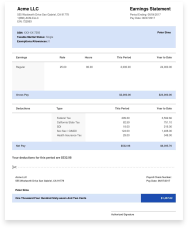
Every hour of overtime needs its own line on the pay stub. That means overtime hours, overtime rate, and overtime amount shown apart from regular wages. This is not a formatting choice. Under FLSA recordkeeping rules, employers must keep detailed payroll records for two to three years, based on the record type.
When the Department of Labor audits you, they start with pay stubs and time records. Sloppy pay stub docs that lump regular and overtime pay into one total are an instant red flag. It also makes it almost impossible to prove you paid right. If you need a refresher on what a compliant stub looks like, our guide to understanding your paystub walks through every line item.
If you are making pay stubs by hand, you are creating audit risk. An automated tool built from compliant pay stub templates handles the overtime split for you. Regular hours at the regular rate. Overtime hours at 1.5x. State-specific double-time if it applies. All on a clean stub the worker can keep and you can defend.
How to Manage Overtime in Your Business
The cheapest overtime hour is the one you prevented, not the one you paid at 1.5x. Once you have decided how much overtime is too much for your shop, a few habits save real money. They also help you avoid common payroll mistakes.
- Set alerts at 35 hours, not 41. Your time-tracking tool should flag the number hours each person has worked mid-week. When a worker hits 41 hours, the overtime is already earned. Flags at 35 or 38 hours give you a chance to shift the schedule before the cost lands.
- Review overtime weekly with managers. Make the overtime report a standing item in your weekly ops meeting. If the same names show up four weeks running, treat it as a hiring talk.
- Cross-train to spread coverage. When only one person can run the register, close the shop, or operate the gear, their overtime is structural. Cross-training removes single points of failure and the premium wages that come with them.
- Audit your schedule against demand data. If overtime clusters on Fridays and Saturdays every week, your schedule does not match your demand. Fix the schedule first. Then fix the staffing.
Balancing work and rest is what keeps output high. When staff work overtime hours past 40 week after week, errors climb and morale drops. Treat the overtime report as an early warning system, not a badge of effort.
You Might Also Like
- Walmart Paystub Portal
- ADP Paystub Guide
- Employment Verification Letter
- IRS Audit Red Flags
- What Is a Payroll Tax Holiday?
Conclusion
How much overtime is too much depends on your margins, your state, and how fast your team starts to burn out. The FLSA sets the federal floor at 40 hours per workweek for nonexempt staff. Your state may set stricter rules. Once overtime passes 5% of total labor cost, it is almost always a staffing gap rather than a scheduling choice. Document every overtime hour on the pay stub, track the pattern weekly, and treat chronic overtime as a hiring talk.
Need to make accurate, compliant pay stubs for your staff with overtime figured out for you? Use our paystub generator to create pro pay docs in minutes.



Frequently Asked Questions
Similar Articles



We’ve helped numerous individuals and businesses create professional documents! Create yours today!