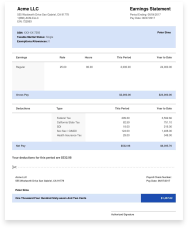
Biweekly Pay Stub Explained: What It Is & How to Read It (2026)
By Jaden Miller , March 5 2026

If your employer just told you you'll be paid biweekly and you're thinking "wait, what does that mean for my paycheck?" you're not alone. Your first biweekly pay stub can feel overwhelming. It's full of numbers and terms you've never seen before.
Don't worry. By the end of this guide, you'll know what a biweekly pay stub is, what every field means, and how your pay gets calculated. No payroll experience required. Head to PayStubs.net if you ever need to create one yourself.
Key Takeaways
- Biweekly pay means you get paid every two weeks, giving you 26 paychecks a year (sometimes 27, like in 2026)
- Your biweekly pay stub shows your gross pay, deductions (taxes and benefits), and your net take-home amount for that 2-week period
- Biweekly and semimonthly are NOT the same thing: biweekly is every 2 weeks (26x/year), semimonthly is twice a month (24x/year)
- 2026 is a 27-pay-period year for some biweekly schedules, meaning slightly smaller per-period paychecks for salaried employees
- Need a pay stub? You can create one at PayStubs.net in minutes, no payroll experience needed
What Is a Biweekly Pay Stub?
A biweekly pay stub is a payment document your employer issues every two weeks, covering a 14-day pay period. It shows your gross earnings for that period, any deductions (taxes, benefits), and your net take-home pay. With biweekly pay, you receive 26 pay stubs per year, sometimes 27 in years like 2026.
Think of a biweekly paystub as a receipt your employer gives you every two weeks. Just like a store receipt shows what you bought and how much you paid, your pay stub shows what you earned and what came out before you got paid.
With a biweekly pay schedule, each stub covers exactly 14 days of work. So if your pay period runs from March 3 to March 16, that 2-week window shows up right at the top. We'll explain the math behind your check amount in the calculation section below.
Biweekly vs. Bimonthly: What's the Difference?
"Biweekly" means every two weeks. Simple enough. But "bimonthly" is trickier: it can mean either twice a month OR every two months depending on who's using it. That's why most employers use "semimonthly" instead (twice a month, 24 times a year) to avoid confusion. Not sure what the difference is between a pay stub vs payslip? They're the same document, just different names.
What's on a Biweekly Pay Stub?
So you've got your pay stub in hand. What do all those boxes and numbers mean? Here's a plain-English walkthrough of every field you'll see. If you need a bi weekly pay stub example to follow along, our pay stub templates show each field filled in correctly.
Pay Period Dates
The "from" and "to" dates at the top of your stub show your 2-week work window. For example: "Pay Period: 03/03/2026 - 03/16/2026." This tells you which 14 days of work are being paid.
Gross Pay
Your gross pay is your total earnings before anything is taken out. For hourly workers, it's your hourly rate multiplied by the hours you worked during the pay period. For salaried employees, it's your annual salary divided by 26 (your number of pay periods).
Deductions
This is the section that surprises most first-timers. Several things get subtracted from your gross pay:
- Federal income tax withholding: Based on your W-4 filing status
- State income tax: Varies by state (some states have no income tax)
- FICA taxes: Social Security (6.2%) and Medicare (1.45%) come out of every paycheck
- Benefit deductions: Health insurance premiums, 401(k) contributions, dental/vision coverage
The sum of all these is your total deductions for the period. Your gross wages minus your deductions equals your net pay.
Net Pay
Net pay is what actually hits your bank account through direct deposit (or what's on your physical check). It's sometimes called "take-home pay." This is the number most people care about most, and it's always smaller than gross pay because of those deductions.
YTD Totals
YTD stands for year-to-date. Your stub shows YTD columns alongside the current period columns. These running totals tell you how much you've earned and how much has been deducted in taxes and benefits since January 1 of the current year. The YTD section is especially useful at tax time. For a deeper look at what each section means, see our guide on earnings statements.
Every field on your biweekly pay stub is there for a reason. And now you know what each one means.
Biweekly vs. Semimonthly Pay: What's the Difference?
Biweekly pay means you're paid every two weeks, 26 times per year. Semimonthly pay means you're paid twice a month on fixed dates (like the 1st and 15th), 24 times per year. On the same $52,000 salary, your biweekly stub shows roughly $2,000 gross per period versus $2,166 for semimonthly. They are not the same.
This trips up a lot of people, and honestly, even HR professionals sometimes mix them up. Here's a clear comparison:
| Biweekly | Semimonthly | |
|---|---|---|
| Pay periods per year | 26 | 24 |
| Pay dates | Every 2 weeks (varies) | Fixed dates (e.g., 1st and 15th) |
| Gross per period ($52k salary) | ~$2,000 | ~$2,166 |
| Overtime calculation | Clear 2-week pay window | More complex (spans variable days) |
| Three-paycheck months | Yes, twice a year | Never |
The pay stub difference is important to understand: a bi weekly pay stub will show a slightly smaller gross amount than a semimonthly one for the same annual salary. This is totally normal and not a mistake. You're not earning less. It's just split over more pay cycles. Our full guide on semimonthly pay breaks down how that schedule works.
Speaking of three-paycheck months: if you're on a biweekly pay schedule, twice a year you'll get three paychecks in a single calendar month. That third paycheck is a great time to boost savings or pay off debt.
How to Calculate Your Biweekly Pay
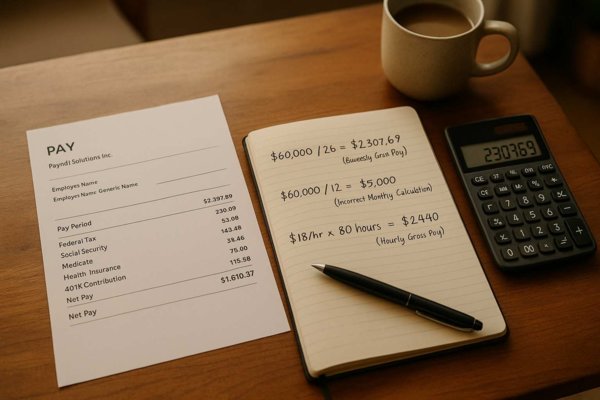
For hourly employees: multiply your hourly rate by 80 (the standard hours in a 2-week period). Example: $18/hr x 80 hours = $1,440 gross biweekly. For salaried employees: divide your annual salary by 26. Example: $52,000 / 26 = $2,000 gross per biweekly paycheck. Your actual take-home will be lower after taxes and deductions.
The math is simpler than it looks.
Hourly: Multiply your rate by 80 hours (40 hrs/week x 2 weeks). Example: $18/hr x 80 = $1,440 gross. Any hours over 40 in a single week count as overtime pay at 1.5x your rate. Learn more about how overtime and time-and-a-half appears on your stub.
Salaried: Divide your annual salary by 26. Example: $52,000 / 26 = $2,000 gross per biweekly paycheck.
The Hidden Math: Why Your Check Seems Smaller
Here's a confusion that comes up all the time. Let's say your salary is $60,000 a year. You do the math: $60,000 / 12 months = $5,000 a month. But your biweekly paycheck is only $2,307. What happened?
Nothing went wrong. The issue is that biweekly pay doesn't map to monthly math. Your salary is divided by 26 pay periods, not 12 months. So: $60,000 / 26 = $2,307.69 per biweekly paycheck.
Your annual earnings haven't changed. It's just spread over 26 payments instead of 12. Add up all 26 paychecks and you still get $60,000. Once you understand this, the math makes perfect sense.
After standard federal and state taxes plus typical benefit deductions, most employees take home somewhere between 70-80% of their gross pay. The exact amount depends on your W-4 withholdings, your state, and what benefit deductions you've enrolled in. Not sure how net pay and gross pay differ? Our guide on understanding pay stubs explains both clearly.
Advantages of Biweekly Pay
There's a reason biweekly pay is the most popular pay frequency in the United States. It works well for a lot of people, and here's why.
Easier budgeting: You always know exactly when your next paycheck arrives, making monthly planning predictable. Cash flow stays consistent.
The three-paycheck bonus: Since there are 52 weeks in a year, 26 biweekly paychecks means twice a year you'll land in a three-paycheck month. Many people use those extra months to build savings or pay off debt.
Overtime is clearer: With a defined 2-week pay period, overtime pay is easy to track. Hours over 40 in any single week show up distinctly on your stub.
Higher employee satisfaction: More frequent paychecks reduce financial stress compared to monthly pay cycles.
Pro tip: Plan for those two three-paycheck months in advance. They're a real financial advantage if you use them intentionally.
Challenges of Biweekly Pay
It's not perfect for everyone. Here are the main downsides worth knowing.
More payroll processing runs: 26 payroll cycles per year means more administrative work than monthly or semimonthly. Most payroll software handles this automatically, but costs are slightly higher.
The 27-pay-period problem: In some years (including 2026 for many schedules), biweekly payroll produces 27 pay periods instead of 26. Salaried employees get slightly smaller per-period gross amounts since the annual salary divides by 27. It's not a pay cut; it's just how the calendar falls.
State compliance complexity: Some states require minimum pay frequencies. State requirements vary, and the Department of Labor maintains a state-by-state guide at dol.gov.
Variable monthly budgets: Most months have two paychecks; two months a year have three. Some employees find the inconsistency harder to budget around than a fixed semimonthly schedule.
Industries Using Biweekly Pay
According to the Bureau of Labor Statistics, 43% of private US businesses used biweekly pay schedules as of 2023, making it the most common pay frequency in the country.
Here's where you'll see it most:
- Retail and hospitality: Hourly workers, predictable scheduling, and consistent pay periods make biweekly natural
- Healthcare and nursing: Shift-based work with clear 2-week scheduling windows
- Construction and manufacturing: Hourly employees, and union contracts often specify biweekly pay frequency
- Technology and professional services: Standard HR practice for salaried employees
- Government and education: Structured payroll calendars favor biweekly schedules
Both hourly and salaried employees can be paid biweekly. The biweekly pay stub looks a bit different depending on your pay type: hourly stubs show rate and hours worked, while salaried stubs just show the flat biweekly amount derived from the annual salary. Curious how ADP and other tools handle payroll? See our ADP paystub guide for more.
Best Practices for Biweekly Pay in 2026
2026 Alert: Depending on when your biweekly pay schedule started, you may have 27 pay periods in 2026 instead of the usual 26. This means salaried employees will receive slightly smaller per-period gross amounts. Check with your payroll provider or HR team to confirm how many pay periods apply to your specific schedule.
Here are the key practices for managing biweekly payroll well.
- Set up a payroll calendar at the start of the year. Know your 26 (or 27) pay dates in advance. Employees appreciate knowing when to expect their paychecks, and it prevents end-of-year surprises.
- Use payroll software. Tools like QuickBooks, Gusto, or ADP handle biweekly payroll calculations automatically, including overtime pay, tax withholdings, and the occasional 27-period year. Manual calculations at scale are error-prone.
- Check your state requirements. Some states mandate minimum pay frequencies. The Department of Labor's state-specific payday requirements guide at dol.gov lists each state's rules.
- Communicate schedule changes to employees. If switching from monthly to biweekly (or any change), give at least 30 days notice. Employees budget around their pay dates.
- Keep biweekly pay stub records. Store pay stubs for at least 3 years. They're needed for tax purposes, audits, and any employment disputes. Learn how to access pay stubs if you ever need to pull old records.
If you're a freelancer or contractor who doesn't receive automatic pay stubs from an employer, you'll need to create your own when lenders or landlords ask for proof of income. Keep reading.
You Might Also Like
- How Many Pay Periods in a Year? (All Schedules Explained)
- Net vs Gross Income: What's the Difference?
- Is a Pay Stub Proof of Residency?
- How to Show Proof of Income If Paid in Cash
- How to Get Pay Stubs from a Previous Employer
Conclusion
Biweekly pay stubs don't have to be confusing. You now know what biweekly pay means (26 paychecks a year, every two weeks), what every field on your stub shows, and how to calculate what you should earn each period. You also know about the 2026 twist: some schedules will have 27 pay periods this year, which is normal.
If you're self-employed or a contractor who needs a biweekly pay stub for proof of income, try our paystub generator at PayStubs.net. No payroll experience needed, and your professional pay stub is ready in minutes.



Similar Articles



We’ve helped numerous individuals and businesses create professional documents! Create yours today!