How to Show Proof of Income if Paid in Cash (2026 Guide)
By Jaden Miller , February 2 2026

Here's how to show proof of income if paid in cash: build a set of records that all tell the same story. Combine bank deposits, a filed tax return, a signed letter from the person who pays you, and a dated income log. Landlords and lenders approve what they can cross-check.
Whether you earn the cash or you're the owner paying it, the same records protect both sides. Below, you'll find the documents that work, a five-step packet, the 2026 reporting rules, and what employers owe. Our paystub generator turns your verified monthly earnings into a professional pay stub.
Key Takeaways
- Cash pay is legal; leaving it unreported is what causes trouble.
- Deposit every cash payment the same week and log it by date.
- Use one monthly income figure across your bank statements, letter, and return.
- Employers who pay in cash still owe withholding, W-2s, and records.
What Does Getting Paid Under the Table Mean?
Getting paid under the table means the employer doesn't report your pay to the IRS. No taxes are withheld, no W-2 is issued, and no payroll record exists. Cash is different. It's only a payment method, and a business can pay in cash while running full, compliant payroll.
Is It Illegal to Get Paid Under the Table?

It usually is. Cash pay itself is lawful, but leaving it unreported isn't. An employer must withhold taxes, including FICA tax, and issue a W-2 for employee wages, and a worker must report all income. Unreported pay also leaves you with nothing to show a landlord or lender.
Proof of Income Documents That Work for Cash Earners
Reviewers accept proof of income documents they can verify elsewhere. Layer the four below, and keep every figure consistent.
Are Bank Statements Proof of Income?
Yes, when they show regular deposits that match your earnings. Landlords and lenders often ask for two to three months. Deposit each cash payment the week you receive it, and note the payer beside each deposit. Cash App and Venmo statements help as backup, but they work best beside a bank statement.
Tax Returns and IRS Transcripts
A filed return is your strongest record because the IRS holds its own copy. Lenders trust an IRS transcript over a photocopy, and you can request one free through IRS Get Transcript. Report cash wages on Form 1040. Self-employed workers add Schedule C and pay quarterly estimated taxes.
Proof of Income Letter From Employer
Ask for a signed letter on business letterhead. It should list the employer's name, address, and phone, plus your job title, start date, pay rate, typical hours, and pay frequency. State that you're paid in cash. Add the date and the signer's contact details, because landlords do call. Request it before you start apartment hunting.
Income Logs and Pay Stub Summaries
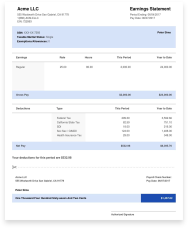
A dated log of every payment explains your deposits and lists your income sources. A pay stub built from that log summarizes it in a format lenders recognize. The stub must reflect real, reported pay, and it should match your deposits and your return. On its own, a self-made stub carries little weight.
How to Show Proof of Income Without Pay Stubs

Follow this packet-building sequence:
- Deposit every payment. Put each cash payment in your bank account the same week.
- Keep a log. Record the date, payer, and amount for every payment.
- Get a signed letter. Ask your employer or client for the letter described above.
- File and pull a transcript. Request your IRS transcript once your return is processed.
- Summarize monthly. Create one pay stub per month from the verified figures with our proof of income generator.
Each step uses the documents covered earlier. The most common reason a packet gets sent back is mismatched numbers, so use one monthly figure everywhere. That consistency is the practical core of how to show proof of income if paid in cash.
How to Report Cash Income
Report every dollar, including any income paid in cash. Reporting creates the record you need later. The rules depend on how you're paid:
- Employees: Wages paid in cash still belong on a W-2, so ask your employer for one.
- Tipped workers: Report cash tips to your employer in writing each month, unless they total under $20 from that employer. Unreported tips go on Form 4137, per IRS tip reporting rules.
- Self-employed and odd jobs: File Schedule C and Schedule SE once net self-employment earnings reach $400, even without a 1099 (see reporting freelance income without a 1099).
- Client payments: A client may skip the 1099-NEC for payments under $2,000 made in 2026. You still report that income.
Reporting also pays off. The no tax on tips deduction reaches $25,000 a year, and only properly reported tips qualify. It phases out above $150,000 of modified adjusted gross income ($300,000 for joint filers).
How to File Taxes as a Nanny Paid Under the Table
Social Security and Medicare taxes apply once a family pays one worker $3,000 or more in cash wages in 2026, according to IRS Publication 926. The employee share is 7.65%. The family must issue a W-2 by February 1, 2027. Without one, report the wages on Form 1040 and ask for the W-2. Our guide to reporting babysitting income without a W-2 covers the details.
How to Show Proof of Income if Paid in Cash to Lenders and Landlords
Many landlords look for income of about three times the monthly rent. For a car loan or a lease, lenders weigh what they can verify independently. Bank statements and tax returns beat a spreadsheet, because anyone can generate a spreadsheet at any time. Self-made records still help when they match your deposits and your filed return.
Treat consistency as the first test. If your log says $2,400 and your deposits say $1,900, expect questions. Self-employed readers can also see our guide to proof of income for the self-employed.
How Employers Can Help Staff Show Proof of Income if Paid in Cash
As an owner, paying cash doesn't change your payroll duties. You still withhold taxes, file payroll returns, and issue W-2s to employees. Workers you classify as contractors get a 1099-NEC once payments reach $2,000 in 2026. Our W-2 and 1099 comparison explains the difference.
Real pay stubs protect you too. They let you show proof of income paid to each worker, so when a landlord or lender calls to verify, your records match what the employee submitted. Keep signed receipts and stubs as proof of income paid out, organized with our record-keeping guide for business owners.
Conclusion
Showing income that arrives in cash comes down to one rule: every document must tell the same story. Deposit payments, log them, report them, and back them with a letter and a transcript.
Ready to put your numbers into a professional format? Use our pay stub templates to create accurate stubs from your verified earnings in minutes.
You Might Also Like



Frequently Asked Questions
Similar Articles



We’ve helped numerous individuals and businesses create professional documents! Create yours today!