Time Off Request: Employer's Guide + Templates (2026)
By Jaden Miller , August 21 2026

Every poorly handled time off request costs a small business owner real money. A last-minute work coverage scramble. A payroll error on the next pay stub. A compliance miss that turns into a Department of Labor letter. Past five or ten employees, this stops being something you can manage on instinct.
A clear PTO request process protects your operations. It keeps employees happy. It creates the paper trail you need at tax time. This guide covers what a time off request is. It shows how to set a written PTO policy. It gives four ready-to-use email templates. It explains the legal floor set by FMLA and 2026 state laws. And it shows how approved time off should appear on the pay stubs you issue.
Key Takeaways
- A time off request is the formal process an employee uses to request paid or unpaid leave, and a documented response is your record of approval.
- Set a written PTO policy in your employee handbook before the first request lands on your desk.
- Federal law (FMLA) and 17+ states with mandatory paid sick leave set the floor; your policy sets the ceiling.
- Every approved request should appear as a separate line item on the employee's pay stub.
- Consistency in how you handle overlapping requests protects you from favoritism and discrimination claims.
What Is a Time Off Request?
A time off request is a formal, written ask from an employee to be absent from work for a paid or unpaid reason. It can be sent by email. It can go through a human resources portal like Workday or BambooHR. It can also be filed on a paper time off request form. Each route creates the written record both sides need.
The phrase covers the whole process, not just an email or a form field. A complete PTO request lists the dates needed. It names the type of leave (vacation, sick, personal, bereavement). It goes to the right channel. And it ends with a written approval or denial from a supervisor. Without the response on file, you do not have a documented decision. You just have a chat.
Types of Time Off Employers Should Plan For
Your PTO policy should account for every category of leave your business may encounter. Lumping everything under "PTO" simplifies the math but creates gaps when compliance questions come up.
- Paid vacation days. Earned through PTO accrual or given as a fixed annual bank.
- Sick leave. Paid by law in 17+ states and DC. In other states, your handbook decides.
- Personal days. Time for appointments, family matters, or mental health days.
- Bereavement leave. Usually 3 to 5 paid days for the death of an immediate family member.
- Jury duty. Federally protected. Pay rules vary by state.
- Military leave. Protected under USERRA. The right to come back to your job is federal.
- Maternity leave and parental leave. Often FMLA-qualifying. Unpaid at the federal level. Paid in some states.
- Emergency time off. For sudden events like a sick child, a car wreck, or a death in the family.
- Unpaid leave. For cases that go past PTO or qualify under FMLA.
Document each category. List the rules for who is eligible. Note whether it is paid or unpaid. That single table in your employee handbook answers 80% of the questions employees ask before they ask. If you need help with the accrual side, our complete PTO guide walks through accrual methods and policy basics for small businesses.
How to Submit a Time Off Request

To submit a time off request, follow five steps. Check your PTO balance and handbook. Give at least two weeks notice for planned leave. Submit through your channel (a human resources portal or a request time off email). Propose a work coverage plan. And confirm approval in writing. Same-day emergencies follow the same rules, just faster.
This is the section you can share with your team. Print it, post it, or paste it into your onboarding packet.
Step 1: Check the employee handbook and your PTO balance.
Before you submit, confirm you have the time accrued. Most companies show your balance in a human resources portal or a leave management system. Your handbook lists the notice period, the blackout dates (busy times when requests are limited), and whether sick leave is separate from vacation. Walking in without this info is the fastest way to get a denial.
Step 2: Give the right amount of advance notice.
Two weeks notice is the standard for planned vacation and personal time. Same-day emergencies (illness, family crisis, jury duty summons) need notice as soon as you can give it, usually before the start of your shift. Extended leave of two weeks or more should be asked for 30 days out. FMLA leave needs 30 days when you can plan for it.
Step 3: Submit through the right channel.
In 2026, most employers route PTO requests through HR portals like Workday, ADP Self Service, BambooHR, or Gusto. Some pair these with time tracking software or a leave management system. Paper forms are rare outside small teams. If your employer uses email, send a request time off email to your direct supervisor and copy human resources. Whatever the channel, the goal is the same: create a record.
The "Ask, Don't Tell" Communication Framework
Frame the request as a chat, not a notice. Three rules turn a weak ask into one your manager wants to approve:
- Propose specific dates, not open-ended time off. "I'd like to take June 12-14" is easier to judge than "I need some time off in June."
- Lead with the work coverage plan, not the reason. Tell your manager who will cover your work. Name the deadlines in that window. Say what you can prep before you leave. The reason for the leave (short of FMLA cases) matters less than the answer for the team.
- Make the business benefit clear. "I'll come back rested and ready for the Q3 launch" is a stronger frame than "I really need a break."
Step 4: Propose a work coverage plan.
This is where most requests fail. List the projects in flight while you are out. Name who can cover each one. Say what handoff notes you will prepare. A request that arrives with a coverage plan gets approved at a much higher rate.
Step 5: Confirm the approval in writing.
Verbal approval is not approval. Get the decision in writing through the HR portal, an email reply, or a signed paper form. Save a copy. Without written proof, you do not have a documented approval, and any future dispute becomes a memory contest.
Time Off Request Email Templates
Use these four time off request email templates as a starting point. Each one works as a pto request email example you can edit in minutes. Replace bracketed placeholders. Send from your work email. CC human resources if your policy requires it.
Template 1: Standard Planned PTO (1-2 Weeks Ahead)
Subject: Time Off Request: [Your Name], [Dates]
Hi [Manager Name],
I'm requesting paid time off from [start date] through [end date], returning [return date]. This is [X] PTO days against my current balance of [Y].
For coverage: [Coworker Name] has agreed to handle [project/task 1], and I'll have [project/task 2] wrapped up before I leave. I'll prepare a handoff document by [date prior to leaving].
Please let me know if these dates work. Happy to adjust if there's a conflict I'm not seeing.
Thanks,
[Your Name]
Template 2: Same-Day Emergency
Subject: Out Today: [Your Name]
Hi [Manager Name],
I have a family emergency and won't be able to make it in today. I expect to be back tomorrow but will update you by end of day.
[Coworker Name] is aware and can cover [time-sensitive task]. I've moved [meeting] to next week.
I'll follow up with the HR portal to log this as [sick / personal / emergency] leave.
Thanks for understanding,
[Your Name]
Template 3: Extended Leave or Vacation (2+ Weeks)
Subject: Extended Time Off Request: [Your Name], [Date range]
Hi [Manager Name],
I'd like to request extended time off from [start date] through [end date], totaling [X] business days. I'm sending this 30 days out per our handbook policy.
Coverage plan:
- [Project 1]: [Coworker Name] will lead during this window
- [Recurring meeting]: I'll pre-record updates or [Coworker Name] will attend
- [Deliverable]: Final draft submitted before [date]
I'll have a full transition document ready 5 days before I leave. Please let me know if you'd like to discuss the plan in our next 1:1.
Thanks,
[Your Name]
Template 4: Follow-Up Email for a Stalled Request
Subject: Follow-up: Time Off Request from [Original submission date]
Hi [Manager Name],
I wanted to follow up on the time off request I submitted on [date] for [dates requested]. With the timeline approaching, I want to confirm coverage and finalize my plans.
If there's a conflict with these dates, I'm open to adjusting. Otherwise, written confirmation would help me lock in [travel / family commitments].
Thanks,
[Your Name]
What to Include in Your Time Off Request Policy

A written PTO policy in your employee handbook stops most of the conflicts that send small business owners to lawyers. At a minimum, write down these six items:
- Eligibility. Who can request time off, after how many days on the job, and whether part-time staff accrue at a different rate.
- Accrual. How PTO is earned (per pay period, per month, or as a fixed annual grant), the maximum balance, and whether unused time rolls over.
- Notice requirements. Standard two weeks notice for planned PTO. Notice for sick leave (as soon as you can). And the 30-day rule for FMLA leave you can plan for.
- Approval process. Who approves requests, the decision timeline (48 to 72 hours is fair), and what happens if no one replies.
- Blackout dates. Busy seasons when requests are limited, like retail holiday weeks, tax season for CPAs, or contract deadlines.
- Documentation. How approved time off is recorded. Where the record lives. And how it shows up on the employee's pay stub. The choice to grant PTO can also affect exempt employee handling, so set rules for both salaried and hourly staff.
At-will employment gives you wide control over scheduling. But a written policy used the same way each time protects you from claims that approvals were random.
Handling Overlapping Time Off Requests
Two employees asking for the same week is the conflict that catches small businesses off guard. Pick a rule. Write it in your handbook. And apply it the same way every time.
The three common methods:
- First-come, first-served. Whoever submitted first gets approval. Simple and fair, but punishes staff who plan further out.
- Seniority-based. Tenure sets priority. Easy to run. Can upset newer staff during peak vacation weeks.
- Coverage-capacity based. Approve as many overlapping PTO requests as your work coverage plan can absorb. Most flexible. You need to set the cap (for example, "no more than 25% of any team out at once").
Whatever you pick, give the decision in writing the same day. When you have to deny one of two overlapping requests, offer the affected employee a specific alternative window. That small step keeps the relationship strong.
Legal Considerations (FMLA + 2026 State Laws)
Federal and state law set the floor on what you can deny. Your policy sets the ceiling.
FMLA basics. The Family and Medical Leave Act gives eligible staff up to 12 weeks of unpaid, job-protected leave per year. It covers a serious health condition, the birth or adoption of a child, maternity leave needs, or care for an immediate family member. FMLA applies to private employers with 50 or more staff within 75 miles of the worksite. It also requires the employee to have worked at least 1,250 hours in the past 12 months. Most small businesses sit below this line, but state rules may still apply.
2026 state paid sick leave landscape. As of 2026, more than 17 states plus the District of Columbia require paid sick leave. The list includes California, New York, Colorado, New Jersey, Washington, and Massachusetts. Several others expanded coverage in 2024 and 2025. If you work in many states, the rules in each state govern your staff there, not your home state. Check your state labor department site once a year.
Jury duty and military leave. Both are federally protected. Jury duty pay rules vary by state. Military leave under USERRA includes a federal right to come back to your job after service.
At-will employment. At-will gives you the right to manage schedules. But it does not override protected leave. Denying an FMLA-qualifying request, or punishing a worker after you approve it, opens you up to federal claims. Keep all medical and family leave chats within HR confidentiality lines to protect both the employee and your business.
Document the reason for any denial in writing. If a request triggers FMLA, route it to human resources or your employment attorney before you reply.
How Time Off Appears on Employee Pay Stubs
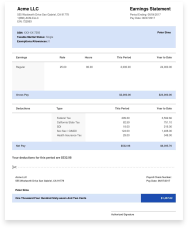
Every approved PTO request should land on the employee's next pay period stub as a separate line item. Show it as PTO, vacation, sick pay, or holiday pay, apart from regular wages. This is a must for two reasons. It stops wage disputes. And it lets the employee check that their PTO balance is going down the right amount. Keep in mind that PTO is taxed as regular wages. So federal, state, and FICA withholdings apply just like a normal paycheck.
If you issue stubs through a payroll provider or generator, confirm the time off code is selected when you run the period. The line item shows hours used, the rate, and the dollar amount. If you make stubs through a pay stub generator, make sure your PTO entries flow through. After every leave period, check the next stub. Make sure the records match the approval. For ongoing recordkeeping, see our guide to managing employee pay stubs.
What Happens If a Time Off Request Is Denied
Most denials come down to three reasons. Not enough notice. Coverage gaps. Or blackout dates. None of these are personal. Most can be fixed by changing the request.
If your PTO request is denied, ask for the reason in writing. Then propose two new date ranges that solve the problem. Try different dates, partial days, or splitting the request into two shorter windows. Most managers approve the new dates once the first conflict is gone.
If you think the denial was unlawful, escalate to human resources first. This may include an FMLA-qualifying medical event, a denial that looks like payback, or different treatment from how coworkers were handled. Most companies require HR investigations to follow a set timeline. If HR does not fix it, the Department of Labor takes complaints tied to FMLA, USERRA, and state paid sick leave laws.
Common Time Off Request Mistakes to Avoid
On the employee side:
- Not checking the PTO balance before sending the request
- Thinking verbal approval counts as approval
- Sending the request without a coverage plan
- Failing to follow up when the reply is late
On the employer side:
- No written policy in the employee handbook
- Inconsistent rules across teams
- Missing FMLA triggers because untrained supervisors handle requests
- Pay stubs that don't reflect approved time off, which leads to wage disputes
Most of these are zero-cost to fix and high-cost to ignore.
You Might Also Like
- Does PTO Count Towards Overtime?
- How Many Pay Periods Are in a Year?
- What HR Does Before Making a Job Offer
- Hiring and HR: Small Business Essentials
- How Much Overtime Is Too Much?
Conclusion
A clean time off request process comes down to three things. A written policy your team can read. A documented channel for sending requests. And accurate records on the pay stub. Get those three right and the conflicts, audits, and wage disputes mostly take care of themselves.
Need to reflect approved time off on your team's pay stubs the right way? Use a reliable pay stub generator to document PTO line items and stay in line with state and federal payroll rules.



Frequently Asked Questions
Similar Articles



We’ve helped numerous individuals and businesses create professional documents! Create yours today!