What Is a Pay Period? A Beginner's Guide (2026)
By Jaden Miller , March 5 2026

If you've just started a new job and your HR paperwork keeps mentioning your "pay period," you might be wondering: what does that actually mean? You're not alone. Lots of people go years without fully understanding pay periods, and that's okay. This guide explains what a pay period is, the four main types, how to figure out which one applies to you, and what confusing terms like "per pay period" and "payday" actually mean. By the end, it'll all make sense. And if you ever need to create your own pay stubs, PayStubs.net has a simple tool that walks you through every step.
Key Takeaways
- A pay period is the window of time your employer uses to calculate your earnings (weekly, biweekly, semimonthly, or monthly)
- Biweekly is the most common pay period in the US, giving you 26 paychecks per year in 2026
- Your payday is NOT the same as your pay period end date; there is usually a gap of a few days
- "Per pay period" on a benefits form means that amount comes out of each individual paycheck
- To find your current pay period, check your most recent pay stub for the "Pay Period Begin" and "Pay Period End" dates
What Is a Pay Period?
A pay period is the set block of time your employer uses to calculate how much you've earned. It has a start date and an end date. Common lengths are 1 week, 2 weeks, twice a month, or once a month. Your paycheck covers everything you earned during that window.
Think of it like a time receipt for your work. Just like a store receipt shows everything you bought during your shopping trip, your pay stub shows everything you earned during your pay period.
A pay period definition you can remember: it's the scheduled time block from when your employer starts counting your hours to when they stop, before calculating your paycheck. Your pay period meaning in practice is simple. When someone asks "what is pay period?" in your new hire paperwork, they want to know how often your employer tallies up your earnings.
What does pay period mean for you as an employee? It determines when your employer processes payroll, which in turn determines when you get paid. How do pay periods work in practice? Your employer tracks your hours (or confirms your salary) within that window, runs payroll calculations, and then issues your check or direct deposit. It usually arrives a few days after the period closes.
Types of Pay Periods
There are four common types of pay periods. A paycycle follows one of these four patterns, so understanding them helps you know what to expect from each employer. How long is a pay period? That depends entirely on which type your employer uses. Understanding your net vs gross income becomes easier once you know your pay frequency.
Weekly Pay Period
A weekly pay period runs for 7 days, typically Monday through Sunday. You get paid once every week, which means 52 paychecks per year. This schedule is common at restaurants, retail stores, and jobs with hourly workers who need frequent access to their earnings. McDonald's pays many of its workers weekly, and many local restaurants and construction companies follow the same pattern. Weekly pay is great if you prefer smaller, more frequent deposits rather than waiting two weeks.
Biweekly Pay Period
A biweekly pay period runs for 14 days, and you get paid every other week. In 2026, this works out to 26 paychecks per year for most employees. Amazon warehouse workers and Starbucks employees, for example, are typically paid biweekly. One thing that surprises first-timers: some months in 2026 (like July or December) may have three pay dates instead of two. It depends on which day of the week your biweekly pay cycle starts. Your employer usually publishes an annual payroll calendar in January so you can plan ahead.
Semimonthly Pay Period
Semimonthly means twice a month, which gives you 24 paychecks per year. The dates are usually fixed, like the 1st and 15th of each month, or the 15th and the last day of the month. This is common for salaried employees, teachers, and many office jobs. Here's the part that trips people up: semimonthly is NOT the same as biweekly. Biweekly is every 14 days; semimonthly is twice per calendar month regardless of the day count. That is why semimonthly gives you 24 paychecks but biweekly gives you 26. For a deeper look at what semimonthly means in payroll, see our guide on semi-monthly pay periods.
Monthly Pay Period
A monthly pay period covers the whole calendar month, and you receive one paycheck per month, totaling 12 per year. This schedule is less common for traditional employees but does show up in certain contract work, some professional salaries, and some school district setups where teachers receive payments spread over 10 or 12 months.
How Many Pay Periods Are in a Year?
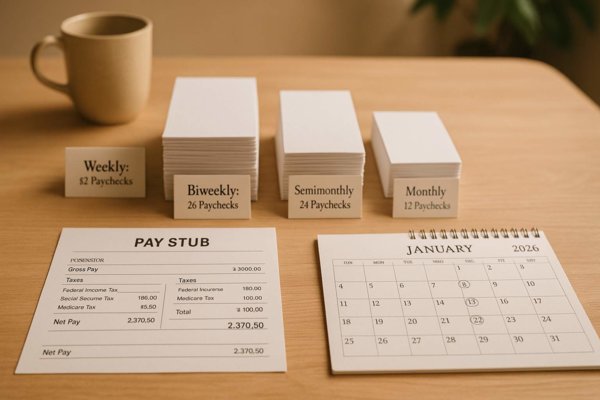
It depends on your pay frequency. In 2026, weekly pay means 52 paychecks per year. Biweekly (every two weeks) means 26 paychecks. Semimonthly (twice a month) means 24 paychecks. Monthly means 12. Biweekly employees may see 3 paychecks in certain months depending on how the calendar falls. For a full breakdown by year, check our dedicated guide on how many pay periods are in a year.
Here's the 2026 quick reference for pay periods in a year:
| Pay Frequency | Paychecks Per Year | Pay Days Per Year |
|---|---|---|
| Weekly | 52 | 52 |
| Biweekly | 26 | 26 |
| Semimonthly | 24 | 24 |
| Monthly | 12 | 12 |
Note that 2026 is not a leap year, so biweekly payroll starting January 2, 2026 will produce exactly 26 pay periods. If you want to know exactly how many pay periods are there in a year for your specific situation, check with your employer or look at the annual payroll calendar they publish. How many pay days in a year you personally experience depends on your specific start date and any employer-specific rules.
Pay Period vs. Payday vs. Pay Cycle
These three terms are related but different. Your pay period is the time you worked (for example, May 1 to May 15). Your payday is when you actually receive the money (often a few days after the period ends). Your pay cycle is the full sequence from the start of one period through the next payday.
Don't worry if you've been mixing these up. Most people do at first. Here's a simple table:
| Term | What It Means | Example |
|---|---|---|
| Pay period | The time window you work | May 1 to May 15 |
| Payday / Pay date | The day you receive your money | May 20 |
| Pay cycle / Payroll cycle | The full loop: period start to payday | May 1 to May 20 |
| Paydate | Same as payday, just another word for it | May 20 |
When is payday? Typically it falls a few days after your pay period ends. If your pay period closes on a Friday, your pay day might be the following Thursday or Friday. When is pay day exactly depends on your employer and how they process payroll. Pay days can shift slightly when they land on holidays. Your employer's payroll calendar will show you every pay date for the year.
The pay cycle meaning is the entire journey: from the first day you clock in during a period, through the payroll processing days, all the way to the moment the money hits your account. Pay cycle and pay period are often used interchangeably in casual conversation, but technically the pay cycle includes the processing time after the period ends.
What Does "Per Pay Period" Mean?

"Per pay period" means the amount that applies to each individual paycheck. For example, if your health insurance costs $50 per pay period and you get paid biweekly, that is $50 taken out of each of your 26 paychecks per year, which equals $1,300 total for the year, or about $108 per month.
This shows up a lot on benefits enrollment forms and your pay stub's deductions section. What does per pay period mean in practice? If you see "$200 per pay period" next to your 401(k) contribution on a biweekly schedule, that is $200 from each paycheck, adding up to $5,200 invested per year.
Per pay period meaning decoded for the most common scenarios:
- Health insurance: shown as cost per paycheck, not per month
- 401(k) contributions: shown as a fixed payment amount for each pay period or as a percentage of your pay each period
- Gym benefit or FSA: deducted at the per pay period rate every paycheck
If your benefits form shows an annual cost and you want to find the per pay period amount, just divide the annual cost by your number of paychecks. For semimonthly employees, divide by 24. For biweekly, divide by 26.
Need to create a pay stub that shows your deductions clearly? Our paystub templates include fields for all common deduction types, pre-formatted and ready to fill in.
How Do I Find What Pay Period I'm In?
The easiest way is to look at your most recent pay stub. It will show a "Pay Period Begin" and "Pay Period End" date. You can also check your employee self-service portal (like ADP, Workday, or Gusto), which typically displays the current pay period on your dashboard when you log in.
Three quick methods to find your current pay period:
- Check your most recent pay stub. Every pay stub is required to show the pay period start and end dates. This tells you what pay period that check covered. Not sure how to read your pay stub? Our earnings statement guide explains every section.
- Log into your employee portal. Platforms like ADP Workforce Now, Workday, Paycom, and Gusto all show your current pay period dates on the dashboard. Look for a "Current Pay Period" label or a payroll summary section.
- Ask HR or check your company's payroll calendar. Most employers share an annual payroll calendar in January showing every pay period's start date, end date, and corresponding pay date for the whole year.
What pay period are we in right now? That depends on your specific employer and their payroll calendar. When does the pay period end? Check your most recent pay stub or employee portal. If your weekly pay period start and end date isn't clear from your stub, your HR or payroll department can tell you in about 30 seconds.
How to Choose a Pay Period
If you're a new business owner, freelancer, or independent contractor setting up your own payroll, choosing a pay period is one of your first decisions. Here's how to think through it.
How do pay periods work for your budget as an employee? The frequency affects how you plan your finances. A fixed payment amount for each pay period varies by type: a $52,000 annual salary works out to $1,000 per weekly paycheck, $2,000 per biweekly paycheck, $2,166.67 per semimonthly paycheck, or $4,333.33 per monthly paycheck. Biweekly and semimonthly feel similar, but biweekly gives you 26 checks while semimonthly gives 24, so each biweekly check is slightly smaller.
Key factors when choosing:
- Employee preference: Hourly workers and gig workers often prefer weekly or biweekly for cash flow
- Payroll software: Many systems make biweekly the easiest to automate
- Industry norms: Check what competitors or similar businesses use
- State law: Some states set minimum pay frequency requirements (more on that below)
Pay Period Legal Requirements
Did you know your state might have rules about how often employers must pay workers? This doesn't affect most employees directly since your employer handles compliance, but it is good to know your rights.
Some examples of state requirements in the US:
- California requires most employees to be paid at least semimonthly (twice per month). Certain workers must be paid more frequently.
- New York requires weekly pay for manual workers in most cases.
- Other states have varying minimum pay frequency laws.
You can look up your state's specific requirements on the U.S. Department of Labor's state payday requirements page. If you think your employer might not be meeting state requirements, that page is the place to start.
You Might Also Like
- How to Access Your Pay Stubs Online
- Amazon Pay Stub: How to View and Download
- What Is Form W-2? A Beginner's Guide
- Employment Verification Letter: What It Is and How to Get One
- Time and a Half: How Overtime Pay Works
Conclusion
Understanding your pay period doesn't need to be complicated. There are four main types: weekly, biweekly, semimonthly, and monthly. Your pay period is the window of time covered by your paycheck, your payday is when the money arrives, and your pay cycle connects the two. When you see "per pay period" on a benefits form, it just means the amount per paycheck.
Now that you understand how pay periods work, you can read your pay stubs with more confidence, plan your budget around pay dates, and make sense of your benefits deductions. Ready to create a pay stub that clearly shows all your earnings and deductions? Our paystub generator makes it easy to build one in minutes, no experience needed.



Frequently Asked Questions
Similar Articles



We’ve helped numerous individuals and businesses create professional documents! Create yours today!