Payroll Software for Home Care: 2026 Owner's Guide
By Jaden Miller , May 15 2026

Running a home care agency means juggling caregiver visits across dozens of homes. You also handle multiple payers and a compliance load. Generic payroll tools weren't built for this. That's where payroll software for home care earns its budget line.
Are you still bolting timesheets onto QuickBooks? Shipping spreadsheets back and forth with your bookkeeper? You've probably already lost a few good caregivers to slow or messy paychecks.
The Bureau of Labor Statistics projects the home care workforce to grow 21% from 2023 to 2033. The payroll software for home care you pick now is the one you'll scale with. This guide covers what makes payroll software for home care different. It explains the features that matter, including time tracking and automated payroll. You'll learn the payroll compliance rules you can't ignore. We'll cover realistic 2026 pricing and the platforms worth a demo this quarter.
Key Takeaways
- Home care payroll is visit-based and multi-payer. It's tied to Electronic Visit Verification. Standard payroll tools weren't designed for any of that.
- Pick home care software that natively handles EVV and multiple payer types. Look for FLSA overtime for caregiver pay and employee self-service access.
- Expect roughly $4 to $12 per employee per month for general payroll. Specialized homecare payroll software typically runs $15 to $30+ PEPM.
- Top 2026 picks include Gusto for small agencies. Viventium and CareSmartz360 work for larger operations needing private duty and non-medical home care features.
- On-time, accurate pay stubs reduce turnover. In an industry pushing 70% annual churn, that's a hard-dollar saving.
How Home Care Payroll Differs From Regular Payroll
Home care payroll is visit-based, not salaried. Paychecks are built from Electronic Visit Verification clock-ins across multiple homes. They're split across payers like Medicaid, private pay, and VA. Caregivers earn overtime under FLSA. They often hit different rates per shift. They need accurate pay stubs fast. Standard payroll software wasn't designed to handle this.
That single difference cascades into everything else. EVV records the start and end of every visit. That data flows directly into payroll. A caregiver who saw four clients across three payers gets one accurate paycheck. Your office doesn't manually reconcile slips.
Caregivers also rotate between per-visit, hourly, and shift-differential pay. This depends on the case. Private-pay arrangements like in-home aides follow similar rules to a nanny pay stub setup. They have the added complexity of Medicaid mixed in.
Since the Department of Labor's 2015 ruling on the companionship exemption, nearly all home care aides are covered. FLSA overtime and minimum wage apply, including most live-in arrangements. Agency turnover often tops 70% in any given year. The difference between on-time, transparent caregiver pay and another late check? That's the difference between keeping caregivers and recruiting their replacements.
What to Look For in Payroll Software for Home Care

Use the same shortlist every time you sit through a demo. If a platform can't tick these boxes, it's a no.
EVV-to-Payroll Integration
EVV needs to be native, not a third-party add-on. A caregiver's clock-in and clock-out should feed directly into payroll calculations. This eliminates manual timesheet reconciliation that drives admin overtime.
Make sure the mobile app handles offline clock-in. Rural cases often have poor cell service. The system should sync once the phone is back online. If reps say "you can integrate with our partner's EVV," treat that as bolted-on. Price it accordingly.
Multi-Payer Billing and Payroll
Your software has to split a caregiver's visits across Medicaid, private pay, VA, and long-term care insurance. No one should re-key data. The same caregiver might be paid one rate for a Medicaid client. Another rate applies for a private-pay client on the same day.
The system should track both. It calculates the right pay per visit. It should show every deduction clearly. It produces a clean audit trail. This is essential for payroll and invoicing, because pay runs are built from visit data across multiple payers, agencies often pair payroll platforms with account reconciliation software to match payroll output against bank and ledger records at month-end.
Caregiver Mobile Access and Self-Service Pay Stubs
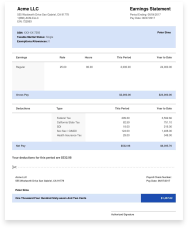
Caregivers should view their pay stubs from their phone. They should also access deductions and W-2 forms. This single feature cuts pay-week call volume to your office in half. Nobody's chasing down a paper stub before applying for an apartment.
Smart employee pay stub management signals to caregivers that you run a real business. This matters when they're choosing between agencies. For caregiver management, employee self-service is essential.
Scheduling, Compliance, and Reporting Built In
Caregiver scheduling, credential tracking, and FLSA overtime alerts should live in the same system as payroll. You'll also want audit-ready exports for state surveys and Medicaid documentation.
Red Flags and Vendor Questions
Watch for these red flags: EVV is an add-on. The vendor can't name when they last updated for a state labor change. Medicaid billing requires a separate platform.
Ask every vendor these questions: Does the system auto-update for state labor law changes? Can caregivers access pay stubs via mobile? Is EVV native? How does payroll handle Medicaid versus private pay? What's your support response time during a payroll error?
Compliance Essentials for Home Care Payroll
This is the section nobody writes about clearly. It's where agencies get fined. Your homecare payroll software has to keep you on the right side of these rules. You shouldn't have to chase every regulatory update. Payroll compliance matters.
- FLSA companionship exemption rollback. Since the 2015 DOL final rule, third-party employers must pay overtime and minimum wage to nearly all home care aides. This includes most live-in shifts. Your software needs to flag overtime as caregivers cross 40 hours per week. You'll want to be clear on what counts as an exempt employee versus a non-exempt caregiver.
- ACA tracking. Variable-hour caregivers who cross the 30 hr/week threshold trigger employer health-coverage obligations. The system should track lookback periods automatically.
- EVV mandate. The 21st Century Cures Act requires EVV for Medicaid personal care and home health services. Without it, you risk claim denials.
- OASIS-E2. Effective April 1, 2026, skilled home health agencies have new documentation fields (Patient Sex, Transportation) that integrated payroll/EHR platforms must support.
- PBJ reporting. Skilled nursing and elder care agencies file Payroll-Based Journal data to CMS. The system should generate PBJ-ready exports.
- HIPAA. Caregiver-side health data (your aides' records, not patient PHI alone) still has to be handled in a HIPAA-compliant environment.
Need accurate pay stubs while you're between systems, onboarding a new contractor, or covering a one-off payment? Our pay stub templates handle the calculations so you can hand a caregiver clean documentation the same day.
Top Payroll Software for Home Care in 2026

There's no single best answer. The right pick depends on agency size, payer mix, and whether you need EVV and scheduling bundled in.
!Side-by-side comparison of payroll software shortlists for home care agencies
Gusto
Small agencies under roughly 20 caregivers get the most out of this one. Private-pay-only operations especially benefit. It handles federal and state tax filings cleanly. It runs automated payroll. It gives caregivers a self-service portal for pay stubs and W-2s. Pricing starts around $40/month plus $6 per person.
The home-care gap: no native EVV, no Medicaid billing, no scheduling for visit-based work. You'll need a separate EVV tool. You'll bring the data in manually.
Paychex Flex
A solid mid-size choice for agencies that need HR, benefits administration, and payroll in one place. Paychex has the regulatory infrastructure to keep up with state-by-state labor law changes, which matters once you're operating in two or three states. Same EVV caveat as Gusto. Demo with the home health industry team specifically, not the generic small business reps.
ADP Workforce Now
Once you cross roughly 50 caregivers, the enterprise toolset earns its keep. This platform handles complex multi-state payroll, garnishments, ACA tracking, and offers HR analytics that smaller platforms don't. Pricing is quote-based and includes implementation. You'll still need a home-care-specific EVV/scheduling layer, but ADP integrates with most major ones.
Viventium
If a vendor was built from the ground up for home care and skilled nursing, this is the one. It handles shift differentials, multi-rate caregivers, FLSA overtime calculation across multiple positions, and the PBJ reporting elder care agencies need. EVV-aware integrations, caregiver mobile pay-stub access, and state-specific compliance updates are part of the core product, not add-ons.
CareSmartz360 and WellSky
When you'd rather pay once and run everything from one login, these all-in-one platforms deliver. They put embedded payroll, scheduling, EVV, and billing in a single system.
The first option fits agencies that want every operational tool consolidated. The second leans toward larger agencies and skilled care. Both cost more than standalone payroll. You trade software sprawl for one integrated stack. These work well for non-medical home care and private duty operations.
Enterprise agencies sometimes look at UKG Ready or Workforce.com for advanced workforce management; those are heavier implementations and rarely the right fit under 100 staff.
Pricing: What Payroll Software for Home Care Costs
Most vendors price per employee per month (PEPM). For general payroll platforms like Gusto and Paychex, you're typically looking at $4 to $12 PEPM. Add a flat base fee of $30 to $50 per month.
Home-care-specific platforms like CareSmartz360 and Viventium usually land in the $15 to $30+ PEPM range. They bundle EVV, scheduling, and billing. Expect implementation fees between $500 and $2,500 for specialized vendors. Budget time for at least two weeks of setup.
Pilot with 5 to 10 caregivers before rolling out agency-wide. You're looking for two things: Does the clock-in work reliably across the homes you actually serve? Can caregivers find their pay stubs without calling you? These questions matter for labor cost analytics.
Common Payroll Pain Points Home Care Agencies Face
The same five common payroll mistakes show up in nearly every agency that hasn't moved off generic tools yet.
- Manual reconciliation of paper visit slips against caregiver timesheets every pay period.
- Caregivers calling the office every Friday asking where their stub is?
- Mis-classifying live-in or sleep-time hours under FLSA and getting hit at audit.
- Splitting hours across Medicaid and private pay by hand, then defending the math when a claim is questioned.
- Year-end W-2 chaos when caregivers turn over mid-year. (For staff caught in that gap, point them to your W-2 retrieval process early.)
Each one is a software problem, not a discipline problem. The right payroll software for home care retires every item on that list on day one.
Conclusion
The three decisions that actually matter when you're picking payroll software for home care: native EVV that feeds payroll automatically, multi-payer handling that splits Medicaid and private pay without manual work, and self-service pay stubs your caregivers can pull on their phone. Get those right and the compliance pieces (FLSA, the EVV mandate, OASIS-E2) become a configuration step instead of an audit risk. Need to generate clean pay stubs for caregivers while you're between systems or covering a contractor? Our paystub generator creates accurate, professional pay documentation in minutes.
You Might Also Like



Frequently Asked Questions
Similar Articles




We’ve helped numerous individuals and businesses create professional documents! Create yours today!