Pay Day Explained: What It Is and When You Get Paid (2026)
By Davis Clarkson , March 5 2026

Confused about pay day? You're not alone. When you start a new job, paychecks and pay cycles can feel like a foreign language. If you've ever stared at your bank account wondering why your deposit arrived at 3am, or why your stub says "pay period ending 01/14" but money showed up on 01/17, this guide is for you. We'll break everything down in plain English so it finally clicks.
Think of PayStubs.net as your friendly guide through the confusing world of payroll. Our paystubs tool helps first-timers and freelancers create professional pay documentation in minutes.
Key Takeaways
- Your pay date is the specific day your money arrives; your pay period is the range of days you worked to earn it
- Payday, pay period, and pay cycle are three different things (this guide explains all three clearly)
- Direct deposits usually hit by 9am on payday; some banks release funds at midnight the night before
- If payday falls on a federal holiday, most employers pay you the business day before
What Even IS Pay Day? (The Basics)
Pay day is the specific date your employer deposits your wages â it's when the money actually lands in your account. It's different from your pay period (the dates you worked) and your pay cycle (the recurring schedule). If your offer letter says you earn $2,000 per pay period, that's when the amount arrives.
Think of it like this: your pay period is a receipt for the work you did, and payday is when you get paid for it.
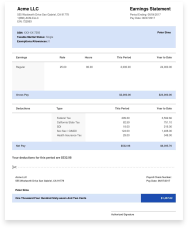
So what is pay period, exactly? What is a pay period in the simplest sense? It's a defined range of dates your employer uses to calculate what you've earned. If your pay period runs January 1-14 and you're paid biweekly, your pay date might be January 17. That gap is normal: payroll departments need a couple of days to process everything. Your earnings statement â the pay stub â will always show both dates clearly.
The "per pay period" number on your offer letter is your gross earnings each cycle before taxes. Your annual salary divided by the number of pay cycles per year gives you that figure. If your annual salary is $52,000 and you're paid biweekly (26 pay cycles per year), your gross pay comes out to $2,000 each period. That's the per pay period meaning in practical terms. Understanding the difference between net vs gross income helps make sense of what you actually take home.
What does per pay period mean on a job offer? It tells you how much you'll receive each time you're paid, before deductions. Knowing this helps you budget and compare offers side by side.
Types of Pay Periods (Weekly, Biweekly, Semi-Monthly, Monthly)
Not sure which schedule your employer uses? Pay periods are crucial to understand because they determine how often payday comes around. Here's what each type means for you.
Weekly Pay
You receive a paycheck every 7 days, totaling 52 pay cycles per year. Retail workers, restaurant staff, and many hourly employees get paid weekly. It's the most frequent schedule and the easiest for covering tight expenses quickly.
Biweekly Pay
You get paid every 14 days, giving you 26 paychecks per year. This is by far the most common schedule in the US. According to the Bureau of Labor Statistics, 36.5% of private businesses use biweekly pay. Most office workers and salaried employees fall into this category.
Semi-Monthly Pay
You're paid twice a month on fixed dates, usually the 1st and 15th, for 24 pay periods per year. This is common at mid-size and larger companies. Don't mix it up with biweekly: semi-monthly meaning is the same two dates every month, while biweekly simply means every 14 days.
Monthly Pay
One paycheck per month, 12 pay periods per year. Common at small businesses and some professional roles. Some employees find monthly pay days harder to manage if they're used to getting paid more often.
Pay period hours means the total hours you worked within that pay period. Your employer multiplies those hours by your hourly rate to calculate your gross earnings for that pay cycle.
Pay Day vs. Pay Period vs. Pay Cycle
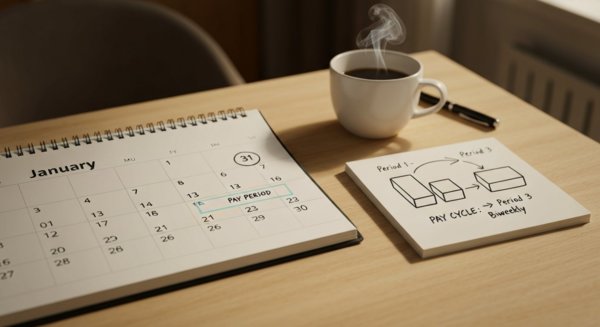
Pay day is the date you receive your money. Your pay period is the range of days you worked to earn it. Your pay cycle is the repeating system â weekly, biweekly, or monthly. Example: if your pay period is January 18-31 and you're paid on January 31, that Friday is your pay date.
Don't worry if these feel confusing â most people mix them up at first. Here's a quick table to make it crystal clear:
| Term | What It Means | Example |
|---|---|---|
| Pay day | The date your money arrives | January 31 |
| Pay period | The date range you worked | January 18-31 |
| Pay cycle | The recurring schedule | Every 14 days (biweekly) |
| Pay date / paydate | Alternate terms for payday | January 31 |
| Paycycle | Same as pay cycle (one word) | Every 14 days |
Pay cycle meaning is slightly broader than pay period. The pay period is one specific stretch of time. The pay cycle is the ongoing pattern â your pay period is just one instance of the cycle repeating. What is a pay cycle in plain English? It's your whole payroll rhythm: how often you're paid, including every pay period and pay date within it.
What is a payroll cycle? It's the same concept as a pay cycle. The full repeating process from when you start working a period to when you receive wages on your pay date.
How is pay period different than pay date? And what's the pay period vs pay date distinction? Your pay period is a range (January 18-31). Your pay date is a single day (January 31). Knowing this helps you read your pay stub correctly.
Pay period definition: a fixed, recurring timeframe that your employer uses to measure work and calculate wages. It begins on a set start date and ends on a set end date. Your pay date falls after that range closes.
Whats a pay period in the simplest terms? It's the stretch of time you work before getting your next paycheck.
Pay Frequency Laws: What Your State Requires
You don't need to be a lawyer to understand this. Federal law (the FLSA) doesn't require employers to pay at any specific frequency â states set those rules. Here's a quick snapshot of common states:
- California: Most employees must be paid at least twice per month
- Texas: Employees must receive wages at least twice per month
- New York: Manual workers must be paid weekly; most others biweekly or semi-monthly
- Florida: No state law â federal FLSA minimum standards apply
When is payday set? Your employer decides the specific pay date within whatever frequency your state requires. Your offer letter or employee handbook always specifies your pay date and pay schedule. Check the US Department of Labor's state payday requirements page for your state's specific rules.
When Does Pay Actually Hit Your Bank?

Direct deposits usually arrive by 9am on your pay day. Employers submit payroll 1-2 business days early through ACH transfers. Some banks â including Chase, Wells Fargo, and Bank of America â release funds at midnight the night before. If your deposit is late, contact your bank first, then your employer.
Your employer initiates the ACH transfer 1-2 days before your paydate. Banks process and post the deposit on the morning of the scheduled date. If your bank has early direct deposit features, funds may show up at midnight. When is pay day in terms of timing? It depends on your bank, not your employer.
What Happens When Pay Day Falls on a Holiday or Weekend?
This trips up a lot of people the first time it happens. Banks can't process transfers on federal holidays, so payday can't land on those days.
Here are the 2026 federal holidays that affect pay schedules this year:
| 2026 Holiday | Date | Day |
|---|---|---|
| New Year's Day | January 1 | Thursday |
| MLK Jr. Day | January 19 | Monday |
| Presidents' Day | February 16 | Monday |
| Memorial Day | May 25 | Monday |
| Juneteenth | June 19 | Friday |
| Independence Day | July 4 | Saturday |
| Labor Day | September 7 | Monday |
| Columbus Day | October 12 | Monday |
| Veterans Day | November 11 | Wednesday |
| Thanksgiving | November 26 | Thursday |
| Christmas Day | December 25 | Friday |
When payday falls on a Saturday, the Federal Reserve is open on the preceding Friday, so many employers pay a day early. When it falls on a Sunday, the Fed is closed on Monday, which means you may receive wages on Tuesday. Payday vs payday: same concept regardless of spelling. Both refer to the date you get paid, whether that lands as scheduled or shifts around a holiday.
How to Find Your Pay Schedule (Without Asking HR)
Nobody wants to look clueless at a new job. Here are four ways to figure out your pay schedule on your own:
- Check your most recent pay stub. Your stub always shows "pay period begin" and "pay period end" dates. That's the fastest confirmation.
- Log into your employer's payroll portal. Common platforms include ADP, Workday, Gusto, and Paychex. Your pay calendar is usually on the main dashboard.
- Read your offer letter or employee handbook. Pay frequency is always specified. Look for "biweekly," "semi-monthly," or "weekly."
- Check your bank transaction history. Look at the dates of your past deposits. The pattern tells you exactly how long your pay cycle runs.
Need a pay stub for proof of income, a rental application, or a loan? Our paystub templates make it easy to create professional documentation in minutes.
Common Pay Day Mistakes (And How to Avoid Them)
These are super common, especially when you're starting out. Don't worry if you've made one.
Confusing your pay period end date with your actual pay date. These are often 2-5 days apart. Pay period ending 01/14 usually means you get paid January 17 or 19, not January 14.
Expecting the money at a specific time. Do you get paid at midnight or in the morning? That depends on your bank, not your employer. Some banks release direct deposits at midnight; others wait until 9am.
Not knowing what "pay period ending" means. Pay period ending meaning is simply the last day of your current work cycle, not the day you get paid. Your actual pay date is listed separately on your stub.
Is pay period per paycheck? Yes â each pay period corresponds to one paycheck. When your pay period ends, your employer processes your wages and deposits them on the following pay date.
You Might Also Like
- How to Access Pay Stubs: A Beginner's Guide
- What Is Paychex? A Plain-English Overview
- Time and a Half: How Overtime Pay Works
- Pay Stubs Explained: What Every Section Means
- Walmart Paystub Portal: How to Access Your Pay
Conclusion
Now you've got the full picture. Your pay date is when the money arrives. Your pay period is the time range you worked. Your pay cycle is the repeating schedule that ties it all together. Understanding all three makes every pay stub and every job offer letter easy to read.
Your pay stub always shows your exact pay period dates â that's the fastest way to confirm your schedule whenever you're unsure. Once you've seen a couple of stubs, it all becomes second nature.
Need to create a pay stub for your records or proof of income? Try our paystub generator â no experience needed, done in minutes.



Frequently Asked Questions
Similar Articles



We’ve helped numerous individuals and businesses create professional documents! Create yours today!