How Do Banks Verify Income for Auto Loan Approval? (2026 Guide)
By Davis Clarkson , March 30 2026

Buying a company vehicle? Helping an employee gather income documents for a lender? Either way, knowing how do banks verify income for auto loan requests saves you time. Lenders check income to make sure borrowers can handle the monthly payments. The process depends on how you earn your money. Having a paystub generator ready makes the paperwork side faster.
This guide covers what banks look for, what papers you'll need, and how to speed things up.
Key Takeaways
- Banks verify income through pay stubs, W-2s, tax returns, and direct employer calls
- A debt-to-income ratio below 36% gets you the best auto loan terms
- Self-employed borrowers need Schedule C filings and bank statements
- Digital verification services can approve W-2 employees in seconds in 2026
- Accurate, up-to-date pay stubs with correct YTD figures prevent verification delays
How Do Banks Verify Income for Auto Loan Qualification?
It starts with three key factors. Every financial institution checks these to confirm that borrowers can afford the monthly payment.
Your credit score shows how likely you are to repay. A score of 700 or higher can reduce the paperwork a lender asks for. Your down payment lowers the lender's risk. A bigger down payment means a smaller loan and less focus on income proof. Your debt-to-income ratio (DTI) compares your total monthly debt to your gross monthly income.
DTI is where most loan applications get flagged. Lenders prefer a DTI below 36% for the best rates. Some will go up to 50% if you have strong credit or a large down payment. Here's what that means in dollars. If your gross monthly income is $4,000, your total monthly debt should stay under $1,440. That includes the new car payment.
How Do Banks Verify Income for Auto Loan Applicants?

Banks verify income for auto loan applicants by checking pay stubs, W-2 forms, and tax returns. For W-2 workers, lenders may also call your employer. Self-employed borrowers submit Schedule C tax filings and bank statements. What you need depends on your employment type and income sources.
W-2 Employees
For W-2 workers, the process is simple. Lenders ask for 1 to 3 recent pay stubs and your latest W-2. Many workers can download these from payroll platforms like ADP, Workday, or Paychex.
The lender may also call your employer to check your job title, start date, and salary. Let your HR team know to expect the call. In 2026, many lenders use The Work Number by Equifax to verify income digitally. This can skip the paper trail entirely.
Self-Employed and Contractors
The process gets more involved if you own a business or work as a contractor. Banks want your Schedule C from Form 1040 and two years of tax returns. They also need 1099 forms and recent bank statements. A business license or EIN on file helps your loan application.
Manual review takes time. Self-employed applicants should apply for pre-approval 2 to 4 weeks before going to a dealership. Knowing how banks verify income for auto loan applicants who are self-employed helps you get the right papers ready. A self-employed pay stub can fill the gap when traditional paystubs aren't available.
Other Income Sources
If you're retired, Social Security Award Letters, 1099-R forms, and pension statements work as proof. If you're unemployed, lenders want to see bank statements or proof of other income sources like rental income.
A cosigner with steady income and good credit is another option. Credit unions tend to be more flexible than big banks when looking at non-standard income.
What Documents Verify Income for an Auto Loan?
The most common documents to verify income for an auto loan are recent pay stubs (1-3 months), W-2 forms, and bank statements. Self-employed applicants need Schedule C filings and 1099s. Retired borrowers should have Social Security Award Letters and pension statements ready.
| Income Type | Required Documents | Supplementary |
|---|---|---|
| W-2 Employee | Pay stubs (1-3 months), W-2 | Employer contact info |
| Self-Employed | Schedule C, Form 1040, 1099s | Bank statements, EIN, business license |
| Freelancer/Contractor | 1099s, bank statements | Client contracts, invoices |
| Retired | Social Security Award Letter, 1099-R | Pension statements, investment accounts |
| Multiple Jobs | Pay stubs from each employer | Combined income summary |
If you're an employer fielding these requests, knowing how do banks verify income for auto loan applicants helps you give the right records. Make sure your payroll system can produce accurate, current pay stubs on demand.
What Your Employees Need on Their Pay Stubs

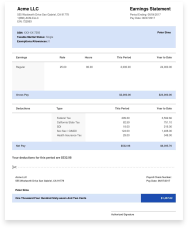
As a business owner, pay stub accuracy affects whether your employees get approved for auto loans and other financing. Lenders check pay stubs for gross earnings, deductions, net pay, and year-to-date (YTD) totals.
Bad YTD figures are the top reason income verification stalls. Say January shows $3,000 YTD and March shows $8,500 YTD. The lender will flag the gap and restart the review. Every pay stub your business creates should show accurate, sequential YTD numbers.
Some states also require employers to give pay stubs by law. Staying compliant protects your business and your team's access to financing.
Tips to Speed Up Auto Loan Income Verification
Now that you know how do banks verify income for auto loan approval, these steps keep the process efficient.
- Get pre-approved first. Apply with your bank or credit union before going to a dealership. This gives you leverage and catches issues early.
- Use digital verification. If your employer uses The Work Number (Equifax) or Plaid, your income can be checked in seconds.
- Submit your most recent pay stub. Lenders need current YTD earnings. A stub from January won't work if you're applying in March.
- Apply Monday through Thursday. HR teams handle calls during business hours. A Friday application means waiting until Monday.
- Know your lender options. Credit unions offer more flexibility than big banks for self-employed or variable-income borrowers.
Streamlining Pay Stub Creation for Your Business
If you're self-employed or run a small business, pay stubs build the paper trail banks need. Lenders verify income against these records for auto loan approvals. Each stub shows gross earnings, deductions, and net pay in a format lenders accept.
For business owners, a good paystub generator makes this easy. Every stub comes out with accurate math, proper deductions, and consistent YTD totals. That means fewer delays when your team needs financing.
You Might Also Like
- Employment Verification Letter: What It Is and How to Get One
- Proof of Income for Mortgage: What Lenders Need
- How to Find Your Annual Income
- Payroll Deductions Explained
- Proof of Employment: What You Need to Know
Conclusion
Now you know how banks verify income for auto loan requests. Whether you need to get your auto loan approved fast or help employees with their paperwork, being prepared is the key.
Keep your payroll records current, maintain accurate YTD numbers, and gather your documents before applying. Need to create pay stubs for your business? Use a reliable paystub generator to make accurate pay records in minutes.



Frequently Asked Questions
Similar Articles



We’ve helped numerous individuals and businesses create professional documents! Create yours today!