What Does Child Support Look Like on a Pay Stub? (2026)
By Jaden Miller , March 2 2026
If you just noticed a deduction on your pay stub labeled something like "CHLD SUP" and you're not sure what it means, you're not alone. Seeing what does child support look like on a pay stub for the first time can feel confusing. Here's the good news: it's simpler than it looks, and we'll walk you through everything step by step.
Key Takeaways
- Child support appears as a separate line item in the deductions section of your pay stub, usually labeled "CHLD SUP," "CS Garnishment," or "Child Support"
- Your employer automatically deducts the amount based on a court-issued Income Withholding Order (IWO)
- Federal law caps child support deductions at 50-65% of your disposable earnings
- If the amount looks wrong, compare it to your IWO document and contact HR
- The money goes from your employer to a state agency, then to the custodial parent
What Is Child Support on a Pay Stub?
Child support on a pay stub is a mandatory deduction where your employer withholds a court-ordered amount from your paycheck to financially support your child. It's sent to the custodial parent through a state agency. You'll see it listed as a separate line item in your deductions section.
Think of it this way: the custodial parent is the one the child lives with most of the time. The non-custodial parent (that's usually the person seeing the deduction) pays child support to help cover the child's expenses. A court order determines the exact amount, so it's not something your employer decides on their own.
What Does Child Support Look Like on a Pay Stub?

Child support appears as a separate line item in the involuntary deductions section of your pay stub. It's usually labeled "CHLD SUP," "CS Garnishment," or "Child Support." The exact label depends on your payroll system. ADP, Paychex, QuickBooks, and Workday each use slightly different codes.
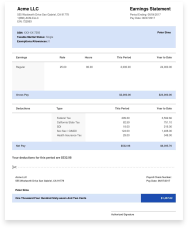
Here's where to find it on your stub. Your pay stub follows a standard layout from top to bottom. First comes gross pay (your total earnings). Then taxes (federal, state, FICA). Then voluntary deductions (health insurance, 401k). Then involuntary deductions. Finally, your net pay. Child support always sits in that involuntary deductions section, separate from things you chose to sign up for.
You might also see a reference number next to the deduction. That ties back to the Income Withholding Order your employer received from the court.
Need to create a pay stub that accurately reflects your child support on paystub deductions? Our simple pay stub generator makes it easy.
How Is the Child Support Amount Calculated?
Child support is calculated using both parents' combined income, the number of children, health insurance costs, childcare expenses, and custody time. One child typically equals about 17% of combined parental income (up to $140,000). A court determines the exact amount based on your state's formula.
Once you understand what does child support look like on a pay stub, the next question is usually about the amount. Don't worry; you don't have to figure this out yourself. Here's a general breakdown of how it works behind the scenes:
- 1 child: ~17% of combined parental income
- 2 children: ~25%
- 3 children: ~29%
- 4 children: ~31%
- 5 or more: ~35%+
Other factors include health insurance premium payments for the children and work-related childcare costs. How much time each parent spends with the kids also matters. Every state uses its own formula, so the exact number on your child support check stub depends on where you live.
How Does Child Support Show Up on Your Paycheck?

So how does child support show up on paycheck records? It's through wage withholding. A court issues an Income Withholding Order (IWO) to your employer. Your employer then deducts the amount each pay period automatically. The money goes to the State Disbursement Unit, which sends it to the custodial parent within 7 business days.
Here's how the payment flows after it leaves your paycheck. Your employer withholds the amount and sends it to your state's disbursement unit (as required by federal law under PRWORA). The state agency then forwards the payment to the custodial parent. This is typically through direct deposit or a prepaid debit card. You don't need to do anything; it's all handled automatically.
How Much Can Child Support Take From Your Paycheck?
Under federal law, child support can take up to 50% of your disposable earnings if you support another spouse or child. If you don't support anyone else, the cap goes up to 60%. Are you 12 or more weeks behind on payments? An additional 5% can be taken, bringing the maximum to 65%.
Here's what "disposable earnings" actually means. It's your gross pay minus legally required deductions like federal and state taxes, Social Security, and Medicare. Voluntary deductions like your 401k or health insurance don't count. As of 2026, these federal limits under the Consumer Credit Protection Act haven't changed.
Quick example: if your disposable earnings are $800 per pay period and you support another family, the max deduction would be $400 (50% of $800). Understanding what does child support look like on a pay stub includes knowing these limits. Some states set even lower caps than the federal limits.
What Does Child Support Look Like on a Pay Stub When the Amount Is Wrong?
Don't panic. Here's what to do:
- Compare your stub to your IWO. Pull up the Income Withholding Order from your court case and check the amount against what's being deducted.
- Contact HR or payroll. Bring your IWO document and point out the discrepancy. Most errors get fixed within 1-2 pay cycles.
- Call your state child support agency. If your employer won't correct the amount, your state agency can step in.
Pro tip: save a copy of your IWO alongside your pay stubs. Many payroll portals like ADP Workforce Now and Paychex Flex let you download stubs directly. Set a reminder each pay period to cross-check the child support line against your order.
You Might Also Like
- How to Show Proof of Income If Paid in Cash
- What Is an Earnings Statement and How to Read It
- How to Access Your Pay Stubs Online
- The 3 Types of Taxes You Need to Know
- How to Get Pay Stubs from a Previous Employer
Conclusion
Now you know exactly what does child support look like on a pay stub and what those codes mean. The key things to remember: look in the involuntary deductions section, check the label against common codes like "CHLD SUP" or "CS Garnishment," and keep your IWO on file so you can verify the amount each pay period.
Need to create a pay stub for your records? Our easy-to-use pay stub templates walk you through every step. No experience needed.



Frequently Asked Questions
Similar Articles



We’ve helped numerous individuals and businesses create professional documents! Create yours today!