Weekly Payroll: A Small Business Owner's Guide (2026)
By Jaden Miller , June 9 2026

If you run a crew of hourly workers, you've probably weighed paying them every week. Weekly payroll keeps cash flowing to your team and your time clock honest. But it also means running payroll 52 times a year instead of 26. This guide covers the benefits, the real costs, how to run it step by step, and what your employees need on every pay stub. When your payroll system can't keep pace, an online pay stub generator covers the gap.
Key Takeaways
- Weekly payroll pays employees 52 times a year and is common in construction, restaurants, and staffing.
- It boosts employee satisfaction and retention but roughly doubles processing runs versus biweekly.
- Every weekly run needs a compliant pay stub: gross pay, itemized deductions, net pay, and YTD totals.
- Check your state's pay-frequency law; some require weekly pay for certain workers.
- A paystub generator cuts weekly documentation from 30-plus minutes to under five.
What Is Weekly Payroll?
Weekly payroll is a pay schedule that compensates employees once every week, producing 52 pay periods a year. It's the most common cadence for hourly and shift-based workforces. For employers, it means running payroll, calculating wages, and issuing pay stubs 52 times annually instead of the 26 runs a biweekly schedule requires.
Each weekly pay period covers seven days, usually closing on a set day so payday lands consistently. Compare that to biweekly payroll (26 paydays), semi-monthly payroll (24), or monthly (12). Weekly pay is widespread for a reason: in February 2023, 27% of U.S. private establishments paid workers weekly, making it the second most common payroll frequency.
Benefits of Weekly Payroll for Employers

For employers, weekly pay is more than an employee perk. It tightens your operations. The bottom line: shorter pay periods make payroll easier to get right.
Here's what that means for your business:
- Cleaner overtime and hourly reconciliation. With only a week of hours per run, errors surface fast and corrections stay small. Overtime pay calculation is simpler when you're not untangling two weeks of timesheets.
- A hiring and retention edge. In tight hourly-labor markets, weekly pay is a genuine recruiting tool. Workers often choose the job that pays them faster, and frequent paychecks lift employee satisfaction.
- A predictable time-tracking rhythm. A weekly cycle sets a steady cadence for timesheet approval, so your managers build the habit instead of scrambling twice a month.
You'll process payroll more often, but each run is smaller and more contained, which keeps mistakes, and the cost of fixing them, low.
Benefits of Getting Paid Weekly for Employees
Your team feels the difference too, and that directly affects retention. Getting paid weekly smooths out cash flow, so workers living paycheck to paycheck aren't waiting two weeks to cover rent, gas, or groceries. They get faster access to money they've already earned, which reduces requests for pay advances. For hourly staff whose hours change week to week, a weekly paycheck tracks their real earnings more closely. That builds trust in how you run payroll.
Challenges and Costs to Weigh

Weekly pay has a real trade-off: cost and administrative burden. Run the math for your team. Most payroll software charges roughly $2 to $10 per employee per run. At 52 runs a year versus 26 for biweekly, you're effectively doubling your payroll processing costs. For a 10-person crew at $5 a head, that's about $2,600 a year instead of $1,300.
There's a time cost too. More frequent runs mean more frequent tax withholding deposits, more timesheet approvals, and more pay stubs to generate and file. Without automation, that adds up to hours every month. The good news: the right tools shrink that burden. That's why most businesses paying weekly lean on software or a paystub generator to handle the repetitive work.
How to Run Weekly Payroll: A Step-by-Step Guide
Running payroll on a weekly cycle comes down to a repeatable five-step process. Once you set it up, each week follows the same rhythm.
- Set your weekly pay schedule. Pick a consistent workweek, for example Monday through Sunday, and a fixed payday such as the Friday after each period closes. Publish the payroll schedule so everyone knows when timesheets are due and when they'll be paid.
- Collect and approve timesheets. Gather hours from your time tracking system and have managers approve them before the deadline. Accurate timesheet approval here prevents corrections later.
- Calculate pay. Work out gross pay, subtract payroll deductions (taxes, benefits, garnishments), and arrive at net pay for each worker. Flag any overtime so it's paid at the correct rate.
- Run the payment. Send wages through direct deposit, or issue checks if that's what your team uses. Direct deposit is faster and cuts the weekly handling that paper checks create.
- Issue pay stubs and keep records. Give every employee an itemized pay stub and store a copy for your records.
Step five is where many small businesses get stuck. Generating 10 or 20 compliant stubs by hand every week is slow and error-prone. A paystub generator or pay stub templates can turn that 30-minute chore into a five-minute one, with the calculations built in. Payroll automation across these steps is what makes the weekly schedule sustainable as you grow.
Weekly Payroll Calculations for Hourly and Salaried Staff
These calculations are straightforward once you know the formulas.
Hourly employees. Multiply hours worked by the hourly rate. Under federal law (the FLSA), any hours over 40 in a workweek are overtime, paid at time and a half, or 1.5 times the regular rate. So a worker at $20 an hour who logs 45 hours earns $800 in regular pay plus $150 in overtime, for $950 gross.
Salaried employees. Take the annual salary divided by 52. A $62,400 salary works out to $1,200 of gross pay per week.
From gross pay, withhold federal income tax, Social Security, Medicare, and any state tax, then subtract benefit deductions to reach net pay. For a full breakdown of what comes out of each check, see our guide to payroll deductions. Use the current 2026 IRS withholding figures from Publication 15-T so each weekly bracket is right.
One edge case to know: roughly every five or six years, the calendar produces 53 weekly paydays instead of 52. For salaried staff paid a fixed weekly amount, that extra run slightly raises their annual total. Most payroll software handles the 53-week year automatically, but it's worth checking.
What Your Employees Need on Their Pay Stubs
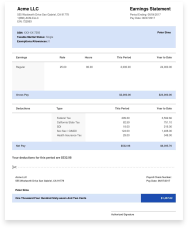
Every weekly paycheck should come with a pay stub, and what's on each pay stub matters for compliance and for your own records. At minimum, each stub should show:
- Gross pay for the week and the hours behind it
- Itemized payroll deductions (federal and state taxes, Social Security, Medicare, benefits)
- Net pay, the actual take-home amount
- Pay period dates and the pay date
- Year-to-date (YTD) totals for earnings and each deduction
Accurate payslips protect you. When an employee questions their pay or applies for a loan, a clear stub settles it fast. Running 52 of these per worker each year is a lot. That's exactly why a generator that auto-fills the calculations and YTD totals saves real time.
Which Industries Pay Weekly?
Weekly pay is the norm in industries built on hourly and shift work:
- Construction. Trade crews expect weekly pay, often tied to project timelines.
- Restaurants and hospitality. Variable shifts and tipped wages make weekly cycles practical.
- Staffing agencies. Temp and contract workers are typically paid weekly.
- Healthcare. Per-diem nurses and aides often run on weekly schedules.
The volume adds up fast. A construction company owner with 12 tradespeople paid weekly generates 12 pay stubs every Friday, which is 624 individual stubs a year. A restaurant manager with 20 part-time staff needs accurate weekly records so YTD totals are correct when tax season arrives.
Weekly vs. Biweekly Payroll: Which Is Right for Your Business?
Weekly pay suits businesses with mostly hourly or shift workers who value frequent, predictable pay, such as construction and hospitality. Biweekly payroll fits salaried teams and lowers processing costs. Many small businesses run a mixed cadence: weekly for hourly staff and biweekly for salaried employees.
Here's how the two compare:
| Factor | Weekly | Biweekly |
|---|---|---|
| Paydays per year | 52 | 26 |
| Processing cost | Higher | Lower |
| Best for | Hourly, shift workers | Salaried teams |
| Overtime tracking | Simpler (one week) | Spans two weeks |
The deciding factor is your workforce. If most of your team is hourly, weekly pay is usually worth the cost. If they're mostly salaried, biweekly pay keeps overhead down without hurting anyone's cash flow.
State Pay Frequency Laws and Compliance
Before you lock in a schedule, check your state's pay-frequency law. Many states set a minimum payday frequency under their labor laws, and some mandate weekly or biweekly pay for certain workers.
| State | Rule of Thumb |
|---|---|
| California | Most employees at least semi-monthly; stricter timelines for some |
| New York | Manual workers generally must be paid weekly |
| Connecticut | Weekly by default unless the labor department approves longer |
| Massachusetts | Weekly or biweekly for most hourly workers |
| Rhode Island | Weekly for most private-sector employees |
These rules change and vary by worker type, so confirm the current requirement with your state labor department or the U.S. Department of Labor before you set your payroll frequency. Strong payroll compliance is far cheaper than back-pay penalties.
Best Practices for Running Payroll Weekly
Keep weekly pay running smoothly with a few habits:
- Automate what you can. Payroll software or a generator removes repetitive manual work.
- Set firm timesheet deadlines. A hard cutoff keeps every run on schedule.
- Reconcile before each pay date. Catch errors before money moves, not after.
- Keep records for at least three years. Store stubs and payroll reports for audits and verification requests.
- Issue audit-ready pay stubs. Clear, itemized stubs every week protect you and your employees.
You Might Also Like
- How Many Pay Periods Are in a Year?
- Semi-Monthly Pay: What It Means
- Gross vs. Net Pay: Key Differences
- What Does YTD Mean on a Pay Stub?
- QuickBooks Pay Stubs Explained
Conclusion
Weekly payroll is a trade-off worth understanding. It costs more to run and demands tighter documentation, but for hourly and shift-based teams, the retention and goodwill it buys are often worth it. The key is keeping the weekly workload manageable, especially the 52 rounds of pay stubs each employee needs. Need to generate professional pay stubs for your team every week? Use a reliable paystub generator to create accurate, compliant documentation in minutes.



Frequently Asked Questions
Similar Articles



We’ve helped numerous individuals and businesses create professional documents! Create yours today!