Are Employers Required to Provide Pay Stubs in Texas? (2026)
By Jaden Miller , March 5 2026

So, are employers required to provide pay stubs in texas? If you just started a new job in Texas and your first paycheck showed up without one, or your employer told you they "don't do that," it's completely understandable to feel confused.
Don't worry. Texas has clear rules about this, and you have more rights than you might think. You'll learn what Texas employers must provide, what goes on every pay stub, and what to do if your employer isn't following the rules. Our paystub generator makes it easy to create pay stubs that meet Texas requirements when you need them.
Key Takeaways
- Texas employers must provide pay stubs every payday under the Texas Payday Law
- Texas is an "access/print" state: electronic stubs are fine only if employees can also print them
- Required fields include hours worked, rate of pay, gross pay, net pay, deductions, and both party names and addresses
- Texas has no state income tax, but federal taxes and SUTA still appear on your stub
- If your employer won't comply, file a wage claim with the Texas Workforce Commission (TWC)
Are Employers Required to Provide Pay Stubs in Texas?
Yes, Texas employers are required to provide pay stubs every payday under the Texas Payday Law, administered by the Texas Workforce Commission (TWC). Texas is classified as an "access/print" state, meaning employers can give electronic pay stubs as long as employees can access and print them on request.
Here's what that actually means in plain terms: your employer can't just hand you a paycheck and call it a day. They're required to also give you documentation showing how that number was calculated.
Texas law says employers must provide this information every single payday. Not just once a year, not just on request. And while digital stubs are totally allowed, there's one important catch: if you want to print yours, your employer has to make that possible. Electronic-only delivery with no printing option doesn't meet Texas requirements.
This detail trips up a lot of employers who think simply switching to an online portal is enough. It isn't, unless you have print access. Learn how to access pay stubs from any employer system. Not sure what a pay stub actually is? Our guide breaks it down simply.
What Must Be on a Texas Pay Stub?
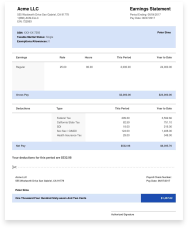
A Texas pay stub must include several required fields. These include hours worked, rate of pay, gross pay and net pay, itemized deductions with purpose, and the names and addresses of both the employee and employer. These requirements come from the Texas Payday Law. Federal and SUTA deductions must still be shown even though Texas has no state income tax.
Think of it like a receipt for your work. A store receipt shows what you bought and the total. Your pay stub does the same: it shows what you earned, what was taken out, and what you took home.
Here's what the Texas Payday Law specifically requires to appear on every texas paycheck stubs document:
- Hours worked (and dates worked)
- Rate of pay (regular and overtime, if applicable)
- Gross pay (total before deductions)
- Net pay (your take-home amount)
- Itemized deductions with explanation of each
- Employee name
- Employer name and address
If any of these are missing from your pay stub, your employer may not be meeting texas pay stub requirements under state law.
Are Employers Required to Provide Pay Stubs in Texas? Federal vs. State Law
New to all this? Here's something that confuses a lot of people: federal law and Texas state law have very different rules on this question.
Federal law (the Fair Labor Standards Act, or FLSA) does NOT require employers to hand pay stubs to employees. The FLSA only requires employers to keep payroll records for at least three years. That's a record-keeping rule for the employer, not a right for the employee.
Texas state law goes further. The Texas Payday Law, enforced by the TWC, requires employers to actually give pay stubs to employees every payday. Texas employees have stronger protections than federal law alone would provide.
Pro tip: don't let an employer tell you "there's no federal law requiring pay stubs" as a reason to skip them. That's technically true about federal law, but Texas has its own requirement. So yes, are employers required to provide pay stubs in texas? Under the Texas Payday Law, absolutely.
One more common misconception worth clearing up: Texas has no state income tax. Some employers confuse this to mean they have fewer payroll obligations overall. That's not right. Federal income tax, Social Security, Medicare (FICA), and the Texas State Unemployment Tax (SUTA) still apply and must appear on every pay stub.
Texas Payroll Basics Every Employee Should Know
Don't panic. These are simpler than they sound. Here's a quick rundown of what Texas law says about pay:
Minimum wage: Texas follows the federal minimum wage of $7.25 per hour.
Overtime: If you work more than 40 hours in a week, you're entitled to time and a half for those extra hours.
Pay frequency: Nonexempt employees must be paid at least twice a month (semi-monthly). Exempt employees can be paid monthly or more frequently.
No state income tax: Texas doesn't have state income tax, which is a nice bonus. But you'll still see federal income tax, Social Security, and Medicare deductions on your stub.
SUTA (State Unemployment Tax): This is a tax your employer pays, not you, but it's worth knowing about. In 2025, Texas SUTA rates range from 0.25% to 6.25% on the first $9,000 of wages. There are no additional local taxes in Texas in 2026.
Need to generate compliant Texas pay stubs? Our pay stub templates are pre-formatted with all required fields for Texas compliance.
What If Your Employer Won't Give You a Pay Stub?
If your Texas employer refuses to provide a pay stub, take these steps: ask HR in writing, then file a wage claim with the Texas Workforce Commission at twc.texas.gov/jobseekers/texas-payday-law. The TWC investigates violations and can order employers to comply. Keep your own records of hours and pay while you wait.
Here's how to handle it, step by step:
- Ask in writing. Send an email or written note to your HR department or payroll manager, specifically mentioning the Texas Payday Law. Having a written record matters.
- Cite the law. You can reference the Texas Payday Law directly. The TWC administers it and takes violations seriously.
- File a wage claim. If your employer still won't comply, file a wage claim with the TWC online at twc.texas.gov. This is free and the TWC investigates on your behalf.
- Keep your own records. While you wait, write down your hours, dates worked, and any amounts paid. This documentation helps your case. If you've changed jobs, also check how to get pay stubs from a previous employer.
You have rights here. The law is on your side. Remember: are employers required to provide pay stubs in texas? Yes, and the TWC is there to enforce it.
You Might Also Like
- What Is Medicare Tax and How Is It Calculated?
- What Is an Earnings Statement?
- How to Find Pay Stubs from an Old Job
- Employment Verification Letter: What It Is and How to Get One
- Is a Pay Stub Proof of Residency?
Conclusion
So, are employers required to provide pay stubs in texas? Absolutely yes. Under the Texas Payday Law, every employer in the state must give employees a pay stub each payday that shows how their wages were calculated. Whether it's paper or electronic, the information has to be there, and you have to be able to print it.
If you're a Texas employee and your employer isn't following these rules, you have a clear path. Ask in writing, cite the law, and if needed, contact the Texas Workforce Commission.
Ready to create your own Texas pay stubs? Our paystub generator makes it easy to generate compliant pay stubs in minutes, with all required fields included. No experience needed.



Frequently Asked Questions
Similar Articles



We’ve helped numerous individuals and businesses create professional documents! Create yours today!