Workers Comp Pay As You Go: Small Business Guide 2026
By Jaden Miller , May 29 2026

If you run payroll, you know the sting of traditional workers' comp billing. You pay a big down payment up front. Then a surprise audit bill lands at year-end. Workers comp pay as you go fixes that. You skip the annual estimate and pay a small amount each pay period instead. The bill tracks the wages you actually run. This guide covers how it works, how it compares to traditional billing, and how to set it up with a reliable pay stub generator.
Key Takeaways
- Workers comp pay as you go sets your premium from each payroll run, not an annual estimate.
- You pay small amounts each pay period instead of a large down payment, which protects cash flow.
- Premiums are based on actual wages, so accurate payroll records and pay stubs affect what you owe.
- Major payroll platforms, including Gusto, QuickBooks, OnPay, and Square, support it.
- Nearly every state requires workers comp coverage for W-2 employees. Texas is the only exception.
What Is Workers Comp Pay As You Go?
Workers comp pay as you go is a billing option for workers' compensation insurance. That coverage pays for a work-related injury on the job. It sets your premium from actual payroll each pay period, not a single upfront estimate. Your insurance carrier deducts a small amount every payroll run based on real wages. So your payments track your true labor costs.
Traditional workers' comp works the other way. It asks you to estimate annual payroll and pay a lump sum payment in advance, often a 25% to 100% deposit. Pay-as-you-go billing flips that. The carrier connects to your payroll and bills you each payroll cycle. This premium calculation follows real wages, not a guess made a year earlier.
How Pay-As-You-Go Workers' Comp Uses Your Payroll
Your premium isn't a flat fee. It's a rate applied to every $100 of payroll. Each employee's job classification and your state set that rate. So your payroll system is the engine behind the bill. Every pay period, it reports actual employee wages to the carrier. The carrier applies the rate and charges that cycle's bill.
A payroll integration makes this automatic. It sends real-time payroll data to your carrier, which sets up automated payments each payroll cycle. You replace rough payroll estimates with the wages you truly run.
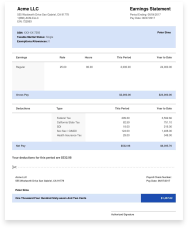
This is where accuracy matters for your business. The pay stubs you generate are the official record of those wages. Any error in your payroll data flows straight into your premium and your year-end audit. Clean records keep your billing correct. They also protect you if the carrier reviews the numbers. For the codes that set your rate, the NCCI is the standard reference most carriers use.
Looking for reliable employee pay records? Our pay stub templates make payroll paperwork simple.
Traditional Billing vs. Workers Comp Pay As You Go
Here's how the two billing models compare for a small business:
| Factor | Traditional Billing | Pay-As-You-Go |
|---|---|---|
| Upfront cost | 25% to 100% deposit | Little to none |
| How premium is set | Estimated annual payroll | Actual wages each pay period |
| Cash flow | Large lump sum, then audit | Small, steady payments |
| Year-end audit | Often a surprise true-up bill | Small adjustment |
| Fees | Built into the deposit | Sometimes a small admin fee |
Traditional billing is where most owners get burned. Three mistakes show up again and again:
- Underestimating payroll, then facing a large bill at the annual workers' comp audit.
- Overpaying through slow seasons, since seasonal fluctuations weren't priced in.
- Forgetting to update headcount, which can leave a gap in your coverage period.
Benefits of Pay-As-You-Go Workers' Comp
For a small business, the wins are practical and clear:
- Better cash flow. No large upfront deposit tying up working capital.
- Premiums tied to reality. Your workers' compensation premiums follow the wages you run, not a forecast.
- Fewer audit surprises. Paying on real payroll all year means smaller year-end adjustments.
- Easier budgeting. Costs rise and fall with your labor, so they stay steady.
Consider a restaurant with $400,000 in annual payroll at a 1% workers' comp rate. That's a $4,000 insurance premium for the year. Traditional billing might demand $1,000 to $4,000 up front. Pay-as-you-go spreads that premium payment to roughly $154 a week. The money stays in your account until you owe it.
How to Set Up Workers Comp Pay As You Go
You have two paths. The simplest is through your payroll provider, if it offers a built-in workers' comp option. The other is signing up directly with a carrier that bills pay-as-you-go from your payroll reports.
Check this first. As of 2026, supported platforms include Gusto, QuickBooks, Square Payroll, OnPay, Patriot Software, Toast, Rippling, and Homebase. One naming note: NEXT Insurance now operates as ERGO NEXT after Munich Re bought it. The pay-as-you-go product continues.
Before you sign up, ask three questions. Does my payroll software integrate with a supported carrier? What's the minimum payroll frequency it accepts? Are there monthly admin fees? Keep your reports current too, since a long reporting gap can trigger a policy cancellation. Confirm your state's requirement as well, because rules vary by location. You can check them through the U.S. Department of Labor.
Which Businesses Benefit Most?
Some businesses gain the most: restaurants, hospitality, construction, retail, and farming. In these fields, staffing levels shift through the year. Still, any small business with W-2 employees can use it. Sole proprietors and independent contractors may be exempt from coverage, depending on your state's rules.
A few monopolistic states, such as Ohio and Washington, make you buy coverage from a state fund instead. If your headcount swings with the season, pay-as-you-go keeps your bill in step with payroll. You're not locked into a flat estimate built on your busiest month.
You Might Also Like
- Are Employers Required to Give Pay Stubs?
- How Pay Periods Work
- How to Create a 1099 for Contractors
- Understanding a Biweekly Pay Stub
- Net vs. Gross Income Explained
Conclusion
Workers comp pay as you go ties your premium to real payroll. It protects your cash flow and cuts the risk of a painful year-end audit. The system only works as well as your payroll records, so good records keep your billing correct. Need to generate pay stubs for your employees? Use a reliable paystub generator to create accurate pay stubs in minutes.



Similar Articles



We’ve helped numerous individuals and businesses create professional documents! Create yours today!