Are Employers Required to Give Pay Stubs? (2026 Guide)
By Jaden Miller , March 26 2026

Are employers required to give pay stubs? It depends on the state. No federal law says you must hand out pay stubs. But 42 states have their own rules, and fines can reach $750 per mistake.
If you have workers in more than one state, things get tricky. Say your office is in Texas, which has no pay stub law. You still must give proper pay stubs to staff in North Carolina or California. This guide covers federal and state rules, what goes on a pay stub, fines, and new laws that affect you in 2026.
Key Takeaways
- No federal law requires employers to give pay stubs, but the FLSA requires payroll records
- 42 states require pay stubs in some form; 8 states have no rule
- Fines range from $500 to $750 per error in states like California, Maryland, and Illinois
- North Carolina requires written or printed pay stubs each pay period
- Follow the rules where each worker is based, not where the business is located
What Is a Pay Stub?
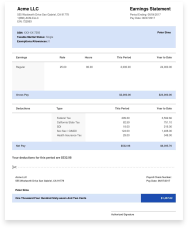
A pay stub is a slip that comes with each paycheck. It shows gross pay, tax amounts taken out, and net pay for that pay period. Employers use pay stubs to keep clear payroll records. Workers use them as proof of income and for tax filing.
For employers, pay stubs serve two goals. They show the breakdown of every paycheck: gross wages, taxes, benefit costs, and take-home pay. This gives you and your staff a clear record. Good stubs also make year-end W-2 prep easier. They help when workers apply for loans or housing and need to prove their income.
Are Employers Required to Give Pay Stubs Under Federal Law?

No. The Fair Labor Standards Act (FLSA) does not require employers to hand out pay stubs. But the FLSA does require you to keep payroll records for a minimum of three years. These records must include hours worked, wages earned, and amounts taken out. State laws decide if you must give pay stubs to workers.
Under the FLSA, the Department of Labor requires you to keep records in 14 areas. These include worker ID, hours per day, overtime hours, wage rates, and all amounts taken out. Records must be ready for DOL or IRS review at any time.
Federal law does not say you must give workers a pay stub. But making one each pay period keeps your records in order. Most payroll tools create pay stubs on their own. This meets the record-keeping rule with little extra work.
Where Are Employers Required to Give Pay Stubs? State Breakdown
Whether you must give pay stubs depends on each state's pay stub laws. Every state fits one of five groups. If you have workers across state lines, follow the rules where each person works. Where your office sits does not matter.
Think of a building firm based in Texas, which has no pay stub rule. That firm has workers in North Carolina (print needed), California (print needed), and a remote clerk in Oregon (opt-out state). Each worker's pay stub rule follows the law where they work.
States With No Pay Stub Requirements
Eight states have no law that says you must give out pay stubs. These are Alabama, Arkansas, Florida, Georgia, Louisiana, Mississippi, South Dakota, and Tennessee. Even in these states, you must still keep payroll records under the FLSA.
Access States
About 26 states fall into this group, the largest one. You must give workers a way to view their pay info. Online portals, emailed slips, or any digital format all count. If you use direct deposit with a payroll system that lets workers log in, you likely meet these rules.
Access and Print States
In 11 states, digital-only is not enough. You must offer written or printed pay stubs. North Carolina is in this group. Under North Carolina pay stub rules, you must give written or printed pay slips each pay period. Online delivery works only if workers can view and print the files on their own. You must show gross wages, hours worked, amounts taken out, and net pay. The NC Wage and Hour Bureau enforces these rules.
Opt-Out and Opt-In States
These groups cover four states with consent rules. Delaware, Minnesota, and Oregon default to paper but allow online delivery if workers can opt out. A best practice is to add a pay stub delivery choice form to your new hire packet.
Hawaii is the only opt-in state. You cannot send online pay stubs unless each worker gives written consent. Until you have that consent on file, you must use paper stubs.
What Must Appear on Employee Pay Stubs?

Most states that require pay stubs list the fields you must show. These include gross pay, hours worked, payroll deductions like federal income tax, Social Security, and Medicare, plus net pay. Some states also want pay period dates, year-to-date totals, and your business name and address.
A proper pay stub should include:
- Worker name and ID
- Pay period start and end dates
- Gross pay (total before amounts taken out)
- Hours worked, plus overtime pay
- Amounts taken out: federal tax, state tax, Social Security, Medicare
- What the employer paid in
- Net pay (take-home amount)
- Year-to-date totals (where needed)
States like Maryland now also require your business name, address, and phone number on every slip. Setting up full stubs from the start saves you trouble when rules change.
Penalties When Employers Don't Give Pay Stubs
Are employers required to give pay stubs in every state? No. But where laws exist, not following them can cost real money:
- California: You must give payroll records within 21 days of a written request. If you don't, the fine is $750 per worker, plus court costs and legal fees.
- Maryland: $500 per case for not giving proper pay slips under the 2024 law update.
- Illinois: Up to $500 per case under Public Act 103-0953, in effect since January 2025.
These fines are easy to avoid. Just one audit with several workers can add up to thousands in fines. That cost is far more than the effort of managing employee pay stubs the right way.
Recent State Pay Stub Law Changes (2025-2026)
Two big state-level changes took effect that you should check against your payroll setup.
Illinois (January 2025): Public Act 103-0953 now says you must give pay stubs every pay period. You must keep payroll records for three years. Workers can ask for copies up to twice per year. Fines reach $500 per case.
Maryland (October 2024): Chapter 305 (SB 38) changed pay slip rules. You must now give written or online pay slips each payday. These must show your business name, address, and phone number. You must also give notice before any pay rate changes. Fines reach $500 per case.
If you work in either state, the question of are employers required to give pay stubs has a clear answer: yes. Make sure your payroll system is up to date to avoid common payroll mistakes.
You Might Also Like
- State-to-State Pay Stub Requirements
- Is a Pay Stub Proof of Residency?
- What Is FICA Tax on My Paystub?
- Proof of Employment
- Net vs. Gross Income
Conclusion
So, are employers required to give pay stubs? Under federal law, no. Under state law, most likely yes. Forty-two states have some form of pay stub rule. The rules depend on where your workers are based, not where your business sits.
Staying on the right side of the law means knowing the rules in every state where you have staff. Keep records for at least three years and update your setup when laws change. A good paystub generator makes this easy by creating correct, clean pay stubs for your whole team in minutes. No complex payroll setup needed.



Frequently Asked Questions
Similar Articles



We’ve helped numerous individuals and businesses create professional documents! Create yours today!