Payroll for Restaurants: A Business Owner's 2026 Compliance Guide
By Jaden Miller , August 24 2026

Tip credits, FICA, and shifting state wage rules eat hours. Payroll for restaurants can pull you off the menu and the floor. It is also one of your highest-risk areas. A single misclassified worker can trigger a Department of Labor audit. So can a missed tip credit. So can a pay stub with no itemized tip income. Each one can spark a state wage claim.
This guide is for restaurant owners. You need to run payroll for restaurants the right way. You should not have to become a part-time payroll clerk. We will cover what makes restaurant payroll different. We will cover what to look for in software. You will get the step-by-step process for each pay run. You will see tipped employee rules and overtime pay. You'll learn the FICA Tip Credit most owners miss. We also cover labor cost benchmarks and what your employees need to see on their pay stubs.
Key Takeaways
- Tipped-wage compliance and the FICA Tip Credit are the two biggest levers. Get these right. The rest follows.
- Weekly pay with POS-integrated hours and tip data is the easiest setup. It works for most restaurants.
- Generate an itemized pay stub every pay period. Most states require it. It is also your best audit defense.
- Benchmark your labor cost each month. Drift above the range signals a scheduling or pricing issue.
- Employee classification (W-2 vs. 1099) and blended overtime are the two most common failures.
What Is Payroll for Restaurants?
Payroll for restaurants pays tipped servers, hourly back-of-house staff, salaried managers, and 1099 contractors. It must meet federal, state, and city wage law. The setup is very different from office payroll. You juggle the federal tipped minimum wage of $2.13 per hour. You handle blended overtime pay that includes tips. You also handle tip pooling rules, FICA on tips, and itemized pay stubs. Each state has its own rules. None of that exists in a basic Form W-2 office workflow. That is why a restaurant payroll service has to handle these cases. A solid restaurant payroll management setup builds on the same base.
Why Payroll for Restaurants Is Harder Than Most Industries

Restaurants hit almost every payroll-complexity factor at once. You face high turnover, tipped wages, and multi-role staff. You may run in many states. Your hours data lives in a POS. Each layer adds a tax compliance trap. A missed tip credit can trigger a DOL audit. So can a wrong overtime rate. So can a stub missing tip income. These rank among the most common payroll mistakes restaurant owners face. Most generic payroll tools were not built for these cases.
The five operational realities driving the difficulty:
- Turnover and employee classification. Annual turnover runs near 75 percent. That means constant onboarding. You collect Form W-4, I-9, and direct deposit forms over and over. Employee classification (W-2 vs. 1099) never slows down.
- Tipped wage compliance. Federal law allows a tipped minimum wage of $2.13 per hour. It applies only if tips bring the worker to the $7.25 federal minimum. Seven states do not allow a tip credit at all. They are California, Oregon, Washington, Nevada, Minnesota, Alaska, and Montana. Tipped workers in those states get the full state minimum wage on the clock.
- Blended overtime pay. The Fair Labor Standards Act requires overtime pay at 1.5× the regular rate of pay including tips. Base wage alone is not enough. Generic payroll tools default to base-wage overtime. That underpays staff. It creates wage-claim risk.
- Multi-state and city wage rules. A two-location operator across state lines must track multiple wage floors. A single restaurant in Seattle or New York faces the same issue with city minimums.
- POS-dependent hours and tip management. Toast, Square, Clover, and SpotOn feed hours and tips into payroll. That only works if your tools integrate. Without it, every pay period turns into manual re-entry.
Bottom line: design this system once. Automate it. Do not redo it every Friday.
What to Look for in Payroll for Restaurants Software
The restaurant payroll software market splits into three categories. Each has a different trade-off. Use the comparison below to narrow your shortlist before you book demos. Look for built-in time tracking, tip reporting, and a worker self-service portal.
| Category | Best For | Typical Range | Strength |
|---|---|---|---|
| POS-integrated payroll (Toast Payroll, Square Payroll, SpotOn) | Single or multi-location operators already on that POS | $40 base + $4-6/employee/month | Hours and tips flow directly from POS to payroll |
| Restaurant-aware general payroll (Gusto, ADP RUN, Paychex, Paylocity, Rippling) | Operators wanting deep HR and benefits features | $40-150 base + $6-15/employee/month | Tax filing, benefits, multi-state, broader HR |
| Pay stub generators (PayStubs.net) | New operators, micro-restaurants, contractor/event staff | Per-stub pricing | Generate compliant, itemized stubs without a full subscription |
Before you sign anything, confirm these features with the vendor:
- Tipped wage handling. Tip declaration import, tip credit calculation, and tip pool allocation for full tip management.
- POS integration with your specific system. Generic "supports POS" claims aren't enough. Ask for the named connector to Toast, Square, Clover, or SpotOn.
- Blended-rate overtime pay. Confirm the system calculates OT on the regular rate of pay including tips.
- Multi-location support. Per-location wage rates, per-location tax IDs, consolidated reporting.
- Itemized pay stub output. Stubs should break out hours by type (regular, OT, tipped), declared tips, taxes, deductions, employer info, and pay period dates.
- Quarterly tax compliance. Form 940, Form 941, state unemployment, and Form W-2 generation should be handled in-product, not as an add-on.
The smallest restaurant payroll companies are basic stub generators and template providers. The largest are full HCM platforms like ADP paystub systems. Those go well beyond payroll. Most owners land in the middle. They pick a POS-integrated tool or a restaurant-aware payroll suite. New operators with one or two employees can run lean. Use a stub generator and EFTPS-filed taxes. Stay there until you cross five employees.
How to Run Payroll for Restaurants: A Step-by-Step Process

Payroll for restaurants has eight repeatable steps. The first setup is the hard part. After that, most of it runs on a fixed weekly rhythm.
- Get employee classification right. Servers, cooks, hosts, and managers are W-2 employees. A live musician booked for one Friday set is a 1099 contractor. So is a one-off event photographer. So is a freelance designer doing a menu. Misclassification penalties run $500 to $5,000+ per violation. When in doubt, classify as W-2.
- Collect onboarding paperwork. Form W-4 (federal withholding), I-9 (work eligibility), state withholding form, direct deposit form, and tip-reporting form. Build one onboarding folder per hire. These are core payroll records.
- Set a pay frequency. Weekly is the restaurant standard. It is the easiest for hourly tipped staff. Bi-weekly pay stub cycles work for smaller shops with salaried roles. Your state's pay-frequency law sets the floor. Many states require at least bi-weekly for hourly workers.
- Pull hours and tips from your POS. Toast, Square, Clover, and SpotOn all export shift-level hours and tips. Tipped staff must also file Form 4070 when monthly tips top $20.
- Calculate gross pay. Apply tipped wage rules. Apply blended overtime pay at 1.5× regular rate including tips for hours over 40. Then apply the tip credit where state law allows it. California payroll tax rules require daily overtime after 8 hours. They require double-time after 12. These override federal rules.
- Withhold taxes. Federal income tax. State income tax where it applies. FICA tax at 7.65% (Social Security plus Medicare). Plus any local taxes. Tips are FICA-taxable. Include them.
- Run payroll and generate pay stubs. Send direct deposits. Generate an itemized pay stub for each worker. Show hours by type, tips, gross pay, all withholdings, deductions, and net wages. Most states require this.
- File and deposit payroll taxes. Form 941 quarterly. Form 940 (FUTA) yearly. State unemployment quarterly. Form W-2 by January 31. Most owners use EFTPS for federal deposits.
Once steps 1 through 4 are set up, the weekly process is steps 5 through 8. That is what payroll software automates.
Tipped Employee Rules and the Tip Credit
Tipped wage rules are where most restaurant tax compliance failures happen. The core mechanics:
- Federal tipped minimum wage: $2.13 per hour. This is allowed only if reported tips bring the employee to the standard federal minimum of $7.25 per hour.
- Makeup pay rule: If declared tips fall short of the gap, the employer must "make up" the difference in cash wages for that pay period.
- States with no tip credit allowed: California, Oregon, Washington, Nevada, Minnesota, Alaska, and Montana. Employers must pay the full state minimum wage to tipped employees on the clock, regardless of tips.
- Tip pooling under the 2020 Fair Labor Standards Act amendment: Tip pools may now include back-of-house staff (cooks, dishwashers). Managers and supervisors are still excluded from any tip share. The 80/20 rule limits tipped employees' non-tipped side work to 20 percent of their time.
- Payroll records: Daily tip declarations (Form 4070 or POS-equivalent), pooled tip distribution logs, and weekly summary totals must be kept for at least three years under the Fair Labor Standards Act.
Multi-state operators: do not assume the federal $2.13 baseline applies. Pull your state's tipped minimum and tip credit status before each new hire. Check the DOL Wage and Hour Division at least once a year.
FICA Tax and the FICA Tip Credit Most Owners Miss
Every restaurant owner pays FICA tax. Far fewer claim the FICA Tip Credit that is available specifically to food and beverage employers.
The FICA breakdown:
- Total FICA: 15.3% of wages, split evenly between employer and employee.
- Employee share: 7.65% (Social Security 6.2% + Medicare 1.45%).
- Employer share: 7.65% (Social Security 6.2% + Medicare 1.45%).
- Tips are FICA-taxable. Every declared tip dollar is subject to FICA on both sides.
The FICA Tip Credit (IRS Form 8846) gives restaurant employers a federal income tax credit. It equals the employer's FICA share on tips above the $5.15-per-hour threshold the IRS still uses. Take a full-time server earning $400 a week in tips. This credit can return $1,500 or more per year to the employer. Across a full tipped staff, this is one of the largest restaurant tax savings. It is also one of the most missed. File Form 8846 with your business return each year.
Also confirm your workers compensation coverage each year. Most states require it for any business with employees. Restaurant rates vary by role and state.
Overtime Pay for Restaurants: A Worked Example
The Fair Labor Standards Act rule sounds simple. Overtime pay is 1.5× the regular rate after 40 hours. But the "regular rate" for tipped staff includes tips. The $2.13 base alone is not enough. Here is the math:
A server works 45 hours in one week. Base wage is $2.13 per hour. Tips for the week: $400.
- Regular wages: 45 hours × $2.13 = $95.85
- Total compensation: $95.85 + $400 tips = $495.85
- Regular rate of pay: $495.85 ÷ 45 = $11.02 per hour
- Overtime premium owed: 5 hours × (0.5 × $11.02) = $27.55
The half-time premium is added to the regular wage. The full regular rate is already paid via base wage plus tips. Total OT owed in cash: $27.55. Skip this step and pay OT on the $2.13 base alone, and you'll face a wage claim every time.
State rules can override federal rules where stricter. California requires daily overtime after 8 hours in a shift. It also requires double-time after 12. A California operator's payroll system must run both daily and weekly OT.
Labor Cost Percentage Benchmarks by Segment
Labor cost percentage is the top payroll metric on your P&L. The formula is simple:
Total Labor Cost ÷ Total Sales = Labor Cost %
Industry benchmarks by segment (National Restaurant Association data):
| Segment | Healthy Labor Cost % |
|---|---|
| Quick-Service (QSR) | ~25% |
| Fast Casual | 25-30% |
| Casual Dining | 30-32% |
| Fine Dining | 30-35% |
Pull this number from your payroll and POS sales data each month. If your labor percentage trends above your segment range for three months running, the issue is usually one of three things. The first is over-scheduling at slow dayparts. The second is menu prices that haven't kept pace with wage increases. The third is productivity drift on the line. All three are fixable once the data surfaces them. That is the whole point of running payroll for restaurants on a tight monthly cadence.
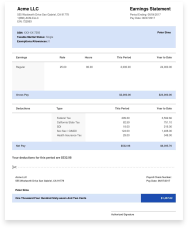
Restaurant Pay Stubs: What Your Employees Legally Need to See
Every pay run must produce an itemized pay stub for every employee. Most states require it by law. Even in the three states that don't (Alabama, Arkansas, Florida), providing one is your best audit defense. A compliant restaurant pay stub shows:
- Employer name, address, and EIN
- Employee name and last four of SSN
- Pay period start and end dates, plus pay date
- Hours by type: regular, overtime, tipped, non-tipped
- Gross wages by hour type
- Declared tips for the period
- Federal, state, and local tax withholdings (itemized)
- FICA withholdings (Social Security and Medicare separately)
- Payroll deductions (benefits, meal credits, uniform deductions where allowed)
- Net wages (net pay)
California, New York, and Texas have stub-content rules that go beyond the federal baseline. Confirm the latest state rules with your state labor department or payroll provider. New operators without a full payroll suite can generate compliant itemized pay stubs on a per-stub basis. Use this until your headcount justifies a full subscription.
Conclusion
Payroll for restaurants is a tax compliance system, not a chore. Set it up right the first time. It pays back in saved time. It also pays back in lower audit risk and lower turnover. Workers notice clean, accurate stubs. You also get clear labor data on your P&L. For a full view of the tools, visit PayStubs.net. Run a single bistro or a 10-location group: the same eight-step process applies. What scales is your tooling.
If you need to generate compliant, itemized pay stubs for your restaurant staff today without committing to a full payroll subscription, use our paystub generator. You can create accurate stubs for tipped servers, hourly cooks, and salaried managers in minutes.
You Might Also Like



Frequently Asked Questions
Similar Articles



We’ve helped numerous individuals and businesses create professional documents! Create yours today!