Pay Rate Meaning: A Small Business Owner's Guide (2026)
By Jaden Miller , June 5 2026

Hiring your first employee, or your tenth, forces a question you can't guess at: what should you pay, and how do you record it? Getting the pay rate meaning right is the foundation of clean payroll, legal compliance, and accurate pay stubs. This guide covers what a pay rate is, the main types, and how to calculate each one. It also walks through the overtime rules you must follow and how the rate should appear on each pay stub.
Key Takeaways
- A pay rate is the amount you pay an employee per unit of work: an hour, a year, a piece, or a sale.
- The FLSA regular rate of pay is the legal basis for overtime, paid at 1.5 times the rate beyond 40 hours a week.
- Always pay the higher of the federal minimum wage ($7.25) or your state's minimum.
- Every pay period, the correct rate has to appear on each employee's pay stub.
Pay Rate Meaning: A Definition for Employers
A pay rate is the amount you pay an employee for a unit of work, such as an hour, a year, a piece produced, or a sale closed. So what is a pay rate, in plain terms? It's the agreed price of labor. For employers, the pay rate meaning is simple: you set the number, document it, and report it on every pay stub.
You'll see the same idea written as "rate of pay." The two phrases are interchangeable. The only thing that shifts is perspective: an employee asks what they earn, while you decide what to offer, what it costs your business, and how to record it.
What Does Rate of Pay Mean?
It's the agreed compensation tied to a measurable unit, whether that's time worked, output produced, or revenue generated. This is the number you reference when you run payroll, calculate overtime, and fill out each pay stub.
Types of Pay Rates Every Employer Should Know

Most small businesses use one or more of five pay structures, from an hourly wage to a monthly salary. Each one is still subject to minimum wage and overtime law. The pay rate meaning stays the same across all of them; only the unit you measure changes.
| Pay Rate Type | How It Works | Common In |
|---|---|---|
| Hourly rate | A set amount for each hour worked | Retail, food service, trades |
| Annual salary | A fixed yearly amount split across pay periods | Management, office roles |
| Piece rate | Pay per unit produced or task completed | Manufacturing, agriculture |
| Commission | Pay tied to sales or targets hit | Sales, real estate |
| Tips | Customer gratuities on top of a base wage | Hospitality, food service |
If you employ tipped staff, the federal cash wage can be as low as $2.13 an hour, but tips plus that wage must reach at least the full minimum wage. Piece-rate and commission workers also have to clear minimum wage for every hour on the clock.
Regular Rate of Pay and Overtime Rules
Under the Fair Labor Standards Act (FLSA), overtime isn't based on an employee's base wage alone. It's based on the regular rate of pay, which bundles in most of what you pay during a workweek. The U.S. Department of Labor enforces this, and getting it wrong is a common source of wage claims.
Here's what the regular rate includes and excludes:
- Included: hourly wages, nondiscretionary bonuses, shift differentials, and commissions.
- Excluded: discretionary bonuses, gifts, holiday and vacation pay, and the overtime premium itself.
Once you have the regular rate, overtime is straightforward: 1.5 times that rate for every hour past 40 in a workweek. Salaried staff aren't automatically exempt either. Under the DOL's salary threshold, workers earning below about $35,568 a year usually qualify for overtime no matter their title. The DOL's regular rate fact sheet spells out the details.
How to Calculate Rate of Pay

To calculate an employee's rate of pay, divide total compensation by hours worked. For a salary, divide the annual income by 2,080 hours ($50,000 ÷ 2,080 = $24.04/hr). For mixed roles, use a weighted average of each rate. For overtime, multiply the regular rate by 1.5 for hours past 40.
Here's a simple rate of pay example. Say a retail employee works two roles in one week. She logs 30 hours on checkout at $15 an hour and 10 hours as a shift lead at $18 an hour. Her weekly pay is (30 × $15) + (10 × $18) = $630 for 40 hours. That makes her weighted average regular rate $15.75 an hour. However you split that pay across each pay period, the underlying rate stays the same.
If she then works overtime, you'd base her 1.5 times overtime on that $15.75 blended rate, not on the lower $15 figure. Skipping that step is one of the most common payroll mistakes employers make.
Pay Rate Meaning on Your Employees' Pay Stubs
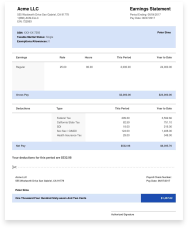
Setting the rate is only half the job. Every pay period, that rate has to show up correctly on each employee's pay stub. It usually appears as a regular rate line, plus a separate overtime rate line when that applies. So it pays to know how to read a pay stub line by line. The stub then carries the math through to gross pay (before deductions) and net pay (take-home).
Accurate stubs protect you during audits, simplify employment verification when staff apply for loans or housing, and keep your records clean. Need reliable documentation without building spreadsheets? Our pay stub templates handle the rate, hours, and totals for you.
Setting Pay Rates as an Employer
From the employer side, what is pay rate really measuring? It's the price you put on an hour, a unit, or a sale of labor, and it drives your labor costs. To set it well, research the market, check your compliance floor, and document the number. The Bureau of Labor Statistics and current salary data can both help. Remember that your true cost per employee also includes payroll deductions and employer taxes, not just the base rate.
Your floor is the higher of the federal $7.25 minimum or your state minimum. The federal rate has held at $7.25 since 2009, and 30 states (plus D.C.) now sit above it. Confirm your state's pay transparency rules too, since states including California, Colorado, New York, and Washington now require pay ranges in job postings.
Avoid the common mistakes here. Don't leave a nondiscretionary bonus out of the regular rate. Don't classify a non-exempt worker as exempt, or apply one rate when an employee actually worked two roles. Check current state minimum wage rates before you finalize any number.
Conclusion
Pay rate meaning comes down to three jobs you own as an employer: define the rate for each role, stay above your federal and state compliance floor, and document the number accurately every pay period. Handle those well and overtime, audits, and employee verification all get easier.
Need to generate professional pay stubs for your employees? Use a reliable paystub generator to create accurate pay documentation in minutes.
You Might Also Like



Frequently Asked Questions
Similar Articles



We’ve helped numerous individuals and businesses create professional documents! Create yours today!