ER Cost of Medical on Pay Stubs: Employer's Guide (2026)
By Jaden Miller , September 16 2026

When your employees see "ER cost of medical" on their pay stubs, questions follow quickly. As a small business owner generating pay stubs for your team, you need a precise answer. ER stands for "employer responsible," the amount your business pays toward employee health coverage. This is payroll terminology, not a reference to emergency room costs. This guide explains what every ER code means and how the 2026 rates calculate out. It covers what the ACA requires on every stub you generate.
Key Takeaways
- ER cost of medical on a pay stub means "employer responsible" health contributions: the amount your business pays toward employee insurance premiums.
- ER costs are not deducted from employee wages; they reflect your company's expense shown for transparency.
- Mandatory ER tax lines include Medicare (1.45%) and Social Security (6.2%), separate from health premium contributions.
- The Affordable Care Act requires every pay stub to accurately show employer-responsible health costs.
What Is ER Cost of Medical on a Pay Stub?
Here is what that label actually means for your business.
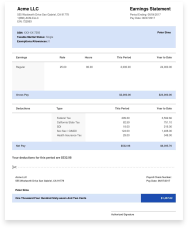
The "ER" prefix on any pay stub stands for "employer responsible." Your business pays this amount toward employee health insurance premiums each pay period. It does not come out of the employee's wages. Think of the er cost of medical on a pay stub as your company's health contribution line — an ACA-required item on every stub you generate.
When you set up a health benefit in your payroll system, the employer contribution amount shows up as the ER health line. Different payroll platforms label it differently: ADP uses "ER Health," Workday displays "Employer Contribution," and QuickBooks shows "ER Med." If your employees search medical er on paystub or "what is er health cost on pay stub," the answer is the same. It all points to the employer's health insurance contribution. "What is er medical on paycheck" means exactly the same thing.
Your payroll platform may display this employer contribution under a slightly different name, but the concept is consistent across all major HR systems.
Your employees may also search "what is er cost of medical on my paycheck" or "what is er medical on my paystub." What is medical er on paycheck? Same answer: er medical on pay stub is what your business pays toward their coverage, not a withholding from their check.
Need accurate pay documentation for your team? Our pay stub templates display all ER fields correctly.
EE vs. ER on Your Employees' Pay Stubs
As the employer, ER lines on a pay stub reflect your costs. EE lines show what you're withholding from the employee's wages. Understanding both helps you verify stubs are accurate before distributing them.
| Contribution Type | ER (Employer Pays) | EE (Employee Pays) |
|---|---|---|
| Health Insurance | 70-85% of premium | 15-30% of premium |
| Medicare | 1.45% of wages | 1.45% of wages |
| Social Security | 6.2% up to wage base | 6.2% up to wage base |
| STD/LTD | Often 100% | Sometimes co-paid |
| HSA | Optional employer deposit | Employee pre-tax contribution |
EE vs er payroll labels exist for every benefit you offer. EE contribution meaning is the employee's share, withheld from their paycheck. In ee only plans, where the employer contributes nothing to health premiums, the ER health line shows $0. Confirm your payroll tool handles this correctly.
What Is STD on Paystub, LTD ER, and Other ER Abbreviations?

STD ER stands for Short-Term Disability Employer: your business's share of short-term disability insurance premiums, which employers typically cover at 100%. LTD ER is the employer's portion of long-term disability coverage. Both appear as separate ER line items on pay stubs when your business provides these benefits to employees.
STD ER: Short-Term Disability
What is std on paystub? STD ER is your company's contribution toward short-term disability insurance. Most employers pay the full premium. Std on paystub shows up when you've enrolled staff in a group disability plan through your insurer.
LTD ER: Long-Term Disability
This benefit line covers your company's share of long-term disability insurance premiums. When you offer both short-term and long-term disability coverage, each plan appears on its own pay stub row. The LTD ER item shows the employer's portion only. Group life insurance appears as "er cost of life on pay stub" in some payroll systems. Verify each benefit is categorized correctly before the next pay run.
ER Medicare and Tax Calculations: 2026 Rates and Examples
As an employer, you're required to match your employees' Medicare and Social Security contributions. For 2026:
- Medicare (Fed MED/ER): 1.45% of all wages, no income cap (IRS source)
- Social Security (Fed OASDI/ER): 6.2% of wages up to the 2026 wage base of $176,100
- FUTA: 6.0% on the first $7,000 per employee per year; employers only, not matched by employees
Take a practical example: an employee earning $5,000 per month generates ER Medicare of $72.50 (1.45%). ER Social Security for the same employee is $310 (6.2%). If you're covering 80 percent of a $500-per-month health plan, the er cost of medical on paycheck is $400 per employee each month.
FICA is the combined total of Medicare and Social Security. Some stubs use OASDI instead of "Social Security" for the employer line. The Additional Medicare Tax of 0.9% applies to wages above $200,000 single or $250,000 married filing jointly, but only on the employee's side.
HSA ER Meaning: What Is an HSA ER Contribution?

HSA ER is an employer deposit directly into an employee's Health Savings Account, separate from any employee contributions. For 2026, combined HSA contribution limits are $4,300 (self-only) and $8,550 (family). Employer HSA contributions are tax-deductible for your business and tax-free for the employee receiving them.
What is hsa er contribution on a stub? It's your company's direct deposit into the employee's HSA, shown as its own ER line. This differs from the ER health cost line, which covers insurance premiums. Only employees enrolled in a high-deductible health plan are HSA-eligible.
ACA Compliance: ER Cost of Medical Reporting Requirements
The Affordable Care Act requires employers to report the cost of employer-sponsored health coverage on Form W-2, Box 12. Employees wondering what is medical er on my paystub will find this amount documented there as an informational, non-taxable item. What is er contribution disclosure? It's this mandatory reporting requirement — not a deduction from pay, but required by law. (IRS guidance)
States with additional ER health reporting mandates include Massachusetts, California, New Jersey, Rhode Island, Vermont, and Washington D.C. Non-compliance with payroll tax filing can trigger penalties of 2 to 15 percent of unpaid taxes. Employers also file Form 941 quarterly, which includes the employer share of Medicare and Social Security taxes.
You Might Also Like
- Medicare Tax Explained
- Do Pay Stubs Have Social Security Numbers?
- Common Payroll Mistakes to Avoid
- Adjusted Gross Income on W-2
- How to Get Your W-2 from a Previous Employer
Conclusion
ER cost of medical on a pay stub means your business's share of employee health insurance premiums. Medicare ER (1.45%), Social Security ER (6.2%), disability, and HSA contributions all use the ER prefix. These are your employer-responsible costs under FICA and ACA rules. Documenting each accurately on every stub keeps your business compliant.
Use our paystub generator to generate accurate pay stubs for your team with all ER fields and tax calculations handled automatically.
---
Word Count: [pending script verification]
Last Updated: 2026-03-19



Frequently Asked Questions
Similar Articles



We’ve helped numerous individuals and businesses create professional documents! Create yours today!