Blended Rate: An Employer's Guide to Calculating Overtime (2026)
By Jaden Miller , August 12 2026

Do your workers earn different hourly rates in the same week? Then payroll math gets tricky once they pass 40 hours. Think of a server who picks up bartending shifts. Or a warehouse hand who covers a night-shift. Or an hourly rep who earns commission. The fix is a blended rate. The Fair Labor Standards Act (FLSA) requires it. Done wrong, this is a top trigger for a Department of Labor audit. This guide walks through the math, the rules, and how to show it on a pay stub.
Key Takeaways
- A blended rate is a weighted average wage. It is used when nonexempt employees work at two or more pay rates in one workweek.
- The FLSA requires it. Skipping the math is a common audit finding and a payroll compliance issue.
- Formula: total straight-time pay ÷ total hours worked.
- The overtime premium is 0.5× when straight time is already paid on all hours.
- Keep payroll records for at least three years, including the math.
What Is a Blended Rate?
A blended rate is a weighted-average wage. You use it when nonexempt employees work at two or more pay rates in the same workweek. The FLSA requires it. To get the rate, divide total straight-time earnings by total hours worked. Then apply that figure to overtime hours over 40.
You'll also see this concept called blended overtime, weighted overtime, or a blended wage rate. They all mean the same thing under state overtime laws and federal rules. The idea is to average multiple wages into one regular rate of pay. That keeps the overtime rate fair.
For employers, the takeaway is clear. A blended rate is not optional when an employee earns more than one rate in the workweek. The Department of Labor treats it as the legal floor. A 2026 freshness note: even with the new "No Tax on Overtime" bill in play, overtime calculations and the rules for the premium have not changed. Accuracy still matters.
When Does a Blended Rate Apply?

It applies any time nonexempt employees earn multiple pay rates in one workweek. Common cases include working two job roles, getting a shift differential, or earning commission on top of an hourly wage. It does not apply to exempt employees, exempt salaried staff, or single-rate workers.
Typical employer-side trigger scenarios include:
- An employee covers two job classifications at different hourly rates (server and bartender, retail floor and stockroom, line cook and shift lead)
- Shift differential is paid for night, weekend, or hazard hours
- Piece-rate work is combined with hourly hours in the same week
- An hourly base wage is supplemented by commission or non-discretionary bonuses
- Tipped employees who also earn non-tip hourly wages in the same week
It does not apply to exempt employees, independent contractors, or workers who only earn one rate. It guides how to calculate overtime pay, not the regular straight-time wages.
How to Calculate a Blended Rate
The FLSA formula is simple:
Total Straight-Time Earnings ÷ Total Hours Worked
Step by step for the workweek:
- Find straight-time earnings for each pay rate (hours × the rate).
- Add the totals for the full workweek.
- Divide by total hours worked. That figure is the FLSA's regular rate of pay.
- Multiply overtime hours (each hour over 40) by 0.5× that figure to get the premium.
- Add the premium to the straight-time pay. The sum is the worker's total gross for the week.
Worked Example: Two Hourly Rates
Maria works two roles in one workweek. She logs 30 hours at $18/hr as a server. She also logs 15 hours at $22/hr as a bartender. Total hours: 45.
- Straight-time earnings: ($18 × 30) + ($22 × 15) = $540 + $330 = $870
- Weighted average: $870 ÷ 45 = $19.33/hr
- Premium: 5 OT hours × ($19.33 × 0.5) = 5 × $9.67 = $48.35
- Total gross: $870 + $48.35 = $918.35
That $19.33 figure shows on the OT line of Maria's pay stub. It won't match either of her actual job rates. That's expected.
The 0.5× vs 1.5× Mistake
The most common employer error is using 1.5× on overtime hours when straight-time pay already covers those hours. The result is paying time and one-half twice.
The rule of thumb is simple. If your straight-time total covers all hours worked, the OT premium is 0.5×. If your straight-time total only covers the first 40 hours, use 1.5× for the OT hours. Both methods give the same final number. CSI Accounting reports that AI calculators often get the blended rate wrong. So check the result by hand for the first few pay periods.
What Counts in the Calculation

Not every payment counts toward the regular rate of pay. The FLSA draws a clear line on what belongs in the math.
| Included | Not Included |
|---|---|
| Hourly wages at each rate | Discretionary holiday gifts |
| Shift differentials | Tips paid directly by customers (state rules vary) |
| Non-discretionary (performance) bonuses | Reimbursed business expenses |
| Commission payments | Premium pay already paid at 1.5× or 2× |
| Piece-rate earnings | Genuine gifts and rewards |
Leaving out commission and non-discretionary bonuses is the second-most-cited FLSA violation in DOL audits, after misclassification. If a bonus is promised in advance for hitting a target, it's non-discretionary. It goes in the math. If it's a true holiday gift with no performance tie, it stays out.
State-Specific Overtime Rules
Federal overtime kicks in after 40 hours in a workweek. Several states add more rules on top.
California has daily overtime. It pays 1.5× after 8 hours in a day. It pays double-time after 12 hours in a day. It also pays double-time on the seventh straight workday. Seven other states have some form of daily overtime: Alaska, Colorado, Kentucky, Nebraska, Nevada, Oregon, and Wisconsin. The California Department of Industrial Relations posts detailed guidance on these rules.
If your business runs in any of these states, the blended rate follows the more generous rule between state and federal. For multistate employers, payroll software earns its keep here. California adds more payroll duties beyond overtime. Our guide on California payroll tax walks through the full picture.
Biweekly Payroll
A common misstep in biweekly payroll is treating the two-week pay period as one window. The FLSA requires the math per workweek, not per pay period.
For biweekly payroll, run the formula for each workweek on its own. Then sum the results for the pay-period total. Averaging across both weeks will inflate or deflate the premium. It also creates risk if a worker's hours are uneven between the weeks. For how the layout differs from weekly stubs, see our biweekly pay stub guide.
Documenting on Pay Stubs
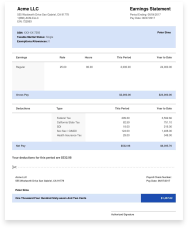
Workers see a number on their pay stub that doesn't match either of their job rates. An employee earning $15 and $18/hr will see something like $16.20/hr on the overtime line. They will ask why. Expect the question. Document the answer on the stub.
The best format shows both base rates as separate line items. Then add a labeled line for the overtime hours. Then show the total. This cuts down on employee disputes. It makes the math clear. And it is the simplest defense in a Department of Labor audit. If your team is new to itemized stubs, our guide on how to understand your paystub is a useful share. Issuing accurate, itemized pay stubs that show every rate and the blended rate takes minutes with a paystub generator built for multiple wage rates.
Compliance and Recordkeeping for Employers
FLSA recordkeeping rules require you to keep payroll records for at least three years. The DOL says the math (the formula and inputs) must be rebuildable from your records, not just the final number.
Keep, at minimum:
- Hours worked per workweek, broken out by pay rate
- Straight-time earnings and the overtime premium, shown separately
- The calculation: the formula used and the inputs
- A copy of each issued pay stub
In an audit, the burden of proof falls on the employer. Clean records turn a multi-week audit into a one-day file review. Avoiding the small errors that build into audit findings is half the battle. Review our list of common payroll mistakes as a quick self-check. And make sure your stub layout shows payroll deductions for every employee.
Conclusion
The blended rate is the FLSA's answer to a simple reality. Workers earn multiple rates, and overtime has to be fair. The math is a weighted average. The trigger is any nonexempt employee with two or more rates in one workweek. The proof lives on the pay stub. Build this into your payroll workflow once, and it becomes a non-issue. Need to issue accurate pay stubs that show overtime the right way? Visit PayStubs.net and create your stubs in minutes. Built for small businesses with multiple pay rates.
You Might Also Like
- Time and a Half: the math behind 1.5× overtime pay and when it's used instead.
- Monthly Salary Meaning: how to translate hourly and weighted wages into a monthly salary figure.
- Working 2 Jobs: How Do You File a W-2?: a reference for employees you may need to share.
- DIY Payroll: The Types of Check Stub Paper Out There: a practical guide for small businesses running payroll in-house.
- How Many Pay Periods in a Year: choose the pay schedule that fits your workforce.



Frequently Asked Questions
Similar Articles



We’ve helped numerous individuals and businesses create professional documents! Create yours today!