How to Calculate Weekly Pay for Employees (2026 Guide)
By Jaden Miller , September 17 2026

Running payroll for your team requires more than just writing a check. Knowing how to calculate weekly pay accurately protects your business from compliance issues and gives your employees the paystubs they need. A miscalculation in gross pay or overlooked overtime creates problems at tax time. It can also affect employees who need proof of income for a loan or rental application.
This guide covers the formulas, worked examples, and documentation requirements your business needs. You'll learn the difference between gross and net weekly pay and how to convert weekly figures to monthly income. A weekly wage calculator can streamline payroll recordkeeping across your team.
Key Takeaways
- Weekly gross pay = Hourly rate × Hours worked, or Annual salary ÷ 52
- Net pay = Gross pay minus federal/state taxes, FICA, and pre-tax deductions
- 2026 FICA rates: Social Security 6.2% (wage base up to $176,100) plus Medicare 1.45%
- For monthly income: use weekly pay × 52 ÷ 12 for the exact figure, or × 4 for a quick approximation
- Document each weekly paycheck with a compliant pay stub for every employee
What Is Weekly Pay? Understanding How to Calculate Weekly Pay
Weekly pay is a payroll frequency where employees are paid weekly, producing 52 pay periods per year. It's most common in industries with hourly workers: construction, food service, and hospitality. The predictable pay frequency helps employees with cash flow management, and many employers in these sectors align weekly pay with shift scheduling.
Compared to biweekly pay (26 periods) or semimonthly pay (24 periods), weekly payroll requires more processing cycles per year. If your business manages multiple hourly employees, a consistent payroll schedule and documentation tools for each pay period keep your records clean and reduce payroll errors.
How to Calculate Weekly Pay

To calculate weekly pay for hourly workers, multiply the hourly rate by total hours worked in the week (e.g., $20/hr × 40 hours = $800 gross). For salaried workers, divide the annual salary by 52 (e.g., $52,000 ÷ 52 = $1,000/week gross). Both methods give you gross pay before taxes and payroll deductions are applied.
For Hourly Employees
Your formula: Gross weekly pay = Hourly rate × Hours worked.
Standard 40-hour week example: $18/hr × 40 hours = $720 gross. Under the Fair Labor Standards Act (FLSA), any hours over 40 in a single workweek must be paid at 1.5× the regular hourly rate. Track hours worked per week, not per pay period, to catch overtime thresholds accurately for each employee.
For Salaried Employees
Your formula: Gross weekly pay = Annual salary ÷ 52.
Example: $65,000/year ÷ 52 = $1,250/week gross. Exempt salaried employees receive the same gross amount regardless of how many hours they work. Non-exempt salaried employees are still subject to FLSA overtime rules, so confirm your classification before applying the formula. Knowing how to calculate weekly pay correctly for non-exempt staff prevents underpayment claims.
Common Mistakes to Avoid
Understanding common payroll deductions errors prevents compliance issues and disputes with employees:
- Using gross pay instead of net pay when advising employees on take-home budgeting
- Ignoring state-specific overtime rules: California and Nevada apply overtime to hours exceeding 8 in a single day, not just 40 per week
- Overlooking the effect of 401(k) pre-tax deductions on employees' taxable income and final net pay
- Confusing semimonthly (24 pay periods/year) with biweekly (26 pay periods/year) when converting weekly figures to annual projections
Gross Weekly Pay and Net Pay Deductions
Once you know how to calculate weekly pay at the gross level, deductions determine the actual gross-to-net calculation. Here's the full chain using a $20/hr, 40-hour employee ($800 gross):
- Start with gross pay: $800
- Subtract pre-tax deductions (e.g., 401(k) contribution of $40): $760 taxable income
- Apply 2026 FICA payroll taxes: Social Security 6.2% = $47.12 + Medicare 1.45% = $11.02 = $58.14 total
- Apply federal income tax withholding based on W-4 filing status: approximately $55 (single, standard allowances)
- Subtract state income tax (ranges from 0% in Texas and Florida to 5%+ in California and New York)
- Result: Net pay (take-home pay): approximately $627 to $650 depending on state
The 2026 Social Security wage base is $176,100 per employee. Earnings above that threshold aren't subject to Social Security tax for the remainder of the calendar year. These rates are sourced from IRS Publication 15 (Circular E), updated annually. For a complete breakdown of how FICA taxes appear on pay stubs, review the specific line items each deduction generates.
How to Calculate Monthly Income from Weekly Paycheck

To calculate monthly income from a weekly paycheck, use one of two methods:
- Exact method: Weekly pay × 52 ÷ 12 (use this for payroll projections and budget planning)
- Approximate method: Weekly pay × 4 (quick mental math, useful for rough estimates)
Using $800/week as an example: the approximate method gives $3,200/month, while the exact method gives $3,467/month. That's a $267 difference per month because two calendar months per year contain five weekly paydays rather than four.
For employer payroll budgeting, use the exact method. It accounts for those five-paycheck months and keeps your annual projections accurate. If you're advising employees on how to calculate their monthly income from a weekly paycheck, share both methods. They'll understand why their balances look different in months with five weekly paydays. Monthly income figures also factor into adjusted gross income calculations that employees use during annual tax filing.
Pay Schedule Types Comparison
| Pay Frequency | Pay Periods/Year | Gross per Period (at $52K/year) |
|---|---|---|
| Weekly | 52 | $1,000 |
| Biweekly | 26 | $2,000 |
| Semimonthly | 24 | $2,167 |
| Monthly | 12 | $4,333 |
Regardless of pay frequency, how to calculate weekly pay for each employee follows the same hourly or salaried formula covered in the previous section. Construction firms like Bechtel and Turner Construction typically pay weekly. Hospitality employers such as Marriott and McDonald's do the same; hourly and shift workers value getting paid on a predictable schedule. Many retailers, including Target and Amazon, use biweekly schedules instead.
A practical example: a 30-hour biweekly employee at $15/hr receives 60 hours × $15 = $900 gross per pay period. Annual gross is $23,400, which is identical to 52 weekly paychecks of $450. The schedule changes the paycheck size but not the annual total.
Overtime: How to Calculate Weekly Pay with Extra Hours
The FLSA sets the federal overtime rate at 1.5× the regular hourly rate for hours exceeding 40 in a workweek.
Formula: (Regular hours × Hourly rate) + (Overtime hours × Hourly rate × 1.5)
Example: 45 hours at $20/hr = (40 × $20) + (5 × $30) = $800 + $150 = $950 gross weekly.
Some states impose stricter rules. California requires overtime pay for any hours over 8 in a single day. Nevada follows a similar daily threshold. In both cases, daily overtime can apply even if weekly hours stay under 40. Overtime must appear as a separate earnings line on each employee's pay stub to meet most states' documentation requirements.
How to Calculate Weekly Pay: 3 Worked Examples
Below are three real-world scenarios covering different employee types, pay rates, and states.
Scenario 1: Hourly Full-Time Worker (California)
$18/hr, 40 hours worked, single W-4 filing status, California employer:
- Gross pay: $720
- FICA: Social Security $44.64 + Medicare $10.44 = $55.08
- Federal income tax (approx.): $55
- California state income tax (approx.): $18
- Net weekly pay: approximately $592
Scenario 2: Salaried Employee (Texas, No State Income Tax)
$65,000/year annual salary:
- Weekly gross: $65,000 ÷ 52 = $1,250
- FICA: Social Security $77.50 + Medicare $18.13 = $95.63
- Federal income tax (approx.): $110
- Net weekly pay: approximately $1,044
Scenario 3: Part-Time Irregular Hours
$15/hr, 28 hours in the week (no overtime; hours didn't exceed 40):
- Gross pay: $420
- FICA: Social Security $26.04 + Medicare $6.09 = $32.13
- Federal income tax (approx.): $28
- Net weekly pay: approximately $360
Each week is calculated independently. If hours vary week to week, run the formula separately for each pay period.
Pay Stubs for Weekly Payroll: Business Documentation
Each weekly paycheck should be accompanied by a pay stub. Most US states require employers to provide them, and several, including California, New York, and Illinois, mandate specific information fields.
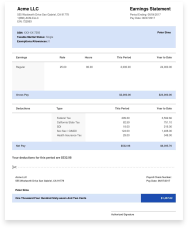
A compliant pay stub must include employee and employer names, pay period dates, and gross wages. It also needs itemized deductions (FICA, federal and state tax, insurance premiums, retirement contributions) and net pay. Pay stubs serve as proof of income for loans, rental housing, and as a pay stub for tax filing during tax season.
You Might Also Like
- What Is a Payroll Tax Holiday?
- ADP Paystub: How to Access and Read Your Pay Information
- Provision for Income Taxes on Your Pay Stub
- Walmart Paystub Portal: Employee Access Guide
- DGME Paystub: Dollar General Employee Payroll Guide
Conclusion
Accurate weekly pay calculation starts with the right formula, runs through the full gross-to-net deduction chain, and ends with proper documentation for each employee. Getting this right protects your business from compliance gaps and gives your team the pay records they need for financial decisions outside work.
With 52 pay periods per year, weekly payroll adds up quickly. Now that you know how to calculate weekly pay for your team, the final step is accurate documentation for every pay period. Use our pay stub templates to create professional documentation for every pay period.
---
Word Count: ~1,360 (excludes Key Takeaways ~65 words and FAQs ~300 words)
Last Updated: 2026-03-19



Frequently Asked Questions
Similar Articles



We’ve helped numerous individuals and businesses create professional documents! Create yours today!