Check Payroll API: A Small Business Owner's Guide
By Jaden Miller , June 2 2026

Do you spend three or four hours each pay period typing numbers into a spreadsheet? Many business owners do. That's often the moment they decide to check payroll API options for the first time. A payroll API is the engine behind modern payroll tools like PayStubs.net. Knowing what it does helps you pick the right way to pay your team and document it. This guide covers what a payroll API is, what it can do for a small business, and whether you really need one.
Key Takeaways
- A payroll API connects payroll data such as wages, taxes, and deductions between software systems automatically.
- For most businesses under 50 employees, a purpose-built tool delivers the same benefit without writing any code.
- Payroll APIs power accurate, repeatable pay stub generation for every pay period.
- When you check payroll API providers, look for automatic tax updates, SOC 2 security, and direct deposit support.
What Is a Payroll API?
A payroll API is a software connector. It moves payroll data between systems on its own. That data includes wages, tax withholding, and deductions. Instead of re-entering numbers by hand each pay period, the API syncs them in real time. Most small business owners never code one. They just use tools built on top of payroll APIs.
API stands for application programming interface. Think of it as a standard handshake that lets two programs swap information on their own. Say your scheduling app talks to your payroll app. A payroll API usually passes the hours, rates, and totals back and forth. So it's worth knowing what runs under the hood before you pick a platform.
How Payroll APIs Work
At a technical level, a payroll API runs on request and response. Your software sends a request. The payroll system checks who's asking. Then it returns the data or runs the action. Most modern payroll APIs are REST APIs, a common format developers build to. API authentication is handled through OAuth. OAuth is a token-based login that grants access without exposing passwords. Each app gets its own access token instead of a shared one. Reputable providers also keep SOC 2 compliance to prove their data controls.
A few other terms come up often. A webhook is an automatic alert. The system fires it when something changes, like a finished payroll run, so your other tools update at once through real-time data exchange. Rate limiting caps how many requests you can send per minute, which keeps the service stable. The data schema defines how the information is structured.
This technology sits on a spectrum. On one end, a simple pay stub generator gives you the output with zero setup. In the middle, a payroll service runs everything for you. On the far end, full payroll api integration connects your own systems. Before you check payroll API providers, knowing where you fall tells you how much of this you need to care about.
What Payroll Data Your Business Can Access

Through a payroll API, your business can reach a full set of employee payroll data. That includes gross pay, net pay, tax withholding, deductions, pay period dates, hours worked, and direct deposit details for every worker. This is the same data that produces a compliant pay stub. That's why accurate API data shapes your payroll records and reporting. Good payroll data management keeps all of it consistent. If you want a refresher on each line, our guide to reading a pay stub walks through every field.
Earnings
Gross pay is the total an employee earns before anything is taken out. It covers regular hours, overtime, and any bonuses or commissions tied to a pay period.
Deductions and Taxes
This is where tax withholding lives. It includes federal and state income tax, Social Security, and Medicare. It also covers voluntary deductions like health premiums or retirement contributions. Each line item has to be tracked accurately for compliance. A clear breakdown of how payroll deductions work helps you spot errors fast.
Net Pay and Payment
Net pay is what actually lands in the employee's account after deductions. The API also carries direct deposit routing details. That way each payroll run pays the right person the right amount.
Why Small Business Owners Check Payroll API Tools
The bottom line is time and accuracy. Calculating withholdings by hand for five employees can eat three to four hours per pay period. Automated payroll handles the same work in minutes. That time goes straight back into running your business.
Accuracy protects your bottom line too. The IRS can charge penalties from roughly $60 to over $310 per incorrectly filed information return. Those add up fast across a year of payroll. Automation cuts that risk because the rates update on their own instead of relying on you to catch every change. That heads off many common payroll mistakes before they happen.
The benefits reach past payday. Connected hr payroll systems streamline employee onboarding. They can also integrate with ITSM tools to manage employee-related IT requests and workflows. A new hire's information flows into payroll once instead of being typed into three places. They sync time and attendance data, so hours convert to pay without manual entry. Many also link to benefits administration, so deductions stay current. For a growing business, that consistency keeps payroll from becoming a second job. It's a strong reason to check payroll API tools as you scale.
Compliance and Tax: What Employers Must Track

As an employer, you have to get payroll taxes right every pay period. That means federal income tax withholding based on each employee's W-4. It also means FICA tax, which is 6.2% for Social Security and 1.45% for Medicare on the employee side, matched by your business. For 2026, the Social Security wage base is $176,100. Earnings above that aren't subject to the Social Security portion.
Compliance starts before the first paycheck. Every new hire needs I-9 authorization to confirm they can legally work in the U.S. You're also on the hook for state income tax withholding where it applies, which varies a lot by location. Add state unemployment tax, known as SUTA, on top of that. Sometimes you'll also run an off-cycle payroll for a bonus or a correction outside the normal schedule. At year end, you file W-2 forms for employees and 1099 forms for contractors. Getting the underlying data right is exactly why accurate payroll matters. The numbers on every form trace back to it.
Pay Stub Generation Through Payroll APIs
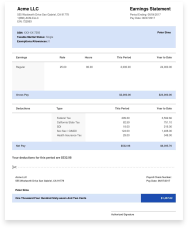
Here's where this gets practical. The data a payroll API handles is exactly what fills a pay stub. Gross pay sits at the top. Each tax and deduction is itemized in the middle. Net pay lands at the bottom. When that data is accurate, pay stub generation for every employee becomes near-instant. Ready-made pay stub templates make it even faster.
Those pay stubs do real work beyond payday. Employees use them for income verification when they apply for a loan or an apartment. You'll reference them for employment verification requests too. As you check payroll API options, favor the ones that turn that data into clean, compliant stubs. A purpose-built tool like our AI pay stub generator gives you that same accurate output. You don't have to wire up any API yourself.
How to Check Payroll API Providers and Get Started
For a business with under 50 employees, you rarely need raw API access. Your real choice is build, buy, or use a tool. Building your own payroll software integration means developers and ongoing upkeep. That almost never pays off at your scale. Buying a full payroll service makes sense once payroll gets complex. Using a purpose-built generator covers most documentation needs right away.
When you check payroll API providers or the tools built on them, run through a short checklist:
- Does it update automatically for federal and state tax law changes?
- Can it generate pay stubs for multiple employees in one batch?
- Does it handle direct deposit details and standard pay schedules?
It also helps to know the landscape. Embedded payroll means the payroll engine is built right into a platform you already use. Modern embedded payroll solutions package this so you never touch the backend. A standalone payroll API instead connects separate systems. Providers like Gusto, ADP, and QuickBooks operate here. So do platforms like Paycor and unified API providers like Merge. Each sits at a different price and complexity level. Match the tool to where your business is now, not where you might be in five years.
You Might Also Like
- Gross vs. Net Pay: What's the Difference?
- DIY Payroll: The Types of Check Stub Paper Out There
- Understanding the Biweekly Pay Stub
- What Is a Payroll Tax Holiday?
- California Payroll Tax Explained
Conclusion
A payroll API automates the flow of payroll data. Wages, taxes, and deductions move between systems without manual entry. For most small business owners, though, the goal isn't the technology. It's the output. You need accurate, compliant pay stubs and clean records, not a coding project. When you check payroll API options, match the solution to your size. A few employees rarely justify a full integration. When you just need professional documentation done right and fast, create accurate stubs for your team with our pay stub generator and get back to running your business.



Frequently Asked Questions
Similar Articles



We’ve helped numerous individuals and businesses create professional documents! Create yours today!