Global Payroll Challenges: A Small Business Guide (2026)
By Jaden Miller , June 3 2026

You hired your first contractor in another country, and payroll suddenly stopped behaving like it did at home. Different tax rules, a different currency, a different idea of when people expect to be paid. That's where most owners first run into global payroll challenges, and the rules only multiply with each new country. Whatever you sort out, every worker you pay still needs a clean pay stub, and a pay stub generator keeps that part simple. Most advice on this topic is written for big multinationals with their own finance teams. This guide is for the rest of us. It's for small businesses and growing teams paying a few people abroad who still need to get it right.
Key Takeaways
- Compliance with local labor laws is the single biggest global payroll challenge, and the most expensive to get wrong.
- Currency conversion, data protection under GDPR, and year-end tax reporting each follow their own country-specific rules.
- For a few international hires, an Employer of Record usually beats building payroll in-house.
- Keep centralized, properly formatted pay stub records for every worker. It protects you and them.
What Are the Main Global Payroll Challenges?
Global payroll challenges are the obstacles to paying a global workforce spread across multiple countries. The big ones: each nation's labor laws and taxes, currency conversion, data protection under rules like GDPR, time zones, and year-end tax reporting. For small businesses, the biggest risk is compliance penalties from misclassifying or underpaying international workers.
These aren't abstract problems. Payroll processing carries real weight for any company planning global expansion. ADP's research found 98% of organizations rely on payroll data to guide cost strategy. Deloitte benchmarking pegs manual data entry as the most time-consuming task for nearly a third of payroll teams. So every error you make abroad isn't just a fine. It's employee trust, board credibility, and your expansion timeline, all at once.
Compliance and Local Labor Laws: The Costliest Global Payroll Challenge

Ask any finance leader which of the global payroll challenges keeps them up at night. Compliance tops the list. Every country sets its own minimum wage, mandatory benefits, social security contributions, and tax withholding rules. The way payroll deductions work varies widely, and those rules change often.
A few concrete examples for 2026 show the range. Brazil mandates a 13th month salary, with the final installment due by December 20. Australia's superannuation guarantee rate rose to 12% on July 1, 2025, up from 11.5% the prior year. The UK tax year runs April 6 to April 5, not January to December. Miss any of these and you're not late on paperwork; you're out of compliance.
Getting payroll compliance right across borders usually means leaning on in-country partners or a provider who tracks local law for you. Don't try to guess from afar.
The Employee Misclassification Trap
Treat someone as a contractor when local law considers them an employee, and you've created an expensive problem. Employee misclassification can trigger back pay, unpaid benefits, and penalties long after the work is done. In 2026, the EU's Platform Work Directive is tightening how gig and platform workers get classified. A setup that passed last year may not pass now. When in doubt, get the difference between W-2 and 1099 workers right and document the relationship before the first payment.
Managing Currencies and Cross-Border Payments
Pay someone in another country and you immediately inherit exchange rate risk. A rate that shifts between approval and payday can shrink what lands in your worker's account or quietly inflate your costs. Decide up front who absorbs currency conversion swings, and write it into the contract so nobody's surprised.
Cross-border payments also move slower and cost more than a domestic transfer. Wires can carry fees on both ends and take days to clear. A multi-currency payment method, or a provider built for international payroll, keeps people paid on time. It also spares you the monthly scramble of chasing failed transfers.
Protecting Employee Data Under GDPR

Payroll runs on sensitive personal and financial data, and the moment you employ someone in the EU, the GDPR applies. That covers how you store, transfer, and share employee records across borders.
The fines come in two tiers, and the difference is worth knowing. Lesser violations, like poor record-keeping, can cost up to 10 million euros or 2% of global annual turnover, whichever is higher. Serious violations, like processing data without a lawful basis, can reach 20 million euros or 4% of turnover. Before you hand payroll data to any provider, sign a Data Processing Agreement (DPA) that spells out how they'll protect it. Strong data security isn't optional once you hire across borders.
Handling Time Zones and Cultural Differences
A time zone gap sounds minor until an approval sits overnight and a payment misses its window. When your payroll contact is eight hours ahead, "I'll fix it this afternoon" can mean tomorrow for them.
Pay expectations differ too. Some countries treat 13th month pay as a given, and payslip formats people expect vary widely. Set your internal cutoffs around the latest time zone you pay into, and confirm local norms before you assume your home-country schedule travels.
Year-End Tax Reporting Across Borders
Year-end tax reporting rarely lines up neatly. Each country has its own tax year, its own forms, and its own deadlines, so December 31 isn't a shared finish line. Matching up reports from several countries at once is where small teams lose the most time.
Keep records audit-ready throughout the year instead of reconstructing them in a panic. If you pay US contractors, note that 1099 e-filing thresholds have tightened, so more businesses now have to file electronically. Tax withholding rules abroad won't match what you know domestically, so verify each one.
Reducing Payroll Errors With Automation and KPIs
Manual, multi-spreadsheet payroll is one of the most common payroll mistakes once you're juggling currencies and country rules. A single mistyped figure can underpay a worker and erode the trust you've built. Payroll automation and standardized processes cut the manual entry that causes most of those errors, and they scale far better than a heroic month-end effort.
What you don't measure, you can't improve.
Payroll KPIs Worth Tracking
A few payroll KPIs tell you whether your process is healthy: payroll accuracy rate, on-time payment rate, cost per payslip, and the error rate. Watch these monthly. Problems then surface before workers feel them.
Choosing the Right Global Payroll Model
There's no universal answer. Most companies handle their global payroll challenges with one of three models for multi-country payroll. Picking the right one early saves painful migrations later.
In-House and Centralized Payroll
You manage everything internally from one system. This fits when you have an ongoing presence and several employees in one or two countries, plus the in-house know-how to track local law. It offers the most control, and the most overhead.
Decentralized and In-Country Partners
You hire local payroll providers in each country to handle their own compliance. This suits businesses with a real, lasting footprint across several markets, though managing multiple vendors adds coordination work.
Using an Employer of Record
An Employer of Record (EOR) legally employs your workers in a country where you have no entity, handling local payroll, taxes, and compliance for you. For a few hires per country or a fast market entry, an EOR is usually the cheapest, quickest path. It's the best fit for most small businesses. Payroll outsourcing to a global provider sits in the same lane.
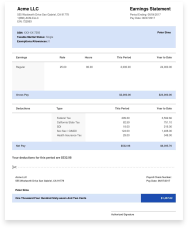
Need to create professional pay stubs for your team in any currency? Our pay stub templates keep records consistent for every worker.
Tackling Global Payroll Challenges as a Small Business
Picture a 10-person US startup hiring its first international contractor in Portugal. Enterprise playbooks assume entities, software, and a payroll department you don't have. The global payroll challenges you actually face are smaller and more concrete, and you can work through them with a short checklist.
Before your first international hire, run these five steps:
- Confirm whether the worker is an employee or a contractor under local law.
- Check the country's minimum wage and mandatory benefits.
- Decide between an EOR and a direct hire based on how many people you'll pay there.
- Set up a multi-currency payment method before payday, not on it.
- Choose a centralized system for payroll records before you need it.
That last step matters more than it looks. International employees and contractors regularly need proof of income for housing, loans, or visa applications back home. A centralized pay stub system gives every worker properly formatted documentation, no matter which country processed their pay. It also keeps you covered if anyone audits the relationship.
You Might Also Like
- 1099-MISC vs 1099-NEC: What's the Difference?
- How to Estimate Quarterly Taxes on 1099 Income
- California Payroll Tax: What Employers Need to Know
- Net vs Gross Income, Explained
- How Many Pay Periods Are in a Year?
Conclusion
The global payroll challenges that trip up growing businesses follow a pattern. Get compliance right first. Then handle the currency, data, and tax mechanics. Finally, pick a payroll model that matches your size. You don't need an enterprise payroll department to do this well. You need the right model for your headcount and clean records you can produce on demand.
Whatever model you choose, every worker still needs accurate documentation. Use a reliable paystub generator to create compliant, professional pay stubs for your team, in any currency, in minutes.



Frequently Asked Questions
Similar Articles



We’ve helped numerous individuals and businesses create professional documents! Create yours today!