CASDI: California Employer's Guide to SDI Tax (2026)
By Jaden Miller , March 17 2026

If you run a business in California, you're required to withhold CASDI from every employee's paycheck. That deduction shows up as "CASDI-E" on the pay stubs you issue. This guide covers the 2026 rate, who qualifies, and your reporting duties. Use it to run a compliant California payroll.
Key Takeaways
- CASDI stands for California State Disability Insurance: a mandatory employee-funded payroll deduction.
- The 2026 CASDI contribution rate is 1.1% of gross wages, with no wage cap (eliminated in 2024).
- "CASDI-E" on pay stubs is the employee contribution line; employees pay 100%, employers withhold and remit.
- Employers must report CASDI withholdings in Box 14 of each employee's W-2.
- California SDI covers both Disability Insurance (DI) and Paid Family Leave (PFL).
What Is CASDI?
California State Disability Insurance (CASDI) is a required payroll tax. It provides short-term wage replacement for California workers who can't work. The cause can be illness, injury, or pregnancy. Employees pay 100% of the cost. Employers withhold it and send it to the EDD.
What is ca sdi tax? The casdi meaning is simple: it's the SDI deduction on every California paycheck. California Employment Development Department (EDD) runs the program. It covers two benefits. Disability Insurance (DI) covers personal health conditions. Paid Family Leave (PFL) covers family care. The casdi tax meaning is the same required deduction, just from a tax view. Ca sdi tax meaning? Same program. What is california sdi tax? It's CASDI. It's part of your California payroll tax duties.
What Does CASDI-E Mean on a Pay Stub?
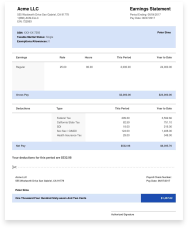
CASDI-E stands for California State Disability Income Tax, Employee Contribution. The casdi-e meaning is simple: it's the SDI deduction label on California pay stubs. As a casdi-e tax, employees pay 100% of it. The shorthand casdi e (no hyphen) refers to the same line. The "-E" suffix distinguishes the employee contribution from the program name.
When you generate pay stubs for California employees, "CASDI-E" is the correct label. Example: an employee earning $52,000/year on a semi-monthly schedule sees "CASDI-E $22.10" each paycheck. That's $52,000 × 1.1% ÷ 24. If she files a disability claim, she could receive 60-90% of her wages.
Payroll software like Gusto, ADP, or Rippling handles CASDI-E for you. PayStubs.net's pay stub templates for California employees include the CASDI-E line by default.
2026 CASDI Tax Rate

The 2026 CASDI rate is 1.1% of gross wages. California removed the taxable wage ceiling in 2024. All wages are now subject to CASDI withholding. There is no cap. Apply this rate to every paycheck all year.
There is no casdi max since 2024. Before that, there was a wage cap ($153,164 in 2023). Workers above the cap stopped having CASDI withheld mid-year. Now withholding runs all year with no limit.
| Year | Rate | Taxable Wage Cap | Max Annual Contribution |
|---|---|---|---|
| 2023 | 0.9% | $153,164 | $1,378 |
| 2024 | 1.1% | No cap | Unlimited |
| 2025 | 1.1% | No cap | Unlimited |
| 2026 | 1.1% | No cap | Unlimited |
A quick check: an employee earning $60,000/year contributes $60,000 × 1.1% = $660/year (about $25.38 per biweekly paycheck).
CASDI on Employee Paychecks and W-2 Forms
Employees often ask what is casdi on w2. CASDI on W-2 (casdi w2) goes in Box 14 under "Other." The label is "CASDI" or "CA SDI" on a W-2 form. On a pay stub, CASDI appears as "CASDI-E." It works like FICA tax on a pay stub. What does casdi mean on w2? It's the total SDI withheld for the year.
Key tax facts for employees:
- SALT deductible: Per Internal Revenue Service (IRS) rules, CASDI payments may be deducted on federal Schedule A if you itemize (subject to the $10,000 SALT cap).
- Benefits not taxable: CASDI disability benefits are not counted as federal taxable income.
- Box 14: If employees ask what does casdi mean on my w2, it's their total SDI withheld for the year.
Who Qualifies for CASDI Benefits?

To qualify for CASDI benefits, three conditions must be met. First, the employee must work in California with wages subject to SDI tax. Second, they must have earned enough during the base period. Third, they must be unable to work due to a certified medical condition. Claims must be filed within 49 days of the disability start date.
Qualification requirements:
- California casdi employee with taxable wages subject to SDI tax.
- Earned at least $300 in taxable wages during the SDI base period (12 months, 5-17 months before the claim).
- Under a doctor's care with medical certification (Form DE 2501).
What can disqualify a claim:
- Receiving Unemployment Insurance (UI) for the same period.
- Disability from a felony conviction.
- Workers' compensation paying at an equal or higher rate.
- Failing to attend a required medical exam (IME).
Benefits replace 60-90% of wages (higher percentages for lower earners), up to 52 weeks for disability.
Is CASDI Mandatory?
Yes. CASDI withholding is required for nearly all California employees: full-time, part-time, and temp workers. Employees can't opt out. Employers may apply to the EDD for a Voluntary Plan. It replaces state SDI. The plan must offer equal or better benefits. It can't cost employees more.
CASDI payments aren't refunded if unused. They may be deducted as a state and local tax if you itemize.
Employer Responsibilities Under CASDI
As a California employer, you have four main CASDI duties:
- Withhold the correct CASDI-E amount from each paycheck (1.1% of gross wages, no cap).
- Remit withheld amounts to the EDD each quarter using Form DE 9C.
- Report total CASDI withheld in Box 14 of each employee's W-2.
- Notify the EDD within 5 days when an employee files a DE 2501 claim.
A Voluntary Plan must match state SDI benefits. It can't cost employees more. The rate cap is the standard CASDI rate.
CASDI for Independent Contractors: DIEC
By default, contractors and self-employed workers aren't covered by California SDI. But there is an opt-in path: Disability Insurance Elective Coverage (DIEC). Through DIEC, California contractors can join SDI by choice. They get the same DI and PFL benefits as regular employees.
If you work with California 1099 contractors, tell them about DIEC at onboarding. It helps those who left employee jobs and still need disability coverage.
How Employees File a CASDI Claim
Employees file using Form DE 2501 (Disability Insurance Benefits). The fastest way is SDI Online at edd.ca.gov. It sends the request directly to the employee's doctor.
Two things employees often miss:
- There's a 7-day wait: the first week of disability is unpaid.
- Payments start about 2 weeks after approval.
As an employer, you may need to fill out Form DE 2511 or DE 2515. Reply fast to avoid delays for your employee. Post the DE 2515 "Notice to Employees" at your workplace.
You Might Also Like
- Adjusted Gross Income on W2: What Employers Need to Know
- What Does YTD Mean on a Pay Stub?
- Earnings Statement Guide
- What Is Form W-2?
- OASDI Meaning: What the Deduction on Your Pay Stub Means
Conclusion
CASDI is a core part of California payroll. It's required for nearly all employees, withheld at 1.1% with no cap. It shows on pay stubs as CASDI-E and on W-2 forms in Box 14. Your job: withhold the right amount, send it to the EDD each quarter, and issue accurate pay records.
Generate accurate California pay stubs with the CASDI-E deduction already calculated. Use our paystub generator to create compliant stubs for your employees: accurate calculations, every time.



Frequently Asked Questions
Similar Articles



We’ve helped numerous individuals and businesses create professional documents! Create yours today!